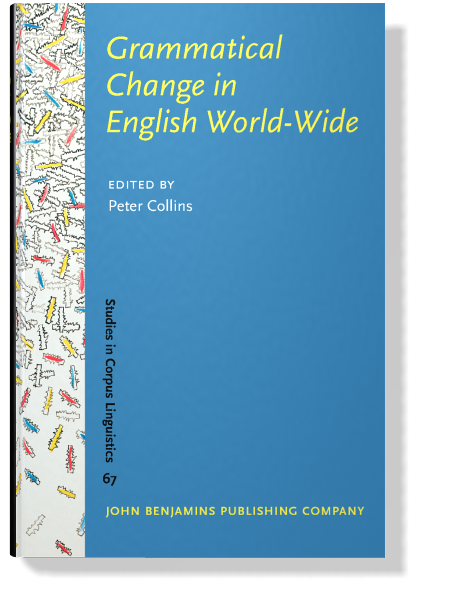
In:Grammatical Change in English World-Wide
Edited by Peter Collins
[Studies in Corpus Linguistics 67] 2015
► pp. 411–436
Cultural keywords in context
A pilot study of linguistic acculturation in South Asian Englishes
Published online: 24 February 2015
https://doi.org/10.1075/scl.67.17muk
https://doi.org/10.1075/scl.67.17muk
The present study focuses on lexicogrammatical routines of South Asian Englishes that are associated with so-called ‘cultural keywords’. These routines are particularly significant manifestations of the overarching process of the linguistic acculturation of the English language in new postcolonial settings. Specifically, we make use of the South Asian Varieties of English Corpus in order to compare acrolectal Indian, Pakistani and Sri Lankan English with regard to typical noun-verb collocations linked to three cultural keywords shared by all three South Asian Englishes: government, terror and religion. This pilot study offers a way of describing the effects of diachronic divergence in the formation of South Asian Englishes although comparable historical corpora of English in South Asia are not (yet) available. Keywords: cultural keywords; South Asian Englishes; collocations; divergence; lexicogrammar

References (41)
Achebe, Chinua. 1975/1993. The African writer and the English language. In Colonial Discourse and Post-Colonial Theory: A Reader, Patrick Williams & Laura Chrisman (eds), 428–434. London: Harvester Wheatsheaf.
Bailey, Guy, Wikle, Tom, Tillery, Jan & Sand, Lori. 1991. The apparent time construct. Language Variation and Change 3: 241–264.
Basso, Keith H. 1967. Semantic aspects of linguistic acculturation. American Anthropologist 69(5): 471–477.
Beardsley, Monroe C. 1975. Figurative language. In Introductory Readings on Language, Wallace L. Anderson & Norman C. Stageberg (eds), 148–157. New York NY: Holt, Rinehart and Winston.
Bernaisch, Tobias, Koch, Christopher, Mukherjee, Joybrato & Schilk, Marco. 2011. Manual for the South Asian Varieties of English (SAVE) Corpus: Compilation, Cleanup Process, and Details on the Individual Components. Giessen: Justus Liebig University.
Biber, Douglas, Johansson, Stig, Leech, Geoffrey, Conrad, Susan & Finegan, Edward. (eds). 1999. Longman Grammar of Spoken and Written English. Harlow: Longman.
Davies, Mark. 2008–. The Corpus of Contemporary American English: 450 Million Words, 1990-Present. <[URL]> (3 December 2013).
. 2010–. The Corpus of Historical American English: 400 Million Words, 1810-2009. <[URL]> (3 December 2013).
Firth, John R. 1935. The technique of semantics. Transactions of the Philological Society 34(1): 36–72.
Hoffmann, Sebastian & Mukherjee, Joybrato. 2007. Ditransitive verbs in Indian English and British English: A corpus-linguistic study. Arbeiten aus Anglistik und Amerikanistik 32: 5–24.
Holt, John Clifford. (ed.). 2011. The Sri Lanka Reader: History, Culture, Politics. Durham, NC: Duke University Press.
Hundt, Marianne & Gut, Ulrike. (eds). 2012. Mapping Unity and Diversity World-Wide: Corpus-Based Studies of New Englishes [Varieties of English around the World G43]. Amsterdam: John Benjamins.
Johnson, Jean Bassett. 1943. A clear case of linguistic acculturation. American Anthropologist 45(3): 427–434.
Kachru, Braj B. 1985. Institutionalised second-language varieties. In The English Language Today, Sidney Greenbaum (ed), 211–226. Oxford: Pergamon Press.
Laporte, Robert. 2002. Pakistan – political system. In Encyclopdia of Modern Asia – 4. Malaysia to Portuguese in Southeast Asia, David Levinson & Karen Christensen (eds), 436–440. New York, NY: Scribner.
Louw, William E. 1993. Irony in the text or insincerity in the writer? The diagnostic potential of semantic prosodies. In Text and Technology: In Honour of John Sinclair, Mona Baker, Gill Francis & Elena Tognini-Bonelli (eds), 157–176. Amsterdam: John Benjamins.
Mesthrie, Rajend & Bhatt, Rakesh M. 2008. World Englishes: The Study of New Linguistic Varieties. Cambridge: CUP.
Mishra, Patit Paban. 2002. India – profile. In Encyclopedia of Modern Asia – 3. Iaido to Malay-Indonesian Language, David Levinson & Karen Christensen (eds), 9–13. New York, NY: Scribner.
Mukherjee, Joybrato. 2007. Structural nativisation in Indian English: Exploring the lexis-grammar interface. In Rainbow of Linguistics: Volume I, Niladri Sekhar Dash, Probal Dasgupta & Pabitra Sarkar (eds), 98–116. Calcutta: T. Media Publication.
Mukherjee, Joybrato & Schilk, Marco. 2012. Exploring variation and change in New Englishes: Looking into the International Corpus of English (ICE) and beyond. In The Oxford Handbook of the History of English, Terttu Nevalainen & Elizabeth Closs Traugott (eds), 189–199. Oxford: OUP.
Natarajan, Swaminathan. 2012. Media freedom in post war Sri Lanka and its impact on the reconciliation process. Reuters Institute for the Study of Journalism Fellowship Papers. <[URL]> (23 September 2013).
Rayson, Paul. 2008. From key words to key semantic domains. International Journal of Corpus Linguistics 13(4): 519–549.
Rocci, Andrea & Wariss Monteiro, Márcio. 2009. Cultural keywords in arguments: The case of interactivity. Cogency 1(2): 65–100.
Schilk, Marco. 2012. Structural Nativization in Indian English Lexicogrammar [Studies in Corpus Linguistics 46]. Amsterdam: John Benjamins.
Schilk, Marco, Bernaisch, Tobias & Mukherjee, Joybrato. 2012. Mapping unity and diversity in South Asian English lexicogrammar: Verb-complementational preferences across varieties. In Mapping Unity and Diversity World-Wide: Corpus-Based Studies of New Englishes [Varieties of English around the World G43], Marianne Hundt & Ulrike Gut (eds), 137–165. Amsterdam: John Benjamins.
Schneider, Edgar W. 2003. The dynamics of New Englishes: From identity construction to dialect birth. Language 79(2): 233–281.
Stubbs, Michael. 1993. British traditions in text analysis: From Firth to Sinclair. In Text and Technology: In Honour of John Sinclair, Mona Baker, Gill Francis & Elena Tognini Bonelli (eds), 1–33. Amsterdam: John Benjamins.
. 1995. Collocations and cultural connotations of common words. Linguistics and Education 7(4): 379–390.
. 1996. Text and Corpus Analysis: Computer-Assisted Studies of Language and Culture. Oxford: Blackwell.
Cited by (12)
Cited by 12 other publications
Callies, Marcus
Deshors, Sandra C.
Ahrens, Kathleen
Smith, Adam & Minna Korhonen
Collins, Peter
Fuchs, Robert
Mukherjee, Joybrato & Tobias Bernaisch
Schneider, Edgar W.
Peters, Pam, Adam Smith, Yasmin Funk & John Boyages
[no author supplied]
[no author supplied]
This list is based on CrossRef data as of 1 december 2025. Please note that it may not be complete. Sources presented here have been supplied by the respective publishers. Any errors therein should be reported to them.