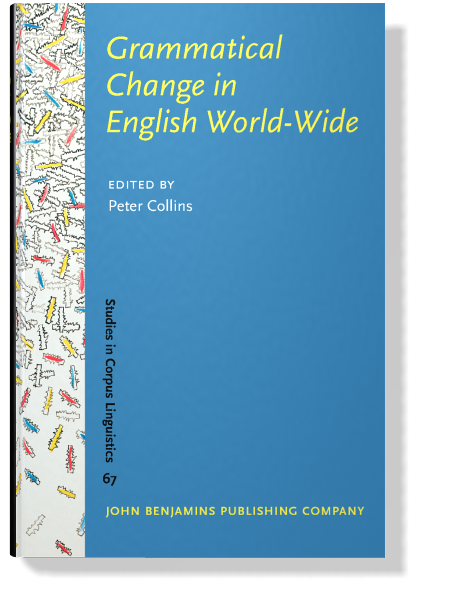
In:Grammatical Change in English World-Wide
Edited by Peter Collins
[Studies in Corpus Linguistics 67] 2015
► pp. 271–296
Recent diachronic change in the progressive in Philippine English
Published online: 24 February 2015
https://doi.org/10.1075/scl.67.12col
https://doi.org/10.1075/scl.67.12col
This chapter reports a diachronic study of the progressive aspect in Philippine English based on the Philippine component of the International Corpus of English and the new ‘Phil-Brown’ corpus which provides insights into evolutionary changes in Philippine English between the 1960s and the 1990s. Some findings suggest a perpetuation of the traditional exonormative influence on Philippine English of its colonial ‘parent’, American English, such as its distaste for progressive passives and the relative popularity of progressives with stative lexical verbs. Other results are suggestive of endonormative stabilisation, including an imperviousness to the forces of colloquialisation as reflected in the weaker endorsement in Philippine English of present progressives and contracted progressives than that in American (and British) English. Keywords: progressive; Philippine English; diachronic change; corpus

References (57)
Aarts, Bas, Close, Joanne & Wallis, Sean. 2013. Choices over time: Methodological issues in investigating current change. In Aarts, Close,Leech & Wallis (eds), 14–45.
Aarts, Bas, Close, Joanne, Leech, Geoffrey & Wallis, Sean. 2013. The Verb Phrase in English: Investigating Recent Language Change with Corpora. Cambridge: CUP.
Bautista, Ma. Lourdes S. 2009. Exemplary analyses of the Philippine English Corpus. In Piakandatu ami Dr Howard P. McKaughan
[In Honour of Dr Howard P. McKaughan]
, Loren Billings & Nelleke Goudsward (eds), 5–23. Manila: Linguistics Society of the Philippines and SIL Philippines.
. 2011a. Introducing the Philippine component of the International Corpus of English circa 2010. In Bautista 2011b, 3–22.
. 2011b. Studies of Philippine English: Exploring the Philippine Component of the International Corpus of English. Manila: Anvil Publishing.
Bautista, Ma. Lourdes S. & Bolton, Kingsley (eds). 2004. Philippine English: Tensions and transitions. Special Issue of World Englishes 23(1): 1–210.
Biber, Douglas, Johansson, Stig, Leech, Geoffrey, Conrad, Susan & Finegan, Edward. 1999. Longman Grammar of Spoken and Written English. London: Longman.
Borlongan, Ariane. 2011. Relocating Philippine English in Schneider’s Dynamic Model. Paper presented at the 17th International Association of World Englishes Conference, Melbourne, Australia.
Buyssens, Eric. 1968. Les Deux Aspectifs de la Conjugation Anglaise au XXe Siècle. Brussels: Presses Universitaires de Bruxelles.
Collins, Peter. 2008. The progressive aspect in World Englishes: A corpus-based study. Australian Journal of Linguistics 28(2): 225–249.
Collins, Peter & Yao, Xinyue. 2013. Colloquial features in World Englishes. International Journal of Corpus Linguistics 18(4): 479–505.
Collins, Peter, Borlongan, Ariane & Yao, Xinyue. 2014. Modality in Philippine English: A diachronic study. Journal of English Linguistics 42(1): 68–88.
Collins, Peter, Yao, Xinyue & Borlongan, Ariane. 2014. Relative clauses in Philippine English: A diachronic perspective. In Corpus Interrogation and Grammatical Patterns [Language and Computers - Studies in Practical Linguistics 78], Lieven Vandelanotte, Kristin Davidse, Caroline Gentens and Ditte Kimps (eds). Amsterdam/New York: Rodopi.
Collins, Peter, Borlongan, Ariane, Lim, Joo-Hyuk & Yao, Xinyue. 2014. The subjunctive mood in Philippine English: A diachronic analysis. In Contact, Variation and Change in the History of English [Studies in Language Companion Series 159], Simone E. Pfenninger, Olga Timofeeva, Anne-Christine Gardner, Alpo Honkapohja, Marianne Hundt & Daniel Schreier (eds), 259–280 Amsterdam: John Benjamins.
Comrie, Bernard. 1976. Aspect. An Introduction to the Study of Verbal Aspect and Related Problems. Cambridge: CUP.
. 1995. Tense and aspect. In Handbücher zur Sprach- und Kommunikationswissenschaft, Vol 9.2: Syntax. Ein Internationales Handbuch Zeitgenössischer Forschung, Joachim Jacobs, Arnim von Stechow, Wolfgang Sternefeld & Theo Vennemann (eds), 1244–1251. Berlin: Mouton de Gruyter.
. 1998. Syntax. In The Cambridge History of the English language, Vol IV: 1776-1997, Suzanne Romaine (ed.), 92–329. Cambridge: CUP.
Fischer, Olga. 1992. Syntax. In The Cambridge History of the English language, Vol II: 1066-1476, Norman Blake (ed.), 207–408. Cambridge: CUP.
Gonzales, Andrew. 1997. Philippine English: A variety in search of legitimation. In Englishes around the World. Studies in Honour of Manfred Görlach [Varieties of English around the World G19], Edgar Schneider (ed.), 205–212. Amsterdam: John Benjamins.
Hilbert, Michaela & Manfred Krug. 2012. Progressives in Maltese English: A Comparison with spoken and written text types of British and American English. In Mapping Unity and Diversity World-Wide: Corpus-based Studies of New Englishes [Varieties of English around the World G43], Marianne Hundt & Ulrike Gut (eds), 103–136. Amsterdam: John Benjamins.
Huddleston, Rodney & Pullum, Geoffrey. 2002. The Cambridge Grammar of the English Language. Cambridge: CUP.
Hundt, Marianne. 2004a. Animacy, agentivity, and the spread of the progressive in Modern English. English Language and Linguistics 8(1): 47–69.
. 2004b. The passival and the progressive passive: A case study of layering in the English aspect and voice systems. In Corpus Approaches to Grammaticalization in English [Studies in Corpus Linguistics 13], Hans Lindquist & Christian Mair (eds), 79–120. Amsterdam: John Benjamins.
Hundt, Marianne & Mair, Christian. 1999. ‘Agile’ and ‘uptight’ genres: The corpus-based approach to language change in progress. International Journal of Corpus Linguistics 4: 221–242.
Hundt, Marianne & Vogel, Katrin. 2011. Overuse of the progressive in ESL and Learner Englishes – fact or fiction? In Exploring Second-Language Varieties and Learner Englishes: Bridging the Gap [Studies in Corpus Linguistics 44], Joybrato Mukherjee & Marianne Hundt (eds), 205–222. Amsterdam: John Benjamins.
Jespersen, Otto. 1931. A Modern English Grammar on Historical Principles. Vol 4. Heidelberg: Carl Winter.
Kearns, Kate. 2003. Durative achievements and individual-level predicates on events. Linguistics and Philosophy 26(5): 595–635.
König, Ekkehard. 1995. He is being obscure: non-verbal predication and the progressive. In Temporal Reference, Aspect, and Actionality, Vol. II: Typological Approaches, Pier Marco Bertinettto, Valentina Bianchi. Östen Dahl & Marion Squartini (eds), 155–167. Turin: Rosenberg and Sellier.
Kranich, Svenja. 2009. Interpretative progressives in Late Modern English. In Current Issues in Late Modern English, Ingrid Tieken-Boon van Ostade & Wim Van der Wurff (eds), 331–357. Bern: Peter Lang.
. 2010. The Progressive in Modern English: A Corpus-Based Study of Grammaticalization and Related Changes. Amsterdam: Rodopi.
Leech, Geoffrey, Hundt, Marianne, Mair, Christian & Smith, Nicholas. 2009. Change in Contemporary English: A Grammatical Study. Cambridge: CUP.
Levin, Magnus. 2013. The progressive verb in modern American English. In Aarts, Close, Leech & Wallis (eds), 187–216.
Ljung, Magnus. 1980. Reflections on the English Progressive [Gothenburg Studies in English 46]. Gothenburg: Acta Universitatis Gothoburgensis.
Mair, Christian & Hundt, Marianne. 1995. Why is the progressive becoming more frequent in English? A corpus-based investigation of language change in progress. Zeitschrift für Anglistik und Amerikanistik 43(2): 111–122.
Mair, Christian & Leech, Geoffrey. 2006. Current changes in English syntax. In Handbook of English Linguistics, Bas Aarts & April McMahon (eds), 318–342. Oxford: Blackwell.
Mustanoja, Tauno. 1960. A Middle English Syntax, Part 1: Parts of Speech. Helsinki: Société Néophilologique.
Nesselhauf, Nadja. 2007. The spread of the progressive and its ‘future’ use. English Language and Linguistics 11(1): 191–207.
Quirk, Randolph, Greenbaum, Sidney, Leech, Geoffrey & Svartvik, Jan. 1985. A Comprehensive Grammar of the English Language. London: Longman.
Römer, Ute. 2005. Progressives, Patterns, Pedagogy. A Corpus-driven Approach to English Progressive Forms, Functions, Contexts and Didactics [Studies in Language Companion Series 22]. Amsterdam: John Benjamins.
Schneider, Edgar. 2007. Postcolonial English: Varieties of English around the World. Cambridge: CUP.
Smith, Nicholas. 2002. Ever moving on? The progressive in recent British English. In New Frontiers of Corpus Research: Papers from the Twenty First International Conference on English Language Research on Computerized Corpora, Sydney 2000, Pam Peters, Peter Collins & Adam Smith (eds), 317–330. Amsterdam: Rodopi.
Smitterberg, Eric. 2005. The Progressive in 19th century English. A Process of Integration. Amsterdam: Rodopi.
Van Rooy, Bertus. 2006. The extension of the progressive aspect in Black South African English. World Englishes 25(1): 37–64.
Visser, Fredericus Theodorus. 1963-1973. An Historical Syntax of the English Language. Leiden: E. J. Brill.
Williams, Christopher. 2002. Non-progressive and Progressive Aspect in English. Fasano di Puglia: Schena Editore.
Williams, Jessica. 1987. Non-native varieties of English: A special case of language acquisition. English World-Wide 8: 161–199.
Cited by (7)
Cited by seven other publications
Bolton, Kingsley, Priscilla Angela T. Cruz & Isabel Pefianco Martin
Gilquin, Gaëtanelle
2022. Diachronic learner corpus research. In Broadening the Spectrum of Corpus Linguistics [Studies in Corpus Linguistics, 105], ► pp. 41 ff.
Meierkord, Christiane & Bebwa Isingoma
2022. Between first language influence, exonormative orientation and migration. English World-Wide. A Journal of Varieties of English 43:2 ► pp. 220 ff.
Buschfeld, Sarah
2021. The question of structural nativization in Namibian
English. In The dynamics of English in Namibia [Varieties of English Around the World, G65], ► pp. 169 ff.
Collins, Peter & Xinyue Yao
Borlongan, Ariane Macalinga
Ssempuuma, Jude, Bebwa Isingoma & Christiane Meierkord
2016. The use of the progressive in Ugandan English. In Ugandan English [Varieties of English Around the World, G59], ► pp. 173 ff.
This list is based on CrossRef data as of 1 december 2025. Please note that it may not be complete. Sources presented here have been supplied by the respective publishers. Any errors therein should be reported to them.