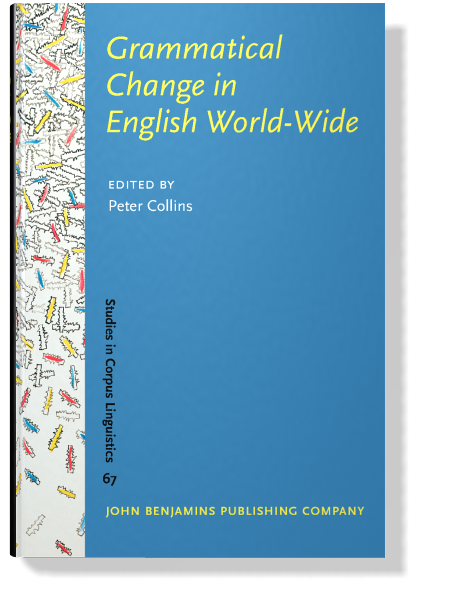
In:Grammatical Change in English World-Wide
Edited by Peter Collins
[Studies in Corpus Linguistics 67] 2015
► pp. 205–220
The evolution of epistemic marking in West Australian English
Published online: 24 February 2015
https://doi.org/10.1075/scl.67.09rod
https://doi.org/10.1075/scl.67.09rod
Across English varieties, frequent subject + epistemic/evidential verb constructions have been reanalysed as formulaic stance markers capable of introducing an embedded clause in the absence of that. I think has grammaticalised further and can occur in a syntactically parenthetical location in an utterance as an ‘epistemic parenthetical’. This chapter explores the emergence of grammatical constraints on think usage in a collection of State Library of Western Australia oral histories. The corpus features 39 speakers of Anglo-Celtic Australian English born between 1874 and 1983. Findings indicate that it is not until the late 20th century that parenthetical I think emerges as a grammatically entrenched variable with pragmatic functions involving the expression of opinion and the mitigation of negative judgement. Keywords: epistemic; evidential; think; Australian English; parenthetical

References (37)
Aijmer, Karin. 1997.
I think – an English modal particle. In Modality in Germanic Languages: Historical and Comparative Perspectives, Toril Swan &Olaf Jansen Westvik (eds), 1–47. Berlin: Mouton de Gruyter.
Boye, Kasper & Harder, Peter. 2007. Complement-taking predicates: Usage and linguistic structure. Studies in Language 31(3): 569–606.
Brinton, Laurel. 1996. Pragmatic Markers in English: Grammaticalization and Discourse Functions. Berlin: Mouton de Gruyter.
Bybee, Joan. 2003. Mechanisms of change in grammaticalization: The role of frequency. In The Handbook of Historical Linguistics, Brian D. Joseph & Richard D. Janda (eds), 602–623. Oxford: Blackwell.
Diessel, Holger & Tomasello, Michael. 2001. The acquisition of finite complement clauses in English: A corpus-based analysis. Cognitive Linguistics 12(2): 97–141.
Erman, Britt & Kotsinas, Ulla-Britt. 1993. Pragmaticalization: The case of ba and you know [Studier I Modern Språkvetenskap, New series 10, Acta Universitatis Stockholmiensis]. Stockholm: Almqvist & Wiksell. 76–93.
Guy, Gregory. 1988. Advanced Varbrul analysis. In Linguistic Change and Contact, Kathleen Ferrara, Becky Brown, Keith Walters & John Baugh (eds), 124–136. Austin TX: Department of Linguistics, University of Texas at Austin.
Israel, Michael. 2004. The pragmatics of polarity. In The Handbook of Pragmatics, Lawrence R. Horn & Gregory Ward (eds), 701–723. Malden MA: Blackwell.
Kaltenböck, Gunther. 2013. Development of comment clauses. In The English Verb Phrase: Investigating Recent Language Change with Corpora, Bas Aarts, Joanne Close, Geoffrey Leech & Sean Wallis (eds), 286–317. Cambridge: CUP.
Kärkkäinen, Elise. 2003. Epistemic Stance in English Conversation: A Description of Interactional Functions, with a Focus on think [Pragmatics & Beyond New Series 115]. Amsterdam: John Benjamins.
. 2007. The role of I guess in conversational stancetaking. In Stancetaking in Discourse: Subjectivity, Evaluation, Interaction [Pragmatics & Beyond New Series 164], Robert Englebretson (ed.), 183–219. Amsterdam: John Benjamins.
. 2010. Position and scope of epistemic phrases in planned and unplanned American English. In New Approaches to Hedging, Gunther Kaltenböck, Wiltrud Mihatsch & Stefan Schneider (eds), 207–241. Bingley: Emerald.
Kearns, Kate. 2007. Epistemic verbs and zero complementizer. English Language and Linguistics 11(3): 475–505.
Mullan, Kerry. 2010. Expressing Opinions in French and Australian English Discourse. A Semantic and Interactional Analysis [Pragmatics & Beyond New Series 200]. Amsterdam: John Benjamins.
Palander-Collins, Mina. 1999a. Grammaticalization and Social Embedding: I THINK and METHINKS in Middle and Early Modern English. Helsinki: Société Néophilologique.
. 1999b. Male and female styles in 17th century correspondence: I THINK. Language Variation and Change 11: 123–141.
Poplack, Shana & Tagliamonte, Sali. 2001. African American English in the Diaspora. Malden MA: Blackwell.
Rodríguez Louro, Celeste. 2013. Quotatives Down Under: Be like in cross-generational Australian English speech. English World-Wide 34(1): 48–76.
Rodríguez Louro, Celeste & Harris, Thomas. 2013. Evolution with an attitude: The grammaticalisation of epistemic/evidential verbs in Australian English. English Language and Linguistics 17(3): 415–443.
Rodríguez Louro, Celeste & Ritz, Marie-Eve. 2014. Stories down under: Tense variation at the heart of Australian English narratives. Australian Journal of Linguistics 34(4): 540–556.
Tagliamonte, Sali. 2002. Comparative sociolinguistics. In The Handbook of Language Variation and Change, Jack K. Chambers, Peter Trudgill & Natalie Schilling-Estes (eds), 729–763. Malden MA: Blackwell.
Tagliamonte, Sali & Smith, Jennifer. 2005. No momentary fancy! The zero ‘complementizer’ in English dialects. English Language and Linguistics 9: 289–309.
Thompson, Sandra. 2002. “Object complements” and conversation: Towards a realistic account. Studies in Language 26(1): 125–164.
Thompson, Sandra & Mulac, Anthony. 1991a. The discourse conditions for the use of the complementizer that in conversational English. Journal of Pragmatics 15(3): 237–261.
. 1991b. A quantitative perspective on the grammaticization of epistemic parentheticals in English. In Approaches to Grammaticalization, Vol. II: Focus on Types of Grammatical Markers, [Typological Studies in Language 19], Elizabeth Traugott & Bernd Heine (eds), 313–329. Amsterdam: John Benjamins.
Torres Cacoullos, Rena & Walker, James. 2009. On the persistence of grammar in discourse formulas. Linguistics 47: 1–47.
Traugott, Elizabeth. 1989. On the rise of epistemic meanings in English: An example of subjectification in semantic change. Language 65(1): 31–55.
. 1995. Subjectification in grammaticalisation. In Subjectivity and Subjectivisation: Linguistic Perspectives, Deiter Stein & Wright, Susan (eds), 31–54. Cambridge: CUP.
Van Bogaert, Julie. 2006.
I guess, I suppose and I believe as pragmatic markers: Grammaticalization and functions. Belgian Journal of English Language and Literatures 4: 129–149.
Cited by (1)
Cited by one other publication
This list is based on CrossRef data as of 1 december 2025. Please note that it may not be complete. Sources presented here have been supplied by the respective publishers. Any errors therein should be reported to them.