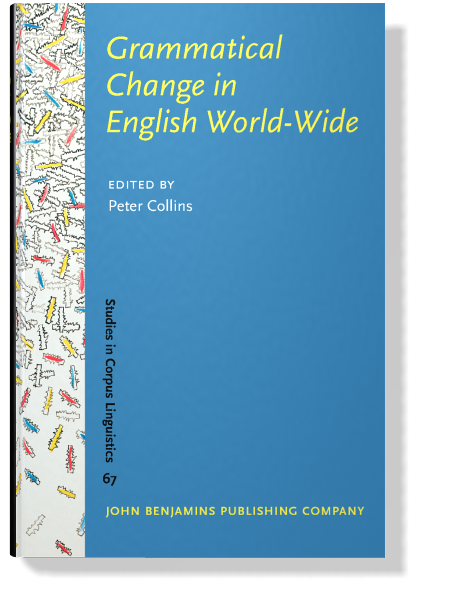
In:Grammatical Change in English World-Wide
Edited by Peter Collins
[Studies in Corpus Linguistics 67] 2015
► pp. 119–146
Cross-variety diachronic drifts and ephemeral regional contrasts
An analysis of modality in the extended Brown family of corpora and what it can tell us about the New Englishes
Published online: 24 February 2015
https://doi.org/10.1075/scl.67.06mai
https://doi.org/10.1075/scl.67.06mai
The present study offers the first analysis of modals and semi-modals which is based on all six completed Brown family corpora (B-Brown, B-LOB, Brown, LOB, Frown, F-LOB) and shows that the dynamics of diachronic change have prevented the emergence and preservation of stable regional contrasts between British and American English. The significance of this finding for the study of modality in the New Englishes is explored. Keywords. modality; ongoing change; British English; American English

References (42)
Aarts, Bas, Close, Joanne & Wallis, Sean. 2013. Choices over time: Methodological issues in current change. In The English Verb Phrase: Corpus Methodology and Current Change, Bas Aarts, Joanne Close, Sean Wallis & Geoffrey Leech (eds), 14–45. Cambridge: CUP.
Biewer, Carolin. 2011. Modal auxiliaries in second language varieties of English – a learner’s perspective. In Exploring Second-Language Varieties of English and Learner Englishes: Bridging a Paradigm Gap [Studies in Corpus Linguistics 44], Joybrato Mukherjee & Marianne Hundt (eds), 7–33. Amsterdam: John Benjamins.
Bowie, Jill, Wallis, Sean & Aarts, Bas. 2013. Contemporary change in modal usage in spoken British English: Mapping the impact of ‘genre’. In English Modality: Core, Periphery and Evidentiality, Juana I. Marín-Arrese, Marta Carretero, Jorge Arús Hita, &Johan Van der Auwera (eds), 57–94. Berlin: Mouton de Gruyter.
. 2014. Quasi-modals and modals in Australian English fiction 1800-1999, with comparisons across British and American English. Journal of English Linguistics 42: 7–30.
Collins, Peter & Peters, Pam. 2004. Australian English: Morphology and syntax. In A Handbook of Varieties of English, Vol 2, Bernd Kortmann, Edgar Schneider, with Kate Burridge, Rajend Mesthrie & Clive Upton (eds), 593–610. Berlin: Mouton de Gruyter.
Collins, Peter & Yao, Xinyue. 2012. Modals and quasi-modals in New Englishes. In Mapping Unity and Diversity World-wide: Corpus-based Studies of New Englishes [Varieties of English around the World G43], Marianne Hundt & Ulrike Gut (eds), 35–53. Amsterdam: John Benjamins.
Collins, Peter, Borlongan, Ariane Macalinga & Yao, Xinyue. 2014. Modality in Philippine English: A diachronic study. Journal of English Linguistics 42: 68–88.
Declerck, Renaat. 2010. Future time reference expressed by be to in present-day English. English Language and Linguistics 14: 271–291.
Denison, David. 2003. Log(ist)ic and simplistic S-curves. In Motives for Language Change, Ray Hickey (ed.), 54–70. Cambridge: CUP.
Deuber, Dagmar. 2010. Modal verb usage at the interface of English and a related creole: A corpus-based study of can/could and will/would in Trinidadian English. Journal of English Linguistics 38: 105–142.
Hinrichs, Lars, Smith Nicholas & Waibel, Birgit. 2007. The Part-of-Speech-Tagged ‘Brown’ Corpora: A Manual of Information, Including Pointers for Successful Use. Freiburg: Department of English, University of Freiburg. <[URL]>
Hundt, Marianne. 2013. The demise of the being to V construction. Transactions of the Philological Society, published online 13 Nov 2013. .
Hundt, Marianne & Leech, Geoffrey. 2012. ‘Small is beautiful’: On the value of standard reference corpora for observing recent grammatical change. In Oxford Handbook of the History of English, Terttu Nevalainen & Elizabeth Closs Traugott (eds), 175–188. Oxford: OUP.
Jankowski, Bridget. 2004. A transatlantic perspective of variation and change in English deontic modality. Toronto Working Papers in Linguistics 23: 85–113.
Krug, Manfred. 2000. Emerging English Modals: A Corpus-Based Study of Grammaticalization. Berlin: Mouton de Gruyter.
Leech, Geoffrey. 2003. Modality on the move: The English modal auxiliaries 1961 – 1992. In Modality in Contemporary English, Roberta Facchinetti, Manfred Krug, & Frank Palmer (eds), 223–240. Berlin: Mouton de Gruyter.
. 2011. The modals ARE declining: Reply to Neil Millar [2009]. International Journal of Corpus Linguistics 16: 547–564.
. 2013. Where have all the modals gone? On the declining frequency of modal auxiliaries in American and British English. In English Modality: Core, Periphery and Evidentiality, Juana I. Marín-Arrese, Marta Carretero, Jorge Arús Hita & Johan Van der Auwera (eds), 95–115. Berlin: Mouton de Gruyter.
Leech, Geoffrey & Smith, Nicholas. 2005. Extending the possibilities of corpus-based research on English in the twentieth century: A prequel to LOB and F-LOB. ICAME Journal 29: 83–98.
. 2009. Change and constancy in linguistic change: How grammatical usage in written English evolved in the period 1931-1991. In Corpus Linguistics: Refinements and Reassessments, Antoinette Renouf & Andrew Kehoe (eds), 173–200. Amsterdam: Rodopi.
Leech, Geoffrey, Hundt, Marianne, Mair, Christian & Smith, Nicholas. 2009. Change in Contemporary English: A Grammatical Study. Cambridge: CUP.
Lorenz, David. 2013. Contractions of English Semi-Modals: The Emancipating Effect of Frequency [New Ideas in Human Interaction / NIHIN] Freiburg: Universitätsbibliothek. <[URL]>
Mair, Christian. 2012. From opportunistic to systematic use of the web as corpus: Do-support with got (to) in contemporary American English. In The Oxford Handbook of the History of English, Terttu Nevalainen & Elizabeth Traugott (eds), 245–255. Oxford: OUP.
Mair, Christian & Leech, Geoffrey. 2006. Current changes. In The Handbook of English Linguistics, Bas Aarts &April McMahon (eds), 318–342. Oxford: Blackwell.
Mesthrie, Rajend & Bhatt, Rakesh M. 2008. World Englishes: The Study of New Varieties. Cambridge: CUP.
Millar, Neil. 2009. Modal verbs in Time: Frequency changes 1923-2006. International Journal of Corpus Linguistics 14: 191–220.
Müller, Friederike. 2008. From degrammaticalisation to regrammaticalisation? Current changes in the use of need
. Arbeiten aus Anglistik und Amerikanistik 33: 71–94.
Nesselhauf, Nadja. 2006. The decline of be to and the rise of be going to in Late Modern English: Connection or coincidence. In Anglistentag 2005 Bamberg: Proceedings, Christoph Houswitschka, Gabriele Knappe & Anja Müller (eds), 515–529. Trier: Wissenschaftlicher Verlag.
Noël, Dirk, Van Rooy, Bertus & Van der Auwera, Johan (eds) 2014. Special Issue: Diachronic Approaches to Modality in World Englishes. Journal of English Linguistics 42: 3–88.
Nokkonen, Soili. 2006. The semantic variation of need to in four recent British English corpora. International Journal of Corpus Linguistics 11(1): 29–71.
Quirk, Randolph, Greenbaum, Sidney, Leech, Geoffrey & Svartvik, Jan. 1985. A Comprehensive Grammar of the English Language. London: Longman.
Seggewiß, Friederike. 2012. Current Changes in the English Modals: A Corpus-Based Analysis of Present-Day Spoken English. PhD dissertation, University of Freiburg.
Smith, Nicholas. 2003. Changes in the modals and semi-modals of strong obligation and epistemic necessity in recent British English. In Modality in Contemporary English, Roberta Facchinetti, Manfred Krug & Frank Palmer (eds), 241–266. Berlin: Mouton de Gruyter.
Taeymans, Martine. 2004. An investigation into the marginal modals DARE and NEED in British present-day English: A corpus-based approach. In Up and Down the Cline: The Nature of Grammaticalization [Typological Studies in Language 59], Olga Fischer, Muriel Norde & Harry Perridon (eds), 97–114. Amsterdam: John Benjamins.
Tagliamonte, Sali A. & D’Arcy, Alexandra. 2007. The modals of obligation/necessity in Canadian perspective. English World-Wide 28: 47–87.
Trudgill, Peter & Hannah, Jean. 2008 [1982]. International English: A Guide to Varieties of Standard English, 5th edn. London: Hodder Education.
Cited by (15)
Cited by 15 other publications
Basile, Carmelo Alessandro, Christophe Lenoble & Debra Ziegeler
Latouche, Lucie, Samantha Laporte & Ilse Depraetere
Leclercq, Benoît & Graeme Trousdale
Seoane, Elena & Lucía Loureiro-Porto
2024. A diachronic corpus-pragmatic approach to democratization. Journal of Historical Pragmatics 25:2 ► pp. 215 ff.
Depraetere, Ilse
Laliberté, Catherine
Morin, Cameron & Carmelo Alessandro Basile
Kranich, Svenja
2021. Decline and loss in the modal domain in recent English
. In Lost in Change [Studies in Language Companion Series, 218], ► pp. 261 ff.
Loureiro-Porto, Lucía
Mair, Christian
Daugs, Robert
2020.
Revisiting global and intra-categorial frequency shifts in the English
modals. In Re-assessing Modalising Expressions [Studies in Language Companion Series, 216], ► pp. 19 ff.
Laitinen, Mikko
Mair, Christian & Geoffrey N. Leech
This list is based on CrossRef data as of 1 december 2025. Please note that it may not be complete. Sources presented here have been supplied by the respective publishers. Any errors therein should be reported to them.