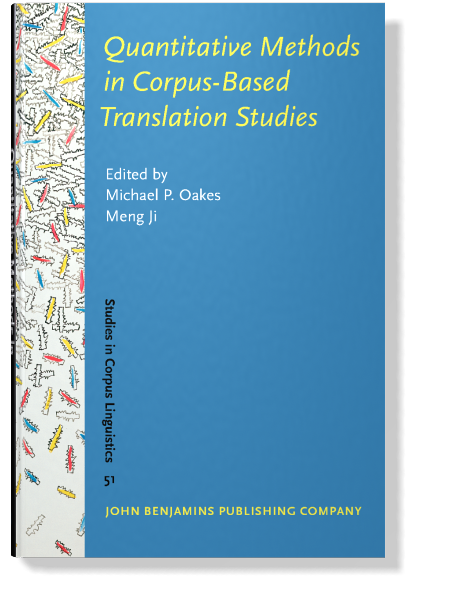
In:Quantitative Methods in Corpus-Based Translation Studies: A practical guide to descriptive translation research
Edited by Michael P. Oakes and Meng Ji
[Studies in Corpus Linguistics 51] 2012
► pp. 251–274
Translation and scientific terminology
Published online: 20 March 2012
https://doi.org/10.1075/scl.51.10ji
https://doi.org/10.1075/scl.51.10ji
The establishment of a working scientific language was instrumental in the construction of China’s early modern scientific identity, as a result of its increasing engagement with Western scientific concepts and idea sets. The current study aims to offer a corpus-based investigation of representative early Chinese scientific translations from a range of Western languages including English, French and Dutch. This corpus-based study examines the complex historical process of the cross-cultural and cross-linguistic scientific exchange between China, Japan and the West in the late nineteenth century. Through the quantitative corpus analysis, this study identified important patterns in the development of key linguistic features of an emerging scientific language system in modern Chinese, for example, token length and functional particles. The insights gained through the use of exploratory statistical techniques point to useful directions for future research in corpus-based translation studies.

Cited by (3)
Cited by three other publications
Elsherif, Garda & Tomasz Rozmysłowicz
Su, Wenchao
This list is based on CrossRef data as of 1 december 2025. Please note that it may not be complete. Sources presented here have been supplied by the respective publishers. Any errors therein should be reported to them.