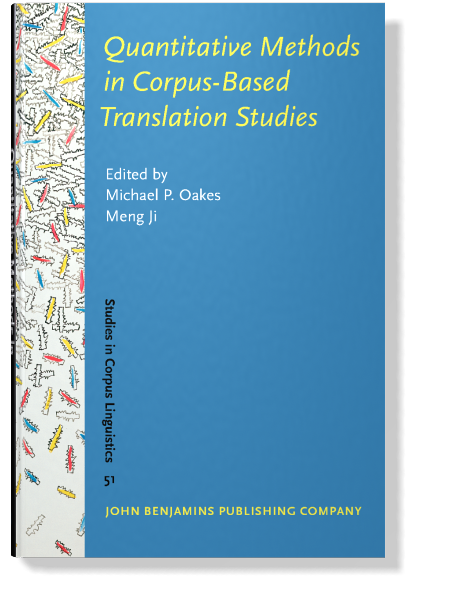
In:Quantitative Methods in Corpus-Based Translation Studies: A practical guide to descriptive translation research
Edited by Michael P. Oakes and Meng Ji
[Studies in Corpus Linguistics 51] 2012
► pp. 53–72
Hypothesis testing in corpus-based literary translation studies
Published online: 20 March 2012
https://doi.org/10.1075/scl.51.03ji
https://doi.org/10.1075/scl.51.03ji
The main purpose of this chapter is to develop useful analytical frameworks for translation studies. The new analytical frameworks proposed will integrate quantitative and qualitative analysis of textual and contextual events and phenomena of translation. Three sets of relationship are highlighted to illustrate the usefulness of these new analytical schemes which are (1) the dependence relation between the source and the target text at various linguistic levels such as lexical, syntactic, grammatical and phraseological; (2) the dependence relation between translation and the target societal and cultural background; and (3) the dependence relation between the language of individual translations and the linguistic evolution of the target language at a general level. To illustrate the use of the new model of quantitative and qualitative analysis, this chapter offers a case study which compares the stylistic profile of Cervantes’s Don Quijote de La Mancha (1605) and its two modern Chinese versions by Yang Jiang in 1978 and by Liu Jingsheng in 1995.

Cited by (8)
Cited by eight other publications
Marín García, Álvaro
2025. Finding synergies in Cognitive Translation and Interpreting Studies via task design. Target. International Journal of Translation Studies 37:2 ► pp. 271 ff.
Rodríguez-Castro, Mónica & Concepción B. Godev
2024. Implicit agent se-constructions. Revista Española de Lingüística Aplicada/Spanish Journal of Applied Linguistics 37:2 ► pp. 628 ff.
Cipriani, Anna Maria
Cipriani, Anna Maria
Jiménez-Crespo, Miguel A.
Ruano, Pablo
Covington, Michael A., Iris Potter & Tony Snodgrass
This list is based on CrossRef data as of 1 december 2025. Please note that it may not be complete. Sources presented here have been supplied by the respective publishers. Any errors therein should be reported to them.