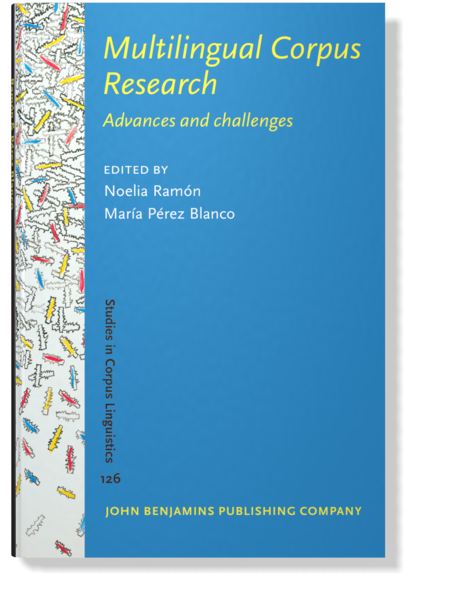
In:Multilingual Corpus Research: Advances and challenges
Edited by Noelia Ramón and María Pérez Blanco
[Studies in Corpus Linguistics 126] 2026
► pp. 174–201
Chapter 7The terminology of inclusion in English and Spanish newspapers
A corpus-based contrastive study
Published online: 20 February 2026
https://doi.org/10.1075/scl.126.07car
https://doi.org/10.1075/scl.126.07car
Abstract
The contemporary discourse surrounding disability is significant both socially and politically, as is the language used to
articulate the experiences of individuals with disabilities. This study intertwines discourse analysis and the exploration of disability
terminology to scrutinise collocations and connotations in left and right-wing newspapers about the participation of individuals with
disabilities. It examines the terms inclusión, integración, and inserción in Spanish
and their equivalents in English. The study aims to assess the inclusivity of the terminology in each language and identify which has
evolved more in this context using two corpora: DISCORP-PRESS (Sánchez Carnicer, 2022) and
DISCORP-PRESS-IN. Results identify the semantic field of each term and linguistic patterns suggesting trends toward a more inclusive,
non-discriminatory language.
Keywords: disability, corpora, English, Spanish, translation
Article outline
- 1.Introduction
- 2.The corpora: DISCORP-PRESS and DISCORP-PRESS-IN
- 2.1Characteristics and compilation of DISCORP-PRESS and DISCORP-PRESS-IN
- 3.Methodology
- 4.Case studies on the Spanish terms inclusión, integración, and inserción
- 4.1Term 1: Inclusión
- 4.1.1Results for inclusión in ABC
- 4.1.2Results for inclusión in El País
- 4.2Term 2: Integración
- 4.2.1Results for integración in ABC
- 4.2.2Results for integración in El País
- 4.3Term 3: Inserción
- 4.3.1Results for inserción in ABC
- 4.3.2Results for inserción in El País
- 4.1Term 1: Inclusión
- 5.Case studies for the English terms inclusion,
integration, and insertion
- 5.1Results for The Guardian
- 5.2Results for The Telegraph
- 6.Discussion of results
- 7.Conclusions
Notes References

References (34)
Ahamjik Ahidar, M. (2015). El posicionamiento en el discurso periodístico sobre la inmigración en el periódico inglés “The Guardian” y el periódico español
“El País”: Estudio comparativo (Unpublished doctoral dissertation). Universidad Complutense de Madrid.
Albaek, E., Van Dalen, A., Jebril, N., & De Vreese, C. H. (2014). Political journalism in comparative perspective. Cambridge University Press.
Anthony, L. (2024). AntFileConverter (Version 2.1.0) [Computer Software].
Baker, P. (2010). Representations of Islam in British broadsheet and tabloid newspapers 1999–2005. Journal of Language and Politics 9(2), 310–338.
Beltrán, M. (1990). Sobre el lenguaje como realidad social. Revista del Centro de Estudios Constitucionales, 7, 33–55.
Brufau Alvira, N. (2011). Traducción y género: El estado de la cuestión en España. MonTI. Monografías de Traducción e Interpretación, 3, 181–207.
Buendía Castro, M. (2020). La fraseología en lexicografía y terminografía. Aplicaciones a la traducción. Comares.
Condamines, A., & Picton, A. (2022). Textual terminology: Origins, principles and new challenges. In P. Faber & M.-C. L’Homme (Eds.), Theoretical perspectives on terminology: Explaining terms, concepts, and specialized knowledge (pp. 219–236). John Benjamins.
Corpas Pastor, G., & Seghiri, M. (2007). Determinación del umbral de representatividad de un corpus mediante el algoritmo N- Cor. SEPLN: Revista de la Sociedad Española para el Procesamiento del Lenguaje Natural, 39, 165–172.
Drouin, P. (2003). Term extraction using non-technical corpora as a point of leverage. Terminology, 9(1), 99–115.
García Rodríguez, J. (2019). Las unidades fraseológicas del español y el catalán con elementos de la naturaleza: Estudio cognitivo — contrastivo y propuesta
de un diccionario electrónico de fraseología bilingüe (Unpublished doctoral dissertation). Universitat Autònoma de Barcelona.
International Labour Organization. 2016. Disability and work, 28 April 2016.
Kilgarriff, A., Rychly, P., Smrz, P., & Tugwell, D. (2004). The Sketch Engine. In G. Williams & S. Vesnier (Eds.), Proceedings of the 11th Euralex Congress (pp. 105–116). Université de Bretagne-Sud.
Marín-Arrese, J. I. (2021a). Winds of war: Epistemic and effective control in political discourse. Cultura, Lenguaje y Representación, 26, 289–307.
(2021b). Stance, emotion and persuasion: Terrorism and the Press. Journal of Pragmatics, 177, 135–148.
McEnery, T., & Hardie, A. (2012). Corpus linguistics: Method, theory and practice. Cambridge University Press.
Mora López, N., & Ferrer Navas, S. (2023). An English-Spanish contrastive analysis of effective stance in newspaper and political discourse. In J. I. Marín Arrese, L. Hidalgo Downing, & J. R. Zamorano Mansilla (Eds.), Stance, inter/subjectivity and identity in discourse (pp. 57–74). Peter Lang.
Orero, P. (2005). La inclusión de la accesibilidad en comunicación audiovisual dentro de los estudios de traducción
audiovisual. Quaderns. Revista de Traducció, 12, 173–185.
Ortego Antón, M. T., & Sánchez Carnicer, J. (2023). La terminología de la discapacidad de los sentidos y su traducción del español al inglés. In M. del Mar Sánchez Ramos (Ed.), Investigaciones recientes sobre traducción y accesibilidad digital (pp. 75–99). Peter Lang.
Ortego Antón, M. T. (2021). e-DriMe: A Spanish-English frame-based e-dictionary about dried meats. Terminology, 27(2), 294–321.
Pawley, A. (2001). Phraseology. Linguistics and the dictionary. International Journal of Lexicography, 14(2), 122–134.
Peñuelas Gil, I. (2024). From corpora to a semi-automatic tool: The use of model lines for the development of TorreznoTRAD. In I. Peñuelas Gil & M. T. Ortego Antón (Eds.), Interpreting and translation for agri-food professionals in the global marketplace (pp. 105–118). De Gruyter.
Pérez-Carrasco, M. (2025). TECNICOR: Una web para la traducción de textos de la industria automotriz. Hermēneus. Revista de Traducción e Interpretación, 26, 659–697.
Sánchez Carnicer, J. (2023). El tratamiento de la discapacidad intelectual en la literatura en inglés y su traducción al español: El caso de novelas
Flowers for Algernon (1959) y Lottery (2007). In C. Adrada & J. M. Zarandona (Eds.), Nuevos avances en torno a la traducción humanística: de la traducción a la revolución digital (pp. 211–224). Comares.
(2022). Traducción y discapacidad. Un estudio comparado de la terminología inglés-español en la prensa escrita. Peter Lang.
(2024). Phraseology within the agri-food industry, torreznos and adobados: A corpus-based study. In I. Peñeulas Gil & M. T. Ortego Antón (Eds.), Interpreting and translation for agri-food professionals in the global marketplace (pp. 237–250). De Gruyter.
Santaemilia Ruiz, J. (2020). Feminismo(s) y traducción, feminismo(s) traducido(s): Notas sobre una interdisciplina asimétrica. In J. Santaemilia Ruiz (Ed.), Feminismo(s) y/en traducción (pp. 1–14). Comares.
Seghiri, M. (2006). Compilación de un corpus trilingüe de seguros turísticos (español-inglés-italiano). Aspectos de evaluación, catalogación, diseño
y representatividad (Unpublished doctoral dissertation). Universidad de Málaga.
(2017). Metodología de elaboración de un glosario bilingüe y bidireccional (inglés-español/español-inglés) basado en corpus para
la traducción de manuales de instrucciones de televisores. Babel, 63(1), 43–64.