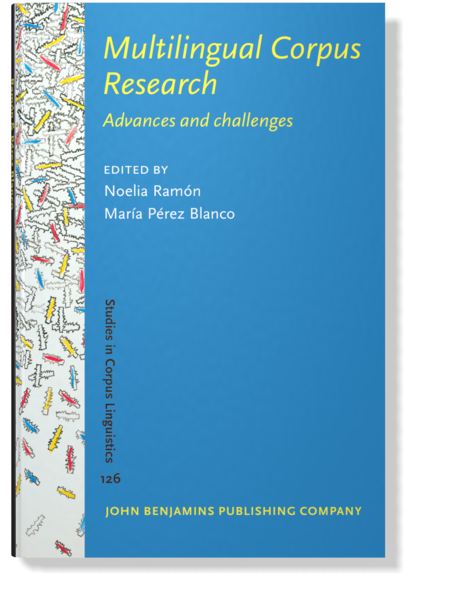
In:Multilingual Corpus Research: Advances and challenges
Edited by Noelia Ramón and María Pérez Blanco
[Studies in Corpus Linguistics 126] 2026
► pp. 123–150
Chapter 5Personal and non-personal epistemic stance in Spanish and Galician political opinion articles
A corpus-based approach
Published online: 20 February 2026
https://doi.org/10.1075/scl.126.05gon
https://doi.org/10.1075/scl.126.05gon
Abstract
This paper explores variation across epistemic stance strategies in newspaper opinion articles in two Romance languages:
Spanish and Galician. Drawing on Marín-Arrese’s model (2011, 2021), the study presents a quantitative and qualitative analysis of personal and non-personal realisations of five stance
subcategories: cognitive attitude, factivity, inferential evidentiality, aphonic or ignorative attitude, and marked enunciational
positioning. The dataset comprises two 62,000-word corpora from left-leaning newspapers covering three refugee crises. The paper aims to
identify patterns of distribution, similarities, and differences across the subcorpora. The findings highlight key points: the Spanish
corpus contains fewer stance markers; both languages favour non-personal forms and share the two prevalent categories — non-personal
cognitives and factives. However, Galician also features non-personal inferentiality as a third prevalent category.
Article outline
- 1.Introduction
- 2.Literature review on stance
- 2.1Cognitive factives
- 2.2Cognitive attitudes
- 2.3Indirect inferential evidentiality
- 2.4Aphonic or ignorative attitude
- 2.5Marked enunciational positioning
- 3.Research hypotheses
- 4.Data and method
- 5.Results and discussion
- 5.1Quantitative and qualitative analysis of stance in Spanish
- 5.2Quantitative and qualitative analysis of stance in Galician
- 5.3Cross-linguistic variation of epistemic stance in Spanish and Galician
- 6.Conclusions
Notes References

References (48)
Biber, D. & Finegan, E. (1989). Styles of stance in English: Lexical and grammatical marking of evidentiality and affect. Text, 9(1), 93–124.
Biber,
D., Johansson,
S., Leech,
G., Conrad,
S., & Finegan,
E. (Eds.). (1999).
Longman grammar of spoken and written English. Pearson. Also published as
Biber,
D.,
Johansson, S.,
Leech, G.,
Conrad, S., &
Finegan, E.
(Eds.). (2022). Grammar of spoken and written English.
John Benjamins.
Boye, K. (2012). Epistemic meaning: A crosslinguistic and functional-cognitive study. Mouton De Gruyter.
Bravo, D. (2004). Tensión entre universalidad y relatividad en las teorías de cortesía. In D. Bravo & A. Briz (Eds.), Pragmática sociocultural: Estudios sobre el discurso de cortesía en español (pp. 15–37). Ariel Lingüística.
Cappelli, G. (2007). I reckon I know how Leonardo da Vinci must have felt… Epistemicity, evidentiality and English verbs of cognitive
attitude. Pari Publishing.
Carrió-Pastor, M. L. (2014). Cross-cultural variation in the use of modal verbs in academic English. SKY Journal of Linguistics, 27, 153–166.
(2016). A contrastive study of the hedges used by English, Spanish, and Chinese researchers in academic papers. In F. Alonso Almeida, I. Ortega Barrera, E. Quintana Toledo, & M. Sanchez Cuervo (Eds.), Input a word, analyse the world: Selected approaches to corpus linguistics (pp. 477–492). Cambridge Scholars.
Conrad, S., & Biber, D. (2000). Adverbial marking of stance in speech and writing. In S. Hunston & G. Thompson (Eds.), Evaluation in text: Authorial stance and the construction of discourse (pp. 56–73). Oxford University Press.
Davies, E., & Bentahila, A. (2012). Anglo-Arab intercultural communication. In C. Paulston, S. Kiesling, & E. Rangel (Eds.), The handbook of intercultural discourse and communication (pp. 231–251). Blackwell.
DuBois, J. W. (2007). The stance triangle. In R. Englebretson (Ed.), Stancetaking in discourse. Subjectivity, evaluation, interaction (pp. 139–182). John Benjamins.
Englebretson, R. (2007). Stancetaking in discourse: An introduction. In R. Englebretson (Ed.), Stancetaking in discourse. Subjectivity, evaluation, interaction (pp. 1–25). John Benjamins.
Fant, L. (2007). Rapport and identity management in Spanish spontaneous dialogue. In E. Placencia & C. García (Eds.), Research on politeness in the Spanish-speaking world (pp. 335–365). Lawrence Erlbaum Associates.
Félix-Brasdefer, C. (2009). Pragmatic variation across Spanish(es): Requesting in Mexican, Costa Rican, and Dominican Spanish. Intercultural Pragmatics, 6, 473–515.
Givón, T. (1982). Evidentiality and epistemic space. Studies in Language, 6(1), 23–49.
Gondar Portasany, M. (1993). Crítica da razón galega. Entre o nós-mesmos e o nós-outros. Edicións A Nosa Terra.
González-Vázquez, M. (2022). Unhas notas sobre o sistema evidencial galego. Estudos de Lingüística Galega, 14(1), 1–33.
(2023a). Da indireccionalidade á retranca. Análise das características asociadas á imaxe estereotipada do falante galego. Servizo de publicación da Universidade de Vigo.
(2023b). Aspectos subxacentes ao emprego dos marcadores evidenciais en galego. Moenia. Revista Lucense de Lingüística e Literatura, 29, 1–24.
González Vázquez, M., & Domínguez Romero, E. (2022). Evidentiality in Galician. In B. Wiemer & J. Marín-Arrese (Eds.), Evidential marking in European languages: Toward a unitary comparative account. (pp. 331–370). Mouton de Gruyter.
Hart, C. (2011). Legitimising assertions and the logico-rhetorical module: Evidence and epistemic vigilance in media discourse on
immigration. Discourse Studies, 13(6), 751–769.
Hunston, S., & Thompson, G. (Eds.). (2000). Evaluation in text. Authorial stance and the construction of discourse. Oxford University Press.
Hyland, K. (2002). Authority and invisibility: Authorial identity in academic writing. Journal of Pragmatics, 34, 1091–1112.
Iwasaki, S. (2009). Initiating interactive turn spaces in Japanese conversation: Local projection and collaborative action. Discourse Processes, 46(2), 226–246.
Kärkkäinen, E. (2006). Stance taking in conversation: From subjectivity to intersubjectivity. Text and Talk, 26(6), 699–731.
Kiparsky, P., & Kiparsky, C. (1970). Fact. In M. Bierwisch & K. E. Heidolph (Eds.), Progress in linguistics (pp. 143–173). Mouton de Gruyter.
Lombardi, E., & Masia, F. (2014). Implicitness impact: Measuring texts. Journal of Pragmatics, 61, 161–184.
Mansfield, J. (2019). Epistemic authority and sociolinguistic stance in an Australian Aboriginal language. Open Linguistics, 5, 25–48.
Marín-Arrese, J. I. (2011). Epistemic legitimising strategies, commitment and accountability in discourse. Discourse Studies, 13, 789–797.
Marín Arrese, J. I. (2015). Epistemicity and stance: A cross-linguistic study of epistemic stance strategies in journalistic discourse in English and
Spanish. A cross-linguistic perspective. Discourse Studies, 17(2), 210–225.
(2021). Stance, emotion and persuasion: Terrorism and the press. Journal of Pragmatics, 177, 135–148.
Marsily, A. (2018). Directness vs. indirectness. A contrastive analysis of pragmatic equivalence in Spanish and French request
formulations. Language in Contrast, 18(1), 122–144.
Martin, J., & White, P. (2005). The language of evaluation: Appraisal in English. Palgrave Macmillan.
Míguez, V. (2024). Revisiting modality: A corpus-based study of epistemic adverbs in Galician. John Benjamins.
Nuyts, J. (2001). Epistemic modality, language, and conceptualisation: A cognitive-pragmatic perspective. John Benjamins.
Sanromán-Vilas, B. (2020). Do evidential markers always convey epistemic values? A look into three Ibero-Romance reportatives. Lingua, 238, 1–26.
Sousa, X. (2012). Estrategias evidenciales y expresión de la fuente de información en gallego: Los marcadores
gramaticalizados. In X. Viejo Fernández (Ed.), Estudios sobre variación sintáctica peninsular (pp. 75–98). Trabe.
Vande Kopple, W. (1985). Some exploratory discourse on metadiscourse. College Composition and Communication, 36, 82–93.
Wiemer, B. (2010). Hearsay in European languages: toward an integrative account of grammatical and lexical marking. In G. Diewald & E. Smirnova (Eds.), Linguistic realisation of evidentiality in European languages (pp. 59–129). Mouton de Gruyter.
Willett, T. (1988). A cross-linguistic survey of the grammaticalisation of evidentiality. Studies in Language, 12, 51–97.
Zuczkowski, A., Bongelli, R., Vincze, L. & Riccioni, I. (2017). Epistemic stance. Knowing, unknowing, believing (KUB) positions. In A. Zuczkowski, R. Bongelli & Riccioni (Eds.), Epistemic stance in dialogue. Knowing, unknowing and believing (pp. 45–84). John Benjamins.