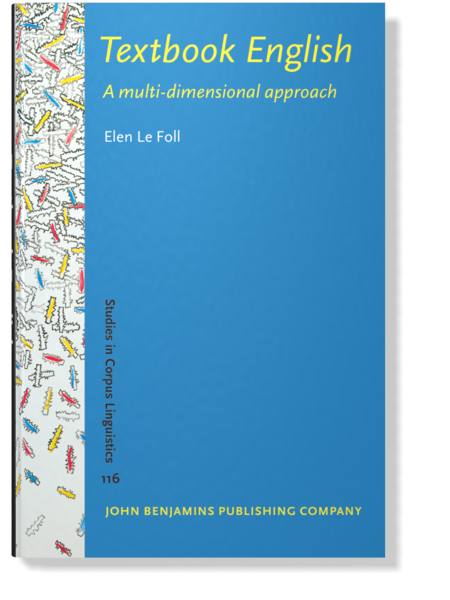
In:Textbook English: A multi-dimensional approach
Elen Le Foll
[Studies in Corpus Linguistics 116] 2024
► pp. vii–x
Published online: 25 July 2024
https://doi.org/10.1075/scl.116.toc
https://doi.org/10.1075/scl.116.toc
Table of contents
AcknowledgementsXI
List of figuresXIII
List of tablesXVII
List of abbreviationsXIX
Chapter 1.Introduction1
1.1Research objectives and methodological approach1
1.2Outline of the book3
Chapter 2.Context and rationale: Why study textbook English?5
2.1English as a foreign language at secondary school level6
2.2Authenticity in EFL teaching9
2.3Usage-based theories to L2 learning and teaching11
2.4Input and frequency13
2.5Input in lower secondary school EFL contexts14
2.6Textbooks in the EFL classroom15
2.7Corpus linguistics and foreign language education21
Chapter 3.Research on the language of school EFL textbooks: The state of the art25
3.1Methodological review27
3.1.1Intra-textbook approaches27
3.1.1.1Checklist approach to textbook evaluation27
3.1.1.2Page-by-page intra-textbook analysis28
3.1.1.3Corpus-based intra-textbook analysis29
3.1.2Comparative approaches30
3.1.2.1Word-frequency list approaches31
3.1.2.2NLP methods34
3.1.2.3Corpus-based comparisons of ‘real-world’ language
to textbook language35
to textbook language35
3.1.2.4Corpus-based comparisons of textbook language
to ‘real-world’ language38
to ‘real-world’ language38
3.1.2.5Elicitation approaches39
3.1.2.6Adding learner corpora to the equation41
3.1.2.7Textbook language as learner target language42
3.1.3Evaluating the impact of textbook language44
3.2Key findings of Textbook English studies47
3.2.1Lexis47
3.2.1.1Individual words47
3.2.1.2Multi-word units50
3.2.2Tense and aspect53
3.2.2.1Future constructions53
3.2.2.2The present perfect53
3.2.2.3The progressive54
3.2.2.4Modals55
3.2.2.5Conditionals56
3.2.2.6Reported speech57
3.2.3Pragmatics58
3.2.4Spoken grammar60
3.3Conclusions62
Chapter 4.Research aims and corpus data64
4.1Insights from the literature review64
4.2The present study67
4.2.1Research aims and questions67
4.2.2Open Science statement68
4.3Corpus data70
4.3.1The Textbook English Corpus (TEC)70
4.3.1.1Selection of textbooks71
4.3.1.2Corpus processing and mark-up75
4.3.1.3Register annotation77
4.3.2The reference corpora84
4.3.2.1The choice of the Spoken BNC201486
4.3.2.2Excursus on the use of L1 norms in English
language teaching87
language teaching87
4.3.2.3Processing of the Spoken BNC201491
4.3.2.4The Youth Fiction corpus92
4.3.2.5The Informative Texts for Teens Corpus (Info Teens)94
Chapter 5.Methodology: Adapting the multi-dimensional analysis (MDA) framework96
5.1The MDA framework97
5.2MDA and textbook language108
5.2.1Exploring Textbook English using additive MDA108
5.2.2Exploring Textbook English by conducting a full MDA110
5.3A modified MDA framework: MDA as applied in the present study111
5.3.1Selection of text samples112
5.3.2Selection of linguistic features114
5.3.3Evaluation of the reliability of the feature counts119
5.3.4Normalisation of feature counts120
5.3.5Factor analysis method124
5.3.6Dealing with skewed distributions of features126
5.3.7Computation of dimension scores131
5.3.8Comparison of dimension scores134
5.3.9Visualisation of the results136
5.3.10Reproducibility and replicability of the results138
Chapter 6.A model of intra-textbook linguistic variation140
6.1A multi-feature/multi-dimensional model of Textbook English140
6.2Dimension 1: ‘Overt instructions and explanations’151
6.3Dimension 2: ‘Involved vs. Informational Production’155
6.4Dimension 3: ‘Narrative vs. Factual discourse’161
6.5Dimension 4: ‘Informational compression vs. Elaboration’163
Chapter 7.A comparative model of Textbook English vs. ‘real-world’
English167
English167
7.1A multi-feature/multi-dimensional model of Textbook English
vs. ‘real-world’ English167
vs. ‘real-world’ English167
7.2Textbook Conversation vs. the Spoken BNC2014181
7.3Textbook Fiction vs. the Youth Fiction corpus188
7.4Textbook Informative vs. the Info Teens corpus191
Chapter 8.Discussion: What is Textbook English?195
8.1RQ1: How homogenous is Textbook English as a variety of English? Which factors mediate intra-textbook linguistic
variation?195
8.2RQ2: To what extent are French, German, and Spanish secondary school pupils confronted with varying English input via their
textbooks?196
8.3RQ3: To what extent is the language of current EFL textbooks used in secondary schools in France, Germany, and Spain
representative of ‘real-world’ English as used by native/proficient English speakers in similar communicative situations? To
what extent are some registers more faithfully represented than others?197
8.3.1Representations of spoken, conversational English
in school EFL textbooks198
in school EFL textbooks198
8.3.2Representations of informative texts in school EFL textbooks198
8.3.3Representations of fiction in school EFL textbooks199
8.4RQ4: What are the defining linguistic features that characterise Textbook English registers as compared to these target language
registers? To what extent are these defining features stable across entire textbook series? To what extent are some specific to certain
proficiency levels?199
Chapter 9.Pedagogical implications and recommendations204
9.1Unpacking the role and impact of Textbook English205
9.2Improving representations of conversational English207
9.3Improving representations of informative texts217
9.4Towards a register approach to teaching EFL224
9.4.1Implications for teacher education227
9.4.2Implications for materials design233
Chapter 10.Methodological reflections237
10.1Strengths and methodological contributions237
10.1.1Replicability and robustness238
10.1.2Complexity240
10.1.3Reproducibility241
10.2Limitations of the study242
Chapter 11.Conclusions245
11.1Synthesis245
11.2Future directions249
References252
Appendices291
Index
