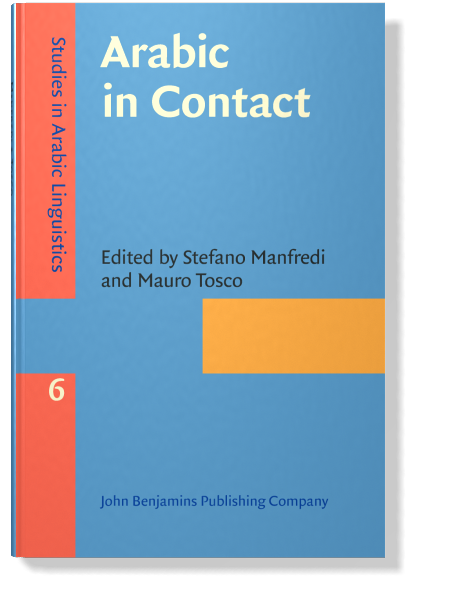
In:Arabic in Contact
Edited by Stefano Manfredi and Mauro Tosco
[Studies in Arabic Linguistics 6] 2018
► pp. 313–330
Get fulltext
From Arabia to Persia and back
Code-switching among the Āl ʿAlī tribe in the UAE and Iran
Available under the Creative Commons Attribution-NonCommercial-NoDerivatives (CC BY-NC-ND) 4.0 license.
For any use beyond this license, please contact the publisher at rights@benjamins.nl.
Published online: 10 July 2018
https://doi.org/10.1075/sal.6.16gaz
https://doi.org/10.1075/sal.6.16gaz
Abstract
This paper explores the discourse functions of Arabic-Persian code-switching and the phonological/lexical outcomes of language
contact among members of the Āl ʿAlī tribe in the United Arab Emirates and Hurmuzgān Province in Iran. The linguistic
environment among the Āl ʿAlī is characterized by bilingualism and multidialectalism. In the spoken and written code, they
generate a tetra-glossic switching between Modern Standard Arabic, Gulf Colloquial Arabic, Modern Standard Persian, Colloquial
Persian and two Persian dialects: Bandarī and Ačumī. The study draws on recorded data with tribal members in the UAE and
conversation threads of fellow Iranian tribesmen on social media sites. The main theoretical construct applied for the
analysis is the Matrix Language-Frame model (Myers-Scotton 2002). It will be argued
that the nature of codeswitching among the Āl ʿAlī is situational and transactional, both inter- and intra-sentential.
Language and dialect choice is determined by the topic of the conversation, the interlocutors’ identity and their relationship
to each other.
Article outline
- 1.Introduction
- 2.Arabs on the Iranian Gulf Coast
- 3.The Āl ʿAlī and their dominion
- 4.Language use among the Āl ʿAlī
- 5.Language data
- 5.1Persian monolingual data
- 5.2Arabic monolingual data
- 5.3Arabic-Persian bilingual data
- 6.Conclusions
Notes Bibliography

References (16)
Al-Anṣārī, Jalāl Khālid (2014). Qabāʾil ʿArab al-Hawla fī ʿUyūn al-Raḥḥāla wa al-Mustašriqīn. Bairūt: al-Dār al-ʿArabīya lil-Mausūʿāt.
Al-Dailami, Ahmed (2014). ‘Purity and Confusion’: The Hawala between Persians and Arabs in the Contemporary Gulf. In Lawrence G. Potter (ed.), The Persian Gulf in Modern Times: People, Ports, and History (pp.299–326). New York, NY: Palgrave Macmillan.
Gazsi, Dénes (2008). Arabic Proverbs from Iran: Some Characteristics of Arabic Spoken in Khūzistān Province. In Stephan Procházka, Veronika Ritt-Benmimoun (eds.), Between the Atlantic and Indian Oceans, Studies on Contemporary Arabic Dialects (pp.195–205). Wien & Münster: Lit Verlag.
Lorimer, John Gordon (1970). Gazetteer of the Persian Gulf, ʼOmān, and Central Arabia, Volume II A & II B. Westmead: Gregg International Publishers.
Myers-Scotton, Carol (2002). Contact Linguistics: Bilingual Encounters and Grammatical Outcomes. Oxford: Oxford University Press.
Nadjmabadi, Shahnaz R. (2009). The Arab Presence on the Iranian Coast of the Persian Gulf. In Lawrence G. Potter (ed.), The Persian Gulf in History (pp.129–145). New York, NY: Palgrave Macmillan.
Poplack, Shana, Sankoff, David, Miller, Christopher (1988). The social correlates and linguistic processes of lexical borrowing and assimilation. Linguistics 26(1), 47–104.
Potts, Daniel T. (2004). Kish Island. In: Ehsan Yarshater (ed.), Encyclopædia Iranica, online edition, available at [URL]
Saršumārī-yi ʿumūmī-yi nufūs wa maskan (2011). Available on [URL]
Sayahi, Lotfi (2014). Diglossia and language contact: language variation and change in North Africa. Cambridge: Cambridge University Press.
Walters, Keith (1996). Diglossia, linguistic variation, and language change in Arabic. In Mushira Eid (ed.), Perspectives on Arabic Linguistics VIII: Papers from the eighth Annual Symposium on Arabic Linguistics (pp.157–197). Amsterdam & Philadelphia: John Benjamins.
Cited by (1)
Cited by one other publication
This list is based on CrossRef data as of 1 december 2025. Please note that it may not be complete. Sources presented here have been supplied by the respective publishers. Any errors therein should be reported to them.