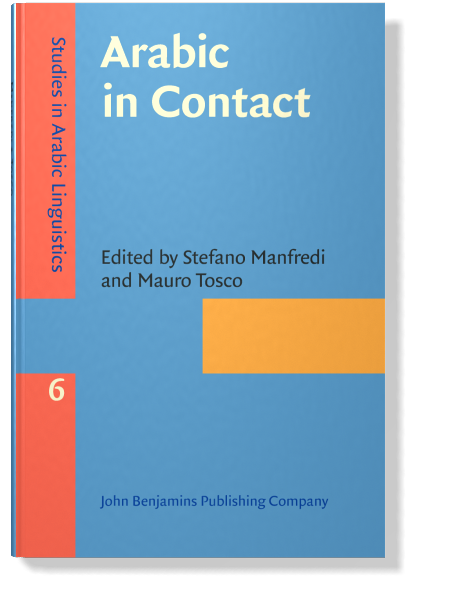
In:Arabic in Contact
Edited by Stefano Manfredi and Mauro Tosco
[Studies in Arabic Linguistics 6] 2018
► pp. 189–205
Get fulltext
An assessment of the Arabic lexical contribution to contemporary spoken Koalib
Available under the Creative Commons Attribution-NonCommercial-NoDerivatives (CC BY-NC-ND) 4.0 license.
For any use beyond this license, please contact the publisher at rights@benjamins.nl.
Published online: 10 July 2018
https://doi.org/10.1075/sal.6.10qui
https://doi.org/10.1075/sal.6.10qui
Abstract
The present paper deals with the lexical contribution of Arabic, the dominant language of Sudan, to Koalib, a Kordofanian
language traditionally spoken in the northeastern part of the Nuba Mountains (Southern Kordofan, central Sudan). The study is
based on a corpus of 400 Koalib items borrowed from Arabic, the main characteristics of which (social context, phonology, part
of speech and semantics) are successively examined and discussed. The conclusion summarizes the main typological implications
of the Arabic influence upon the Koalib grammatical system.
Keywords: borrowings, Koalib, Kordofanian, language contact, lexicon, Nuba Mountains, Sudanese Arabic
Article outline
- Introduction
- 1.Koalib and Arabic in contact: Some basic notions
- 1.1Linguistic characteristics of the contact
- 1.1.1Varieties of Arabic involved in the contact
- 1.1.2Varieties of Koalib involved in the contact
- 1.2 Social characteristics of the contact between Koalib and Arabic
- 1.3 The Arabic loanwords discussed in this study
- 1.1Linguistic characteristics of the contact
- 2.Phonological integration of Arabic borrowings into Koalib
- 2.1Segmental integration
- 2.2Tonal integration
- 3.Arabic borrowings according to their parts of speech and their morphological characteristics
- 3.1
Common nouns
- 3.1.1Formal integration
- 3.1.2Paradigmatic integration
- 3.1.3Introducing new distinctions into Koalib: The case of sex-based gender
- 3.2Proper nouns
- 3.3Verbs
- 3.4Adverbs
- 3.4.1Classical loanwords
- 3.4.2Arabic-Koalib adverbial bases used in conjugation
- 3.5 Other parts of speech
- 3.1
Common nouns
- 4.Some semantic characteristics of Arabic borrowings
- 4.1Typical semantic fields
- 4.2Conventionalized calques
- 5.Conclusion
Acknowledgments Abbreviations Notes References Appendix

References (19)
[A1]Anonym 1 (cca. 1950 ?), Lessons in ŋirere, Typed textbook designed to learn réré (ŋireɽe) in 30
lessons.
[A3]Anonym 3 (cca. 1960 ?), Ŋiɽaŋal ŋuludir zi kitam-na keni
tikitadiza tuɽun / Old Testament Stories in
ŋirere, Abɽi (Nuba Mountains), 185 pp.
[A4]Anonym 4 (1996), Yəwə na Nyaamin Nyəthi Kithla Kir 1996 Kandis-gi Kəthi Koaliib, 24 pp. without numbers.
[A5]Anonym 5 (ca. 2000 ?), Kiraw ŋa Kwurul gi, Khartoum (?): no publisher mentioned, 2 p. [incomplete: the end of the story is missing].
Abdalla, Jummize [Jummeiz] [CA1] & Komi, Abdalla (2000), Yəwə na Nyaamin Nyəthi Kithilə Kir 2000, Khartoum: Khartoum Workshop Programme. 8 pp. without any numbers.
Ewald, J. J. (1990). Soldiers, Traders, and Slaves, State Formation and Economic Transformation in the Greater Nile Valley,
1700–1885. Madison: University of Wisconsin Press.
Manfredi, S. (2010).
A Grammatical Description of Kordofanian Baggara Arabic [PhD]. Naples: Università degli Studi di Napoli “L’Orientale”.
Nunez, J. J. F. (2015). L’alternance entre créole afro-portugais de Casamance, français et wolof au Sénégal. Une
contribution trilingue à l’étude du contact de langues [PhD]. Paris/Dakar: INALCO (Institut National des Langues et Civilisations Orientales)/UCAD (Université Cheikh Anta Diop).
Quint, N. (2006). Phonologie de la langue koalibe, dialecte réré (Soudan). Paris: L’Harmattan. xvi + 238.
Quint, N. (2009). The Phonology of Koalib. Cologne/Köln: Rüdiger Köppe. Coll. Grammatical Analyses of African Languages. Vol. 36. xviii + 206.
Quint, N. (2010a). “La littérature orale en koalib (Sud-Kordofan).” Études Littéraires Africaines (ELA) (28): 45–57.
Quint, N. (2010b). “Benefactive and Malefactive Verb Extensions in the Koalib
Verb System”. In Seppo Kittilä & Fernando Zúñiga (eds.), Benefactives and malefactives. Typological perspectives and case studies. Amsterdam/Philadelphia: John Benjamins. 295–315.
Quint, N. (2014). “Integration of borrowed nouns in Koalib, a noun class language”. In Roger Blench & Thilo Schadeberg (eds.), Nuba Mountain Language Studies. Cologne/Köln: Rüdiger Koppe. 115–134.
Cited by (3)
Cited by three other publications
Quint, Nicolas & Marc Allassonnière-Tang
This list is based on CrossRef data as of 1 december 2025. Please note that it may not be complete. Sources presented here have been supplied by the respective publishers. Any errors therein should be reported to them.