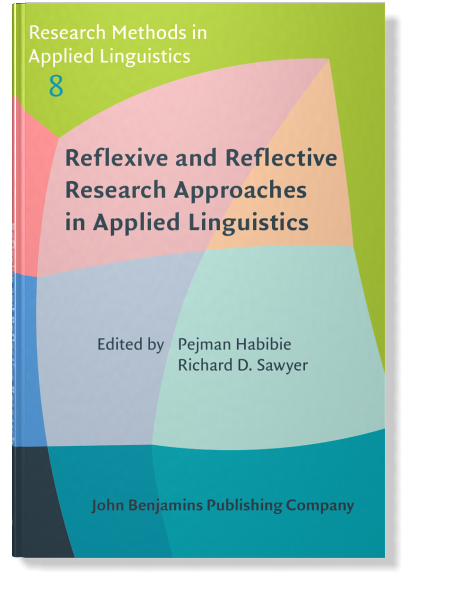
In:Reflexive and Reflective Research Approaches in Applied Linguistics
Edited by Pejman Habibie and Richard D. Sawyer
[Research Methods in Applied Linguistics 8] 2025
► pp. 172–187
Chapter 10An autoethnography of migration, language, and power dynamics
Published online: 3 March 2025
https://doi.org/10.1075/rmal.8.10nik
https://doi.org/10.1075/rmal.8.10nik
Abstract
This chapter explores the influence of power structures and social imaginaries on my language
choices as a migrant residing in Australia and using English as a foreign language. The methodology adopted in this
chapter is critical autoethnography. It critically examines the phenomenon of English linguistic imperialism. Through
the sharing of personal narratives, the chapter highlights instances where I have observed power imbalances in my
everyday interactions as a migrant in Australia, prompting me to switch to English in the presence of others. By
delving into these experiences, this research sheds light on the complex dynamics of language use and the implications
of power differentials within a multicultural context. This chapter contributes to enhancing the understanding of
sociolinguistic challenges confronted by migrants and the influence of dominant language ideologies on their
linguistic practices. By providing insights that foster increased awareness and empathy, it offers a pathway towards
promoting a more inclusive and equitable language environment within multicultural societies.
Article outline
- Research approach
- Daycare Story, 30 March 2021
- Theoretical lens
- Linguistic imperialism
- Social imaginaries
- Name change dilemma
- Late September 2020, a conversation with Sarah
- Playground story, January 2022
- End of term cathering in the café, June 2021
- La vie est belle, May 2021
- The shift of power in language choice, July 2022
- Affordances and limitations
- Ethical considerations
- Final reflection
Notes References

References (30)
Adamovic, M. (2022). When
ethnic discrimination in recruitment is likely to occur and how to reduce it: Applying a contingency
perspective to review resume studies. Human Resource Management
Review, 32(2), 100832.
Adams, T. E., Holman Jones, S., & Ellie, C. (2022). Introduction:
Making sense and taking action: Creating a caring community of
autoethnographers. In T. E. Adams, S. Holman Jones, & C. Ellie (Eds.), Handbook
of autoethnography (2nd
ed., pp. 1–19). Routledge.
Adoniou, M. (2018). Monolingualism
in multicultural Australia: Paradoxes and
challenges. In Y.-K. Cha, S.-H. Ham, & M. Lee (Eds.), Routledge
international handbook of multicultural education research in Asia
Pacific (pp. 272–285). Routledge.
Appadurai, A. (1996). Modernity
at large: Cultural dimensions of
globalization (Vol. 1). University of Minnesota Press.
Baquiran, C. L. C., & Nicoladis, E. (2020). A
doctor’s foreign accent affects perceptions of competence. Health
Communication, 35(6), 726–730.
Bourdieu, P. (1986). The
forms of capital. In J. Richardson (Ed.), Handbook
of theory and research for the sociology of
education (pp. 241–258). Greenwood.
(2002). The
forms of capital (R. Nice, Trans.). In N. W. Biggart (Ed.), Readings
in economic sociology. Blackwell.
Bourdieu, P., & Wacquant, L. J. (1992). An
invitation to reflexive sociology. The University of Chicago Press.
Darvin, R. (2017). Social
class and the inequality of English speakers in a globalized world. Journal of
English as a Lingua
Franca, 6(2), 287–311.
Ellis, C. (2007). Telling
secrets, revealing lives: Relational ethics in research with intimate
others. Qualitative
Inquiry, 13(1), 3–29.
Ellis, C. S., & Bochner, A. P. (2006). Analyzing
analytic autoethnography: An autopsy. Journal of Contemporary
Ethnography, 35(4), 429–449.
Grabe, W. (2012). Applied
linguistics: A twenty-first-century
discipline. In R. B. Kaplan (Ed.), The
Oxford handbook of applied linguistics (2nd
ed., pp. 34–44). Oxford University Press.
Grant, A. (2010). Writing
the reflexive self: An autoethnography of alcoholism and the impact of psychotherapy
culture. Journal of Psychiatric and Mental Health
Nursing, 17(7), 577–582.
Holman Jones, S. (2016). Living
bodies of thought: The “critical” in critical autoethnography. Qualitative
Inquiry, 22(4), 228–237.
Jones, R. H., & Hafner, C. A. (2021). Understanding
digital literacies: A practical introduction. Taylor and Francis.
Kelly, P. F. (2012). Migration,
Transnationalism, and the spaces of class identity. Philippine Studies:
Historical and Ethnographic
Viewpoints, 60(2), 153–185.
Méndez, M. (2013). Autoethnography
as a research method: Advantages, limitations and criticisms. Colombian Applied
Linguistics
Journal, 15(2), 279–287.
(1997). Realities
and myths of linguistic imperialism. Journal of Multilingual and Multicultural
Development, 18(3), 238–248.
Reed-Danahay, D. (2017). Bourdieu
and critical autoethnography: Implications for research, writing, and
teaching. International Journal of Multicultural
Education, 19(1), 144–154.
Rizvi, F. (2007). Lifelong
learning: Beyond neo-liberal imaginary. In D. N. Aspin (Ed.), Philosophical
perspectives on lifelong
learning (pp. 114–130). Springer.
(2011). Beyond
the social imaginary of ‘clash of civilizations’? Educational Philosophy and
Theory, 43(3), 225–235.
Seidlhofer, B. (2012). Anglophone-centric
attitudes and the globalization of English. Journal of English as a Lingua
Franca, 1(2), 393–407.
(2004). What
is a ‘‘social imaginary’’? In G. Dilip Parameshwar, K. Jane, L. Benjamin, & W. Michael (Eds.), Modern
social
imaginaries (pp. 23–30). Duke University Press.