In:Research Methods in Complex Dynamic Systems Theory Approaches to Second Language Development
Edited by Wander Lowie, Rosmawati and Vanessa De Wilde
[Research Methods in Applied Linguistics 14] 2025
► pp. v–vi
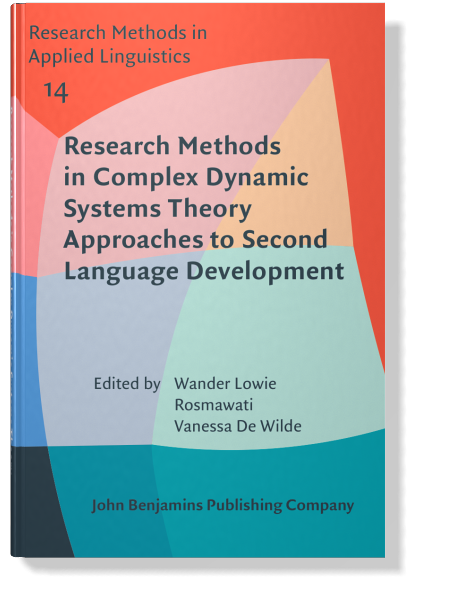
Table of contents
Foreword: Explore and explain
Diane Larsen-Freeman
Chapter 1.Introduction
Wander Lowie
Rosmawati
Vanessa de Wilde
Chapter 2.A non-linear Bayesian approach to examine the development
of Brazilian Portuguese (L3) vowels by an Argentinean learner
of Brazilian Portuguese (L3) vowels by an Argentinean learner
Ronaldo Lima Jr.
Ubiratã Kickhöfel Alves
Chapter 3.Dynamic Structural Equation Modeling in response
to the generalizability concern about CDST-inspired research
to the generalizability concern about CDST-inspired research
Majid Elahi Shirvan
Tahereh Taherian
Chapter 4.Two stories on applying novel methods: General growth mixture modeling and multi-layered approach
Kyoko Baba
Ryo Nitta
Chapter 5.A Latent transition analysis of Chinese EFL learners’
motivational profiles: Configurations, stability, and transitions
motivational profiles: Configurations, stability, and transitions
Hongying Peng
Hanjing Yu
Chapter 6.Using Granger Causality to investigate causes of change
in L2 oral development
in L2 oral development
Vanessa De Wilde
Simone E. Pfenninger
Freek Van de Velde
Chapter 7.Applying retrodictive qualitative modeling to activity theory: A case of study abroad research
Yukiko Oki
Masatoshi Sato
Chapter 8.Unravelling the dynamics of language learning: Insights from temporal network analysis
Lani Freeborn
Björn S. Siepe
Chapter 9.Variability analysis using CAF measures
May Yue Wu
Rasmus Steinkrauss
Wander Lowie
Chapter 10.Using a multifractal analysis approach to explore
(Multi)Fractality in L2 writing in English
(Multi)Fractality in L2 writing in English
Rosmawati
Wander Lowie
Notes on contributors
Index
