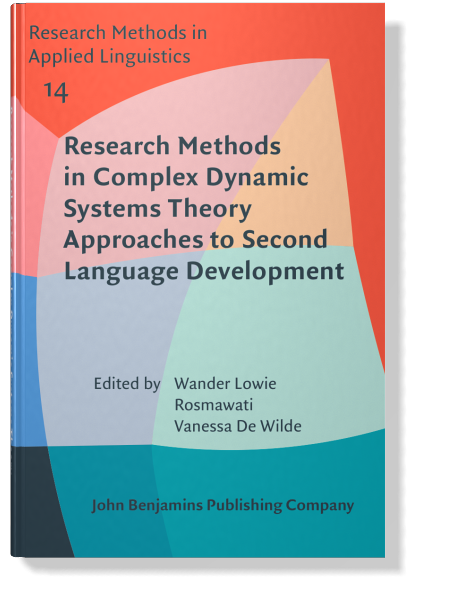
In:Research Methods in Complex Dynamic Systems Theory Approaches to Second Language Development
Edited by Wander Lowie, Rosmawati and Vanessa De Wilde
[Research Methods in Applied Linguistics 14] 2025
► pp. 102–120
Chapter 6Using Granger Causality to investigate causes of change in L2 oral
development
Published online: 11 September 2025
https://doi.org/10.1075/rmal.14.06dew
https://doi.org/10.1075/rmal.14.06dew
Abstract
Complex Dynamic Systems Theory (CDST) approaches to
second language (L2) development have stressed that subsystems of language
are intertwined (De Bot et al.,
2007, Larsen-Freeman,
1997). A key challenge is accurately attributing causal
explanations and determining suitable statistical methods to study
relationships between linguistic processes, features, and forms within the
CDST framework. In this chapter, we propose Granger Causality to investigate
causes of change. This method quantitatively assesses to what extent one
time series is dragging the other along, suggesting that one is causally
prior to the other. We explored how this method can be used to assess
whether certain aspects of linguistic complexity can induce change in
others, thus serving as precursors or supporters in the relationship.
Article outline
- Introduction
- Granger Causality
- Using Granger
Causality in CDST approaches
to second language development - The empirical study
- Method
- Dataset 1
- Context of the study
- Participants
- Tasks and procedures
- Dataset 2
- Context of the study
- Participants
- Tasks and procedures
- Complexity measures
- Analysis
- Dataset 1
- Results
- Discussion of results
- Method
- Affordances and challenges of the method
- Conclusion
Note References

References (50)
Bates, E., Dale, P. S., & Thal, D. (1996). Individual
differences and their implications for theories of language
development. In P. Fletcher & B. MacWhinney (Eds.), The
handbook of child language (1st
ed., pp. 95–151). Wiley.
Bates, E., & Goodman, J. C. (1999). On
the emergence of grammar from
lexicon. In B. MacWhinney (Ed.), The
emergence of
language (pp. 29–80). Lawrence Erlbaum Associates
Berdicevskis, A., Coussé, E., Koplenig, A., & Adesam, Y. (2024). To
drop or not to drop? Predicting the omission of the infinitival
marker in a Swedish future
construction. Corpus Linguistics and
Linguistic
Theory, 20(1), 219–261.
Caspi, T. (2010). A
dynamic perspective on second language
development (Thesis fully internal
(DIV)). University of Groningen.
Caspi, T., & Lowie, W. (2010). A
dynamic perspective on L2 lexical development in academic
English. In R. Chacón-Beltrán, C. Abello-Contesse, & M. D. M. Torreblanca-López (Eds.), Insights
into non-native vocabulary teaching and
learning (Ch.
4., pp. 41–58). Multilingual Matters.
(2013). The
dynamics of L2 vocabulary development: A case study of receptive and
productive knowledge. Revista
Brasileira de Linguística
Aplicada, 13, 437–462.
De Bot, K., Lowie, W., & Verspoor, M. (2007). A
Dynamic Systems Theory approach to second language
acquisition. Bilingualism: Language
and
Cognition, 10(1), 7.
Dewaele, J. M. (2016). Why
do so many bi-and multilinguals feel different when switching
languages? International Journal of
multilingualism, 13(1), 92–105.
De Wilde, V. (2023). Lexical
characteristics of young L2 English learners’ narrative writing at
the start of formal
instruction. Journal of Second
Language
Writing, 59, 100960.
De Wilde, V., Brysbaert, M., & Eyckmans, J. (2020). Learning
English through out-of-school exposure. Which levels of language
proficiency are attained and which types of input are
important? Bilingualism: Language and
Cognition, 23(1), 171–185.
De Wilde, V., & Lowie, W. (2024). The
forest and the trees: Investigating groups and individuals in
longitudinal second language English speaking
development. Language
Learning.
Epskamp, S., Waldorp, L. J., Mõttus, R., & Borsboom, D. (2018). The
Gaussian graphical model in cross-sectional and time-series
data. Multivariate Behavioral
Research, 53(4), 453–480.
Freeborn, L., & Siepe, B. (2025). Unravelling
the dynamics of language learning: Insights from Temporal Network
Analysis. In W. Lowie, Rosmawathi, & V. de Wilde (Eds.), Research
methods in Complex Dynamic Systems Theory approaches to second
language development. John Bejamins. (this
volume)
Furnham, A. (2016). Rerum
cognoscere causas: Dependent and independent variables in
psychology. In R. Harré & F. M. Moghaddam (Eds.), Questioning
causality. Scientific explorations of cause and consequence across
social
contexts (pp. 67–80). Praeger.
Goldschneider, J. M., & DeKeyser, R. M. (2001). Explaining
the “Natural order of L2 morpheme acquisition” in English: A
meta-analysis of multiple
determinants. Language
Learning, 51(1), 1–50.
Granger, C. W. J. (1969). Investigating
causal relations by econometric models and cross-spectral
methods. Econometrica, 37(3), 424.
Havron, N., Raviv, L., & Arnon, I. (2018). Literate
and preliterate children show different learning patterns in an
artificial language learning
task. Journal of Cultural Cognitive
Science, 2(1–2), 21–33.
Hill, A. B. (1965). The
environment and disease: Association or
causation? Proceedings of the Royal
Society of
Medicine, 58(5), 295–300.
Koplenig, A. (2017). Why
the quantitative analysis of diachronic corpora that does not
consider the temporal aspect of time-series can lead to wrong
conclusions. Digital Scholarship in
the
Humanities, 32(1), 159–168.
Koplenig, A., & Müller-Spitzer, C. (2016). Population
size predicts lexical diversity, but so does the mean sea level —
Why it is important to correctly account for the structure of
temporal data. PloS
one, 11(3), e0150771.
Kovelman, I., Baker, S. A. & Petitto, L.–A. (2008). Age
of first bilingual language exposure as a new window into bilingual
reading development. Bilingualism:
Language and
Cognition, 11, 203–223.
Kyle, K. (2016). Measuring
syntactic development in L2 writing: Fine grained indices of
syntactic complexity and usage-based indices of syntactic
sophistication (Doctoral
Dissertation). Georgia State University.
Kyle, K., & Crossley, S. A. (2018). Measuring
syntactic complexity in L2 writing using fine-grained clausal and
phrasal indices. The Modern Language
Journal, 102(2), 333–349.
Kyle, K., Crossley, S. A., & Jarvis, S. (2021). Assessing
the validity of lexical diversity indices using direct
judgements. Language Assessment
Quarterly, 18(2), 154–170.
Larsen-Freeman, D. (1997). Chaos/complexity
science and second language
acquisition. Applied
Linguistics, 18(2), 141–165.
Larsen-Freeman, D., & Cameron, L. (2008). Complex
systems and Applied
Linguistics. Oxford university press.
Lowie, W. M., & Verspoor, M. H. (2019). Individual
differences and the ergodicity
problem. Language
Learning, 69, 184–206.
Marchman, V. A., & Bates, E. (1994). Continuity
in lexical and morphological development: A test of the critical
mass hypothesis. Journal of Child
Language, 21(2), 339–366.
McCarthy, P. M., & Jarvis, S. (2010). MTLD,
vocd-D, and HD-D: A validation study of sophisticated approaches to
lexical diversity
assessment. Behavior Research
Methods, 42(2), 381–392.
Moscoso del Prado, F. (2014). Grammatical
change begins within the word: Causal modeling of the co-evolution
of Icelandic morphology and
syntax. In Proceedings
of the Annual Meeting of the Cognitive Science
Society (Vol. 36, No. 36).
Ortega, L., & Byrnes, H. (2008). Theorizing
advancedness, setting up the longitudinal research
agenda. In L. Ortega & H. Byrnes (Eds.), The
longitudinal study of advanced L2
capacities (pp. 281–299). Routledge
Pfenninger, S. E. (2020). The
dynamic multicausality of age of first bilingual language exposure:
evidence from a longitudinal content and language integrated
learning study with dense time serial
measurements. The Modern Language
Journal, 104(3), 662–686.
Pfenninger, S. E., De Wilde, V., & Kliesch, M. (under
review). The ‘chicken or egg’
causality dilemma in SLA: Evidence from late life language
learning. Manuscript submitted for
publication.
R Core
Team. (2023). R: A
language and environment for statistical
computing (R version 4.3. 1
(2023-06-16)). R Foundation for Statistical Computing.
Rosemeyer, M., & Van de Velde, F. (2021). On
cause and correlation in language change: Word order and clefting in
Brazilian Portuguese. Language
Dynamics and
Change, 11(1), 130–166.
Schumann, J. H. (2015). Foreword. In Z. Dörnyei, P. MacIntyre, & A. Henry (Eds), Motivational
dynamics in language learning (p.
xv-xix). Multilingual Matters.
Sigurðardóttir, Sigríður. (2024). Language
forecasting with focus on variation and change within
Icelandic (Unpublished doctoral
dissertation). Yale University.
Thelen, E. (2005). Dynamic
Systems Theory and the complexity of
change. Psychoanalytic
Dialogues, 15(2), 255–283.
Thelen, E., & Smith, L. B. (1994). A
dynamic systems approach to the development of cognition and
action. The MIT Press.
Thurman, W. N., & Fisher, M. E. (1988). Chickens,
eggs, and causality, or which came
first? American Journal of
Agricultural
Economics, 70(2), 237–238.
Van de Velde, F., & Petré, P. (2020). Historical
linguistics. In S. Adolphsis (Ed.), The
Routledge handbook of English language and digital
humanities (pp. 328–359). Routledge.
Van den Bergh, H., & Evers–Vermeul, J. (2017). Validity
issues in longitudinal
research. In J. Evers–Vermeul & E. Tribushinina (Eds.), Usage-based
approaches to language acquisition and language
teaching (pp. 97–116). De Gruyter Mouton.
Van Dijk, M., Lowie, W., Smit, N., Verspoor, M., & van Geert, P. (2024). Complex
Dynamic Systems Theory as a foundation for process-oriented research
on second language
development. Second Language
Research.
Van Dijk, M., Verspoor, M. H., & Lowie, W. M. (2011). Variability
analyses in language
development. In A
dynamic approach to second language development: Methods and
techniques (pp. 55–84). John Benjamins.
Van Geert, P. (1991). A
dynamic systems model of cognitive and language
growth. Psychological
Review, 98(1), 3.
Van Geert, P., & Verspoor, M. (2015). Dynamic
systems and language
development. In B. MacWhinney & W. O’Grady (Eds.), The
handbook of language
emergence. (pp. 537–556). Wiley-Blackwell.
Verspoor, M., Schmid, M. S., & Xu, X. (2012). A
dynamic usage based perspective on L2
writing. Journal of Second Language
Writing, 21(3), 239–263.
Verspoor, M., & Smiskova, H. (2012). Foreign
language development from a dynamic usage-based
perspective. In R. M. Manchón (Ed.), L2
writing development: Multiple
perspectives (pp. 17–46). Walter de Gruyter.
Yu, H., & Lowie, W. (2020). Dynamic
paths of complexity and accuracy in second language speech: a
longitudinal case study of Chinese
learners. Applied
Linguistics, 41(6), 855–877.
Zeileis, A., & Hothorn, T. (2002). Diagnostic
checking in regression
relationships. R
News 2(3): 7–10. [URL]