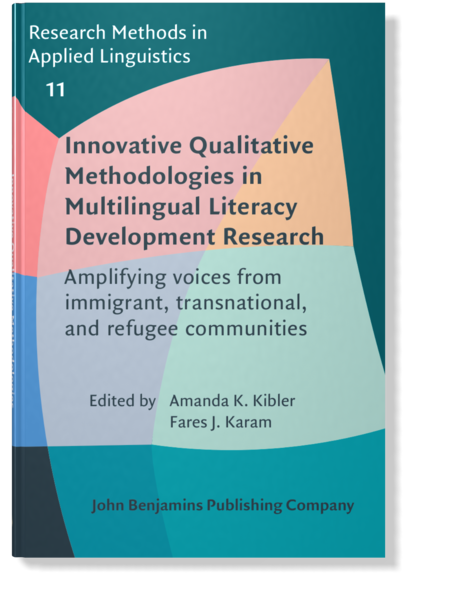
In:Innovative Qualitative Methodologies in Multilingual Literacy Development Research: Amplifying voices from immigrant, transnational, and refugee communities
Edited by Amanda K. Kibler and Fares J. Karam
[Research Methods in Applied Linguistics 11] 2025
► pp. v–vi
Published online: 7 April 2025
https://doi.org/10.1075/rmal.11.toc
https://doi.org/10.1075/rmal.11.toc
Table of contents
List of contributors
vii
Chapter 1.Introduction: Innovative paths in researching multilingual literacy development: Rethinking data, theory, and positionality
1
Amanda K. Kibler
Fares J. Karam
Part 1.Challenges and affordances of qualitative methodological approaches
Rethinking “data” in qualitative research on multilingual literacy 23Chapter 2.Rethinking qualitative meta-syntheses in literacy studies: Critical questions
24
Maneka D. Brooks
Chapter 3.An ethnetnography of (non)belonging: The transliterate practices of a Muslim refugee-background mother
45
Fares J. Karam
Amanda K. Kibler
Chapter 4.Communicating selves: Immigrant, emergent multilingual students’ voices and agency through their multimodal artworks
67
Hsiao-Chin Kuo
Sanela Sprečić
Chapter 5.Commentary: The instability of ‘data’ in a postdigital era: Key challenges for qualitative multilingual researchers
92
Amy Stornaiuolo
Part 2.Challenges and affordances of qualitative methodological approaches
Rethinking “theory” in qualitative research on multilingual literacy 101Chapter 6.Korean American children’s voices in translanguaging
play-based family literacy (PBFL) through the Suda (수다) approach 102
play-based family literacy (PBFL) through the Suda (수다) approach 102
Jinhee Kim
Su-Jeong Wee
Sohyun Meacham
Chapter 7.Bridging language and STEM: Using an Anzalduan framework to center Latinx elementary and middle school students’
understanding of robotics
125
Rachel Salas
Lizeth I. Lizárraga Dueñas
Chapter 8.Families’ literacies of (in)visibility: Methodological approaches to understanding precarity without culpability
149
Melissa Adams Corral
Sarah Gallo
Chapter 9.Commentary: Advancing theory through multilingual literacy qualitative research
171
Jim McKinley
Part 3.Interrogating research practices
New explorations of positionality in research on multilingual literacy development 183Chapter 10.Embodied reflexivity and researching the literacy practices of an adolescent multilingual refugee who is
d/Deaf/Hard-of-Hearing
184
Liv Dávila
Chapter 11.Exploring the ‘void’ of silent/ced knowledge and expertise of multilingual learners
206
Diana J. Arya
Fátima Andrade Martinez
Valerie Meier
Andrew Maul
Chapter 12.Critical collaborative autoethnography
232
M. Sidury Christiansen
Zhongfeng Tian
Chapter 13.Commentary: Challenging extractive epistemologies through positionalities of relation and community accountability
253
María Paula Ghiso
Chapter 14.Conclusion: Innovative research on multilingual literacy development: New directions for methodology
261
Amanda K. Kibler
Fares J. Karam
Index
265
