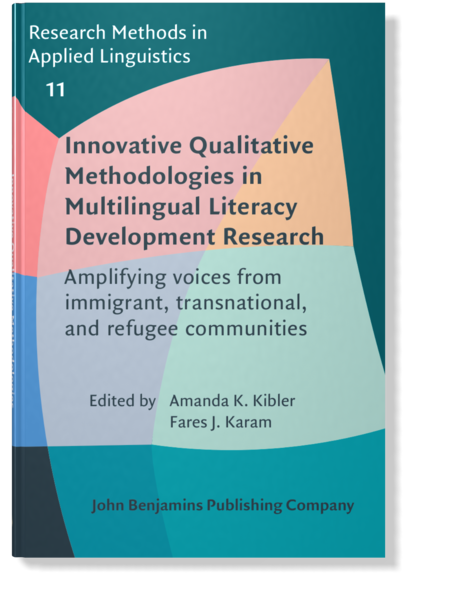
In:Innovative Qualitative Methodologies in Multilingual Literacy Development Research: Amplifying voices from immigrant, transnational, and refugee communities
Edited by Amanda K. Kibler and Fares J. Karam
[Research Methods in Applied Linguistics 11] 2025
► pp. 149–170
Chapter 8Families’ literacies of (in)visibilty
Methodological approaches to understanding precarity without culpability
Published online: 7 April 2025
https://doi.org/10.1075/rmal.11.08cor
https://doi.org/10.1075/rmal.11.08cor
Abstract
In our ethnographic research with mixed-status transborder families who had relocated from the U.S. to
parents’ hometowns in México, we have sought to better understand what we term transborder literacies of
(in)visibility, or diasporic people’s innovative interactions around texts that prepare them to move
across incompatible, racializing mononational institutions divided by borders (Gallo & Adams Corral, 2023). In this chapter we adopt a transborder literacies of (in)visibility
framework to trouble and unpack our research methodologies. We turn this lens to our research practices to better
understand instances where transborder families’ actions challenged us as researchers to think through the colonial
roots of our own literacies and thinking.
Keywords: transborder, colonialism, undocumentedness, families, reflexivity, immigration, literacies
Article outline
- Introduction
- Confronting colonial logics
- Extending reflexivity
- Overview of the study and its findings
- Beginning with a transborder lens
- Transborder literacies of (in)visibility
- Our research studies
- Reflexivity in dialogue
- Beginning with a transborder lens
- Methodological discussion: Rethinking theory for more equitable research
- Un-documenting transborder subalternity
- What we don’t write in our field notes
- Siempre hay una raíz
- Centering transborder knowledges, challenging colonial logics
- Mis(sed) deliveries
- Navigating institutions and shifting (in)visibility practices
- Un-documenting transborder subalternity
- Implications for qualitative research on multilingual literacy
development
- Researcher literacies of subalternities
Notes References

References (44)
Adams Corral, M., & Krause, G. (2022). “How
do I work with my newcomer students?”: Labels and their implications for
teaching [Webinar]. TODOS: Mathematics for All.
Adams Corral, M., Krause, G. H., & Maldonado Rodríguez, L. (2024). “Va
a cambiar”-identifying and rejecting border patrol pedagogies in a Dual Language
Classroom. Journal of Latinos and
Education, 23(3), 1186–1204.
Beltrán, C. (2020). Cruelty
as citizenship: How migrant suffering sustains white democracy. University of Minnesota Press.
Berg, L. A., & Carranza, M. (2018). Organized
criminal violence and territorial control: Evidence from northern
Honduras. Journal of Peace
Research, 55(5), 566–581.
Cervantes-Soon, C., & Carrillo, J. (2016). Toward
a pedagogy of border thinking: Building on Latin@ students’ subaltern
knowledge. The High School
Journa,l 99(4), 282–301.
Charles, J., & Iglesias, J. A. (2022,
July 1). Haiti’s brain drain: Educated youth are leaving the country as fast as
they can. The Miami Herald. Retrieved on 17 November
2024 from [URL]
Chavez, M. S. (2012). Autoethnography,
a Chicana’s methodological research tool: The role of storytelling for those who have no choice but to do
critical race theory. Equity & Excellence in
Education, 45(2), 334–348.
del Bosque, M. (2023,
February 8). Facial recognition bias frustrates black asylum applicants to us,
advocates say. The Guardian. Retrieved on 17 November
2024 from [URL]
Dolmage, J. T. (2018). Disabled
upon arrival: Eugenics, immigration, and the construction of race and
disability. The Ohio State University Press.
Dyrness, A., & Sepúlveda III, E. (2020). Border
thinking: Latinx youth decolonizing citizenship. University of Minnesota Press.
Emerson, R. M., Fretz, R. I., & Shaw, L. L. (2011). Writing
ethnographic fieldnotes. University of Chicago press.
Gallo, S. (2017). Mi
padre: Mexican immigrant fathers and their children’s education. Teachers College Press.
Gallo, S., & Adams Corral, M. (2023). Transborder
literacies of (in)visibility. Journal of Literacy
Research, 55(1), 101–123.
Jackson, A. Y., & Mazzei, L. (2012). Thinking
with theory in qualitative research: Viewing data across multiple
perspectives. Routledge.
Jaffe-Walter, R. (2020). Into
the breakdown: Embracing ethnographic confusion in challenging nationalist policy
truths. International Journal of Qualitative Studies in
Education, 33(2), 166–173.
Kirkland, D. (2014). Why
I study culture and why it matters: Humanizing ethnographies in social science
research. In D. Paris & M. Winn (Eds.), Humanizing
research: Decolonizing qualitative inquiry with youth and
communities (pp. 179–200). Sage.
Loperena, C. A. (2017). Settler
violence? Race and emergent frontiers of progress in Honduras. American
Quarterly, 69(4), 801–807.
Lugo, A. (2008). Fragmented
lives, assembled parts: Culture, capitalism, and conquest at the U.S.-México
border. University of Texas Press.
Mao, L., Mian Akram, A., Chovanec, D., & Underwood, M. L. (2016). Embracing
the spiral: Researcher reflexivity in diverse critical
methodologies. International Journal of Qualitative
Methods, 15(1), 1609406916681005.
McDevitt, S. E. (2021). “Don’t
be afraid”: Exploring methodological relationships in (re) searching the experiences of immigrant teachers of
color. Multicultural
Perspectives, 23(1), 40–47.
Meko, H. (2022,
November 3). Migrants encounter ‘chaos and confusion’ in New York immigration
courts. The New York Times. Retrieved on 17 November
2024 from [URL]
Mignolo, W. (2000). Local
histories/global designs: Coloniality, subaltern knowledges, and border
thinking. Princeton University Press.
Minian, A. R. (2018). Undocumented
lives: The untold story of Mexican migration. Harvard University Press.
Moses, R., & Cobb, C. E. (2001). Radical
equations: Civil rights from Mississippi to the Algebra Project. Beacon Press.
Mullen, L. (2018,
June 15). The fight to define Romans 13. The
Atlantic. Retrieved on 17 November 2024 from [URL]
Obinna, D. N. (2021). Seeking
sanctuary: Violence against women in El Salvador, Honduras, and
Guatemala. Violence Against
Women, 27(6–7), 806–827.
Oliveira, G. & Gallo, S. (2023). “I
have a story for you: Im/migrant children’s politicized funds of knowledge and the role of the
researcher. International Journal of Qualitative Studies in
Education, 36(10), 1966–1980.
Paris, D., & Winn, M. T. (Eds.). (2014). Humanizing
research: Decolonizing qualitative inquiry with youth and
communities. Sage.
Peña-Pincheira, R. S., & Allweiss, A. (2022). Counter-pedagogies
of cruelty across Abya Yala: A move with otherwise
present-futurities. Educational
Studies, 58(5–6), 581–595.
Perez, M. J., & Salter, P. S. (2019). Trust,
innocence, and individual responsibility: Neoliberal dreams of a colorblind
peace. Journal of Social
Issues, 75(1), 267–285.
Pyles, L. (2021). Progressive
community organizing: Reflective practice in a globalizing
world. Routledge.
Rivera, L. G. (2013). Territories
of violence: State, marginal youth, and public security in
Honduras. Springer.
Rose, J. (2022,
September 7). After Del Rio, some Haitian migrants found safety in the U.S. But many
have not [Radio
broadcast]. NPR: Morning Edition. Retrieved on 17 November 2024 from [URL]
Sandoval, E. (2022,
December 27). At a crowded border camp in México, frustration and shattered
hopes. The New York Times. Retrieved on 17
November 2024 from [URL]
U.S. Citizenship and Immigration Services
(U.S.CIS). (2022). Humanitarian or Significant Public Benefit
Parole for Individuals Outside the U.S. Retrieved on 17 November 2024
from [URL]