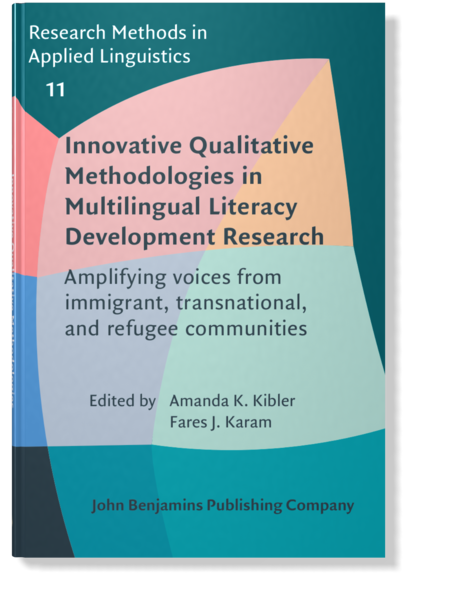
In:Innovative Qualitative Methodologies in Multilingual Literacy Development Research: Amplifying voices from immigrant, transnational, and refugee communities
Edited by Amanda K. Kibler and Fares J. Karam
[Research Methods in Applied Linguistics 11] 2025
► pp. 1–21
Chapter 1Introduction: Innovative paths in researching multilingual literacy development
Rethinking data, theory, and positionality
Published online: 7 April 2025
https://doi.org/10.1075/rmal.11.01kib
https://doi.org/10.1075/rmal.11.01kib
Abstract
In this introductory chapter to the volume, Innovative Qualitative Methodologies in Multilingual Literacy
Development Research: Amplifying Voices from Immigrant, Transnational, and Refugee Communities, we situate the
key aims of the collection in the context of conceptual innovations in multilingualism, literacy, and equity. To unlock the
full potential of these recent developments, innovative rethinking of methodological approaches is needed to keep pushing the
boundaries of our understanding of multilingual literacy development and to further our ethical commitments to humanizing
research. We describe selected recent empirical studies in which qualitative literacy researchers have begun to “rethink”
data, theory, and positionality in their work before presenting an overview of the contributions in this volume.
Keywords: qualitative research, literacy, multilingual, methodology, innovation, equity
Article outline
- Introduction
- Resituating concepts in multilingual literacy development
- Resituating equity in multilingual literacy development
- Resituating research on multilingual literacy development
- Rethinking data
- Rethinking theory
- Rethinking positionality
- Overview of chapters in the volume
References

References (98)
Abril-Gonzalez, P. (2020). Accompanying
a nepantlera border artist’s empathy: One Mexican teen’s testimonios of healing, empowerment, and
transformation. Journal of Adolescent & Adult
Literacy, 64(3), 271–280.
Androutsopoulos, J. (2020). Trans-scripting
as a multilingual practice: The case of Hellenised English. International Journal of
Multilingualism, 17(3), 286–308.
Arlander, A. (2017). Data,
material, remains. In M. Koro-Ljungberg, T. Löytönen, & M. Tesar (Eds.), Disrupting
data in qualitative inquiry: Entanglements with the post-critical and
post-anthropocentric (pp. 173–184). Peter Lang.
Ayoub, A., & Omidire, M. F. (2021). Storyboards
as a qualitative method of exploring learners’ experience with the use of a multilingual support
strategy. International Journal of Qualitative
Methods, 20.
Bacon, C. K. (2017). Multilanguage,
multipurpose: A literature review, synthesis, and framework for critical literacies in English language
teaching. Journal of Literacy
Research, 49(3), 424–453.
Baker, S., & Scott, J. (2016). Sociocultural
and academic considerations for school-age d/deaf and hard of hearing multilingual learners: A case study of a deaf
Latina. American Annals of the
Deaf 161(1), 43–55.
Barton, D., & Hamilton, M. (2000). Literacy
practices. In D. Barton, M. Hamilton, & R. Ivanič (Eds.), Situated
literacies: Reading and writing in
context (pp. 7–15). Routledge.
Bloome, D., Power Carter, S., Christian, B. M., Otto, S., & Shuart-Faris, N. (2010). Discourse
analysis and the study of classroom language and literacy events: A microethnographic
perspective. Routledge.
Burns, A., & McPherson, P. (2017). Action
research as iterative design: Implications for English language education
research. In S. A. Mirhosseini (Ed.), Reflections
on qualitative research in language and literacy
education (pp. 105-120). Springer.
Canagarajah, A. S. (2017). Introduction:
The nexus of migration and language: The emergence of a disciplinary
space. In S. A. Canagarajah (Ed.), The
Routledge handbook of migration and
language (pp. 1–28). Routledge.
Carr, D. (2005). Making
sense of education: An introduction to the philosophy and theory of education and
teaching. Routledge.
Chávez-Moreno, L. C. (2022). Critiquing
racial literacy: Presenting a continuum of racial literacies. Educational
Researcher, 51(7), 481–488.
Compton-Lilly, C. F., Rogers, R. L., & Lewis Ellison, T. (2019). A
meta-ethnography of family literacy scholarship: Ways with metaphors and
silence. Reading Research
Quarterly, 55(2), 271–289.
Cook, G. (2015). Birds
out of dinosaurs: The death and life of applied linguistics. Applied
Linguistics, 36, 425–433.
Cope, B. & Kalantzis, M. (2023). Multiliteracies:
A literature review. In C. G. Zapata, M. Kalantzis, & B. Cope (Eds.), Multiliteracies
in international educational contexts. Routledge.
Coyle, Y., & Roca de Larios, J. (2023). Exploring
children’s L2 disciplinary literacy through a multimodal science project in a CLIL
context. TESOL
Quarterly,58(2), 628–663.
Creswell, J. W., & Creswell, J. D. (2018). Research
design: Qualitative, quantitative, and mixed methods approaches. (5th
ed.) Sage.
de los Ríos, C. V., & Molina, A. (2020). Literacies
of refuge: “Pidiendo posada” as ritual of justice. Journal of Literacy
Research, 52(1), 32–54.
de los Ríos, C. V., & Patel, L. (2023). Positions,
positionality, and relationality in educational research. International Journal of
Qualitative Studies in Education, 1–12.
Deliovsky, K. (2017). Whiteness
in the qualitative research setting: Critical skepticism, radical reflexivity and anti-racist
feminism. Journal of Critical Race
Inquiry, 4(1), 1–24.
D’warte, J. (2014). Exploring
linguistic repertoires: Multiple language use and multimodal literacy activity in five
classrooms. The Australian Journal of Language and
Literacy, 37(1), 21–30.
Ehret, C., & Hollett, T. (2014). Embodied
composition in real virtualities: Adolescents’ literacy practices and felt experiences moving with digital, mobile
devices in school. Research in the Teaching of
English, 48(4), 428–452. [URL].
Fasavalu, T. I., & Reynolds, M. (2019). Relational
positionality and a learning disposition: Shifting the conversation. The International
Education Journal: Comparative
Perspectives, 18(2), 11–25. [URL]
Gao, J., Pham, Q. H. P., & Polio, C. (2022). The
role of theory in quantitative and qualitative second language learning research: A corpus-based
analysis. Research Methods in Applied
Linguistics, 1(2), 100006.
García, O., & Li Wei.
(2014). Translanguaging, bilingualism, and bilingual
education. Palgrave Macmillan.
García-Fernández, C. (2023) Shattering
deaf and hearing dualism through a Deaf-Latinx epistemology lens, International Journal
of Qualitative Studies in
Education, 36(1), 72-86.
González Ybarra, M., & Saavedra, C. M. (2021). Excavating
embodied literacies through a Chicana/Latina feminist framework. Journal of Literacy
Research, 53(1), 100–121.
Hackett, A., MacLure, M., & Pahl, K. (2020). Literacy
and language as material practices: Re-thinking social inequality in young children’s
literacies. Journal of Early Childhood
Literacy, 20(1), 3–12.
Handsfield, L. J. (2015). Literacy
theory as practice: Connecting theory and instruction in K–12 classrooms. Teachers College Press.
Hawkins, M. R., & Mori, J. (2018). considering
‘trans-’ perspectives in language theories and practices, Applied
Linguistics, 39(1), 1–8.
Holmes, A. G. D. (2020). Researcher
positionality – A consideration of its influence and place in qualitative research – A new researcher
guide. Shanlax International Journal of
Education, 8(4), 1–10.
Hull, G. A., & Stornaiuolo, A. (2014). Cosmopolitan
literacies, social networks, and “proper distance”: Striving to understand in a global
world. Curriculum
Inquiry, 44(1), 15–44.
Hunt, C. S., Crumpler, T. P., & Handsfield, L. J. (2016). “Do
you want an idea of what they’re doing?” Transgressive data generation and analysis within a bilingual writers
workshop. International Journal of Qualitative Studies in
Education, 29(3), 399–425.
Ibrahim, N. C. (2022). Visual
and artefactual approaches in engaging teachers with multilingualism: Creating DLCs in pre-service teacher
education. Languages, 7(2), 152.
Iida, A., & Chamcharatsri, B. (2022) Emotions
in second language poetry writing: A poetic inquiry into Japanese EFL students’ language learning
experiences. Innovation in Language Learning and
Teaching, 16(1), 53–66.
Ilomäki, L., Lakkala, M., Kallunki, V., Mundy, D., Romero, M., Romeu, T., & Gouseti, A. (2023). Critical
digital literacies at school level: A systematic review. Review of
Education, 11(3).
Jackson, A. Y., & Mazzei, L. A. (2012). Thinking
with theory in qualitative research: Viewing data across multiple
perspectives. Routledge.
Jewitt, C. (2008). Multimodality
and literacy in school classrooms. Review of Research in
Education, 32(1), 241–267.
Karam, F. J. (2021). Writing
the story of Sabadullah: Transnational literacies of two refugee-background
parents. In D. Warriner (Ed.), Refugee
education across the lifespan: Mapping experiences of language learning and
use (pp. 231–250). Springer.
Karam, F. J., Oikonomidoy, E., & Kibler, A. K. (2021). Artifactual
literacies and TESOL: Narratives of a Syrian refugee-background family. TESOL
Quarterly, 55(2), 510–535.
Kedley, K. E. (2022) The
illegible and illiterate researcher in Honduras: Research in a transnational setting as a queer from the Global
North, International Journal of Qualitative Studies in
Education, 35(9), 1007-1021,
Keles, U. (2022). Autoethnography
as a recent methodology in applied linguistics: A methodological review. The
Qualitative
Report, 27(2), 448–474.
Kessler, M. (2024). Digital
multimodal composing: Connecting theory, research, and practice in second language
acquisition. Multilingual Matters.
Kibler, A. K. (2019). Longitudinal
interactional histories: Bilingual and biliterate journeys of Mexican immigrant-origin
youth. Palgrave Macmillan.
Kim, M. S. (2014). The
multi-literacy development of a young trilingual child: Four leading literacy activities from birth to age
six. European Early Childhood Education Research
Journal, 22(2), 154–168.
Kim, K. M., & Park, G. (2020). “It
is more expressive for me”: A translingual approach to meaningful literacy instruction through sijo
poetry. TESOL
Quarterly, 54(2), 281–309.
Kiramba, L. K. (2017). Multilingual
literacies: Invisible representation of literacy in a rural classroom. Journal of
Adolescent & Adult
Literacy, 61(3), 267–277.
Kramsch, C. (2015). Applied
linguistics: A theory of the practice. Applied
Linguistics, 36, 454–465.
Lee, C. C., Falter, M. M., & Schoonover, N. R. (2021). Encountering
the affective in Latino immigrant youth narratives. Reading Research
Quarterly, 56(2), 273–292.
Leonelli, S. (2015). What
counts as scientific data? A relational framework. Philosophy of
Science, 82(5), 810–821.
Leung, C., & Valdés, G. (2019). Translanguaging
and the transdisciplinary framework for language teaching and learning in a multilingual
world. The Modern Language
Journal, 103(2), 348–370. [URL].
Little, S. (2024). Rivers
of multilingual reading: exploring biliteracy experiences among 8–13-year old heritage language
readers. Journal of Multilingual and Multicultural
Development, 45(2), 323–336.
MacSwan, J. (2017). A
multilingual perspective on translanguaging. American Educational Research
Journal, 54(1), 167–201.
Marshall, S., & Moore, D. (2018). Plurilingualism
amid the panoply of lingualisms: Addressing critiques and misconceptions in
education. International Journal of
Multilingualism, 15(1), 19–34.
Martin, J. P., Desing, R., & Borrego, M. (2022). Positionality
statements are just the tip of the iceberg: Moving towards a reflexive process. Journal
of Women and Minorities in Science and
Engineering, 28(4), v–vii.
Masny, D. (2013). Rhizoanalytic
pathways in qualitative research. Qualitative
Inquiry, 19(5), 339–348.
McKinley, J. (2022). An
argument for globalized L2 writing methodological innovation. Journal of Second
Language Writing, 58.
McNeill, E. (2022). Exploring
global religious traditions through artifactual literacy projects, English Teaching:
Practice & Critique, 21(3).
Mirra, N., & Garcia, A. (2020). In
search of the meaning and purpose of 21st-century literacy learning: A critical review of research and
practice. Reading Research
Quarterly, 56(3), 463–496.
Moses, L., & Kelly, L. B. (2017). The
development of positive literate identities among emerging bilingual and monolingual first
graders. Journal of Literacy
Research, 49(3), 393–423.
New London
Group. (1996). A pedagogy of multiliteracies: Designing social
futures. Harvard Educational
Review, 66(1), 60–93.
Otheguy, R., García, O., & Reid, W. (2015). Clarifying
translanguaging and deconstructing named languages: A perspective from
linguistics. Applied Linguistics
Review, 6(3), 281–307.
(2019). A
translanguaging view of the linguistic system of bilinguals. Applied Linguistics
Review, 10(4), 625–651.
Pahl, K., & Rowsell, J. (2010). Artifactual
literacies: Every object tells a story. Teachers College Press.
Palaganas, E., Sanchez, M., Molintas, Ma. V., & Caricativo, R. (2017). Reflexivity
in qualitative research: A journey of learning. The Qualitative
Report, 22(2), 426–438.
Paris, D., & Winn, M. T. (2014). Humanizing
research: Decolonizing qualitative inquiry with youth and
communities. Sage.
Poveda, D., Giampapa, F., & Relaño-Pastor, A. M. (2020). Gatekeeping
the interactional order: field access and linguistic ideologies in Content and Language Integrated Learning–type
bilingual education programs in Spanish secondary schools. Qualitative
Research, 20(6), 854–873.
Purcell-Gates, V., Perry, K. H., & Briseño, A. (2011). Analyzing
literacy practice: Grounded theory to model. Research in the Teaching of
English, 45(4), 439–458. [URL].
Rose, H. (2019). Dismantling
the ivory tower in TESOL: A renewed call for teaching-informed research. TESOL
Quarterly, 53(3), 895–905.
Rowsell, J., & Pahl, K. (2020). What
is living literacies? In K. Pahl, J. Rowsell, D. Collier, S. Pool, Z. Rasool, & T. Trzecak (Eds.), Living
literacies: Literacy for social
change (p. 1–16). The MIT Press.
Ruecker, T. (2017). Stranger
in a strange land: Conducting qualitative literacy research across
contexts. In S. A. Mirhosseini (Ed.), Reflections
on qualitative research in language and literacy
education (pp. 45-57). Springer.
Secules, S., McCall, C., Mejia, J. A., Beebe, C., Masters, A. S., L. Sánchez-Peña, M., & Svyantek, M. (2021). Positionality
practices and dimensions of impact on equity research: A collaborative inquiry and call to the
community. Journal of Engineering
Education, 110(1), 19–43.
Shanahan, C., & Shanahan, T. (2017). Disciplinary
literacy. In D. Fischer & D. Lapp (Eds.), Handbook
of research on teaching the language arts. Routledge.
Smith, B. E., Pacheco, M. B., & Khorosheva, M. (2020). Emergent
bilingual students and digital multimodal composition: A systematic review of research in secondary
classrooms. Reading Research
Quarterly, 56(1), 33–52.
Stewart, M. A., & Babino, A. (2022). Enacting
resistance literacies through languaging and advocacy: Intergenerational testimonios to inform literacy research and
instruction. Literacy Research and
Instruction, 61(4), 361–382.
Stornaiuolo, A., Smith, A., & Phillips, N. C. (2017). Developing
a transliteracies framework for a connected world. Journal of Literacy
Research, 49(1), 68–91.
St. Pierre, E. A. (2013). The
appearance of data. Cultural Studies ↔ Critical
Methodologies, 13(4), 223–227.
St. Pierre, E. A., & Jackson, A. Y. (2014). Qualitative
data analysis after coding. Qualitative
Inquiry, 20(6), 715–719.
Street, B. (2003). What’s
“new” in new literacy studies? Critical approaches to literacy in theory and
practice. Current Issues in Comparative
Education, 5(2), 77–91.
Sybing, R. (2022). Dead
reckoning: A framework for analyzing positionality statements in ethnographic research
reporting. Written
Communication, 39(4), 757–789.
Truman, S. E., Hackett, A., Pahl, K., McLean Davies, L., & Escott, H. (2020). The
capaciousness of no: Affective refusals as literacy practices. Reading Research
Quarterly, 56(2), 223–236.
Van Wingerden, E. (2022). Unmastering
research: Positionality and intercorporeal vulnerability in international
studies. International Political
Sociology, 16(2).
Vieira, K. (2016). Writing
remittances: Migration-driven literacy learning in a Brazilian homeland. Research in
the Teaching of
English, 50(4), 422–449. [URL].
Vu, V., Warschauer, M., & Yim, S. (2019). Digital
storytelling: A district initiative for academic literacy improvement. Journal of
Adolescent & Adult
Literacy, 63(3), 257–267.
Wandera, D. B. (2020). Resisting
Epistemic blackout: Illustrating Afrocentric methodology in a Kenyan classroom. Reading
Research
Quarterly, 55(4), 643–662.
Wargo, J. M. (2020). Between
an iPhone and a safe space: tracing desire in connective (auto)ethnographic research with LGBTQ youth, International
Journal of Qualitative Studies in
Education, 33(5,) 508-523.
Wei, L., Tsang, A., Wong, N., & Lok, P. (2020). Kongish
Daily: Researching translanguaging creativity and
subversiveness. International Journal of
Multilingualism, 17(3), 309–335.
West, G. B., & Crookes, G. (2017). Critical
practitioner research in language education under difficult
circumstances. In S. A. Mirhosseini (Ed.), Reflections
on qualitative research in language and literacy
education (pp. 139-155). Springer.
Wynter-Hoyte, K., & Smith, M. (2020). “Hey,
Black child. Do you know who you are?” Using African diaspora literacy to humanize Blackness in early childhood
education. Journal of Literacy
Research, 52(4), 406–431.