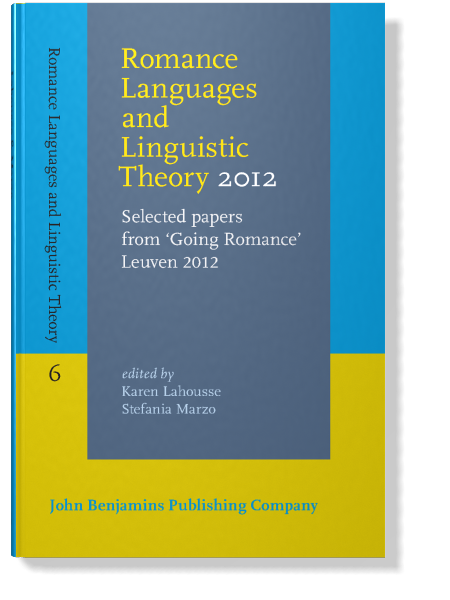
In:Romance Languages and Linguistic Theory 2012: Selected papers from 'Going Romance' Leuven 2012
Edited by Karen Lahousse and Stefania Marzo
[Romance Languages and Linguistic Theory 6] 2014
► pp. 161–180
(Pseudo-)Inflected infinitives and Control as Agree
Published online: 18 December 2014
https://doi.org/10.1075/rllt.6.08gon
https://doi.org/10.1075/rllt.6.08gon
This paper discusses the distribution of inflected infinitives in standard and non-standard European Portuguese. In the standard variety, inflected infinitives are generally available in non-obligatory control contexts, but can only occur in obligatory control contexts when the temporal orientation of the complement is not specified by the matrix verb. An explanation for this fact is offered along the lines of an Agree theory of control. This analysis also accounts for the possibility of controlled inflected infinitives, which bear morphological inflection but which cannot license nominative, occurring in non-standard varieties of European Portuguese: they are considered the result of the spell out of the Agree operation that takes place in control contexts.

References (19)
Ambar, Manuela. 2007. “Verb Movement and Tense – EPP and T-Completeness.” In Proceedings of the XXXII Incontro di Grammatica Generativa, ed. by M. Cecilia Picchi, and Alan Pona, 1-20. Alessandria: Edizioni dell’Orso.
Ambar, Manuela, Esmeralda Negrão, Rita Veloso, and Luís Graça. 2009. “Tense Domains in BP and EP – vP, CP and phases.” In Romance Languages and Linguistic Theory 2007, ed. by Enoch O. Aboh, Elisabeth van der Linden, Josep Quer, and Petra Sleeman, 1-24. Amsterdam: John Benjamins.
Chomsky, Noam. 2000. “Minimalist Inquiries.” In Step by Step: Essays on Minimalst Syntax in Honour of Howard Lasnik, ed. by Roger Martin, David Michaels, and Juan Uriagereka, 89-155. Cambridge, Mass.: The MIT Press.
. 2008. “On Phases.” In Foundational Issues in Linguistic Theory, ed. by Robert Freidin, Carlos P. Otero, and Maria-Luisa Zubizarreta, 133-166. Cambridge, MA: The MIT Press.
Cunha, Luís F., and Purificação Silvano. 2006. “A interpretação temporal dos infinitivos em orações completivas de verbo.” In Textos Seleccionados do XXI Encontro Nacional da Associação Portuguesa de Linguística, ed. by Fátima Oliveira, and Joaquim Barbosa, 303-314. Lisboa: APL.
Duarte, Inês, Anabela Gonçalves, and Ana Lúcia Santos. 2012. “Infinitivo flexionado, independência temporal e controlo.” In Textos Selecionados. XXVII Encontro Nacional da Associação Portuguesa de Linguística, ed. by Armanda Costa, Cristina Flores, and Nélia Alexandre. Lisboa: APL.
Gonçalves, Anabela. 1999. Predicados complexos verbais em contextos de infinitivo não preposicionado do Português Europeu. PhD thesis, University of Lisbon.
Gonçalves, Anabela, Luís F. Cunha, and Purificação Silvano. 2010. “Interpretação temporal dos domínios infinitivos na construção de reestruturação do Português Europeu.” In Textos Seleccionados do XXV Encontro Nacional da Associação Portuguesa de Linguística, ed. by Ana M. Brito, Fátima Silva, João Veloso, and Alexandra Fiéis, 435-447. Lisboa: APL.
Kamp, Hans, and Uwe Reyle. 1993. From Discourse to Logic: Introduction to Modeltheoretic Semantics of Natural Language, Formal Logic and Discourse Representation Theory. Dordrecht: Kluwer.
Krapova, Iliyana, and Vassil Petkov. 1999. “Subjunctive complements, null subjects and Case checking in Bulgarian.” In Proceedings of the 7th Meting of Formal Approaches to Slavic Linguistics, ed. by Dziwirek Katarzyna, Herbert Coats, and Cynthia M. Vakareliyska, 267-285. Ann Arbor: University of Michigan.
Landau, Idan. 2000. Elements of Control. Structure and Meaning in Infinitival Constructions. Dordrecht: Kluwer.
. 2004. “The Scale of Finiteness and the Calculus of Control.” Natural Language & Linguistic Theory 22 (4): 811-877.
Modesto, Marcello. 2010. “What Brazilian Portuguese Says About Control: Remarks on Boeckx and Hornstein.” Syntax 13 (1): 78-96.
. 2011. “Infinitivos flexionados em Português Brasileiro e sua relevância para a Teoria do Controle.” In Estudos da Linguagem, Casamento entre Temas e Perspectivas, ed. by Dermeval da Hora, and Esmeralda Negrão, 63-87. João Pessoa: Idéia.
Raposo, Eduardo. 1987. “Case Theory and Infl-to-Comp: The Inflected Infinitive in European Portuguese.” Linguistic Inquiry 18 (1): 85–109.
Sheehan, Michelle. 2012. “A New Take on Partial Control: Defective Thematic Intervention.” Occasional Papers in Linguistics 6: 1-47.
Silvano, Purificação. 2002. Sobre a semântica da sequência de tempos em Português Europeu. Análise das relações temporais em frases complexas com completivas. MA Thesis, University of Minho.
Sitaridou, Ioanna. 2006. “The (Dis)Association of Tense, phi-features EPP and Nominative Case: Case Studies from Romance and Greek.” In Studies on Agreement, ed. by João Costa, and M. Cristina Figueiredo Silva, 243-260. Amsterdam: John Benjamins.
Cited by (13)
Cited by 13 other publications
López Otero, Julio César, Abril Jimenez & Gabriel Martínez Vera
Barbosa, Pilar
2021. Alleged obligatorily controlled inflected infinitives. In Non-canonical control in a cross-linguistic perspective [Linguistik Aktuell/Linguistics Today, 270], ► pp. 35 ff.
Cardoso, Aida, Inês Duarte & Ana Lúcia Santos
2021. Infinitival complement clauses. In Romance Languages and Linguistic Theory 2018 [Current Issues in Linguistic Theory, 357], ► pp. 25 ff.
Rivas, Javier & Esther L. Brown
Santos, Ana Lúcia
2021. Some thoughts on (the acquisition of) control. In L1 Acquisition and L2 Learning [Language Acquisition and Language Disorders, 65], ► pp. 83 ff.
Sheehan, Michelle, Martin Schäfer & Maria Carmen Parafita Couto
Duarte, Inês
2018. Comments on complementation in Portuguese. In Complement Clauses in Portuguese [Issues in Hispanic and Lusophone Linguistics, 17], ► pp. 241 ff.
Gonçalves, Anabela & Ana Lúcia Santos
2018. Complement clauses in Portuguese. In Complement Clauses in Portuguese [Issues in Hispanic and Lusophone Linguistics, 17], ► pp. 1 ff.
Martins, Ana Maria
2018. Infinitival complements of causative/perception verbs in a diachronic perspective. In Complement Clauses in Portuguese [Issues in Hispanic and Lusophone Linguistics, 17], ► pp. 101 ff.
Sheehan, Michelle
2018. Control of inflected infinitives in European Portuguese. In Complement Clauses in Portuguese [Issues in Hispanic and Lusophone Linguistics, 17], ► pp. 27 ff.
Ambar, Manuela & Ángel L. Jiménez‐Fernández
This list is based on CrossRef data as of 30 november 2025. Please note that it may not be complete. Sources presented here have been supplied by the respective publishers. Any errors therein should be reported to them.