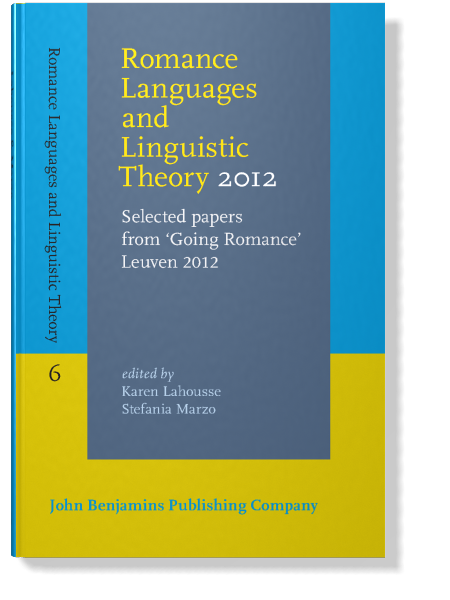
In:Romance Languages and Linguistic Theory 2012: Selected papers from 'Going Romance' Leuven 2012
Edited by Karen Lahousse and Stefania Marzo
[Romance Languages and Linguistic Theory 6] 2014
► pp. 123–140
What lies behind dative/accusative alternations in Romance
Published online: 18 December 2014
https://doi.org/10.1075/rllt.6.06pin
https://doi.org/10.1075/rllt.6.06pin
This paper accounts for dative/accusative alternations in several Romance languages with verbs with one complement of person, such as Catalan telefonar [DAT a la Roser]/telefonar [ACC la Roser] ‘to phone Roser’. Although the paper focuses on Catalan and Spanish, reference is also made to Italian Southern dialects and Asturian. Regardless of their case-marking, these complements are always Goals of unergative verbs: if dative-marked, they behave as expected; if accusative-marked, they instantiate what we call Differential Indirect Object Marking (following Bilous 2011). The two options of case-assignment are due to two different sorts of Low Applicatives, one Romance-like (the dative-assigning one) and the other English-like (the accusative-assigning one). The postulation of an Applicative Head with our apparently unergative verbs follows from analysing them as hidden transitive verbs (light verb + cognate noun).

References (28)
D’Alessandro, Roberta. 2013. “Microvariation and Syntactic Theory. What Dialects Can Tell Us about Language.” Ms,
The Syntactic Variation of Catalan and Spanish Dialects
, Barcelona July 2013.
Andriani, Luigi. 2011. Differential Object marking, Clitic Doubling and Argument Structure in Barese. Research Master Thesis, Leiden University.
Arad, Maya. 1998. VP-structure and the Syntax-Lexicon Interface. PhD Dissertation, University College London.
Bilous, Rostyslav. 2011. Transitivité et marquage d’objet différentiel. PhD Dissertation, University of Toronto.
Blume, Kerstin. 1998. “A Contrastive Analysis of Interaction Verbs with Dative Complements.” Linguistics 36 (2): 253-280.
Cabré, Teresa, and Jaume Mateu. 1998. “Estructura gramatical i normativa lingüística: a propòsit dels verbs psicològics en català.” Quaderns. Revista de Traducció 2: 65-81.
Chung, Sandra. 1978. Case Marking and Grammatical Relations in Polynesian. Austin: University of Texas Press.
. 2003b. “Structural Asymmetries but Same Word Order: the Dative Alternation in Spanish.” In Asymmetry in Grammar. Volume 1: Syntax and semantics, ed. by Anna Maria Di Sciullo, 117-144. Amsterdam: John Benjamins.
Diccionari de l’Institut Catalans. Available at [URL].
DPD = Diccionario Panhispánico de Dudas. Available at [URL].
DRAE = Diccionario de la Lengua Española. Available at [URL].
Fernández, Beatriz, and Jon Ortiz de Urbina. 2009. Datibo alternatiboak hiztegian eta hizkeretan. Ms, Euskararen sintaxia XXVII. Donostiako Uda ikastaroak / XXI Europar ikastaroak, 2009 -ko uztailaren 2-3.
Fournier, David H. 2010. La structure du prédicat verbal: une étude de la construction à double objet en français. PhD Dissertation, University of Toronto.
Hale, Kenneth, and Samuel Jay Keyser. 2002. Prolegomenon to a Theory of Argument Structure. Cambridge: MIT Press.
Jónsson, Jóhannes Gísli. 2010. Dative/Accusative Variation and Event Structure in Icelandic. Ms, 4th European Dialect Syntax Meeting.
Morant, Marc. 2008. L’alternança datiu/acusatiu en la recció verbal catalana. PhD Dissertation, Universitat de València.
NGLE = Real Academia española i Asociación de Academias de la Lengua Española. 2009. Nueva Gramática de la Lengua Española. Madrid: Espasa-Calpe.
Pérez-Saldanya, Manuel. 2004. Gramaticalització i reanàlisi: funció i estructura del canvi sintàctic. Ms, Xarxa Telemàtica de Lingüística Teòrica.
Pineda, Anna. 2013. “Double Object Constructions in Spanish (and Catalan) Revisited.” In Romance Languages and Linguistic Theory 2011, ed. by S. Baauw, F.A.C. Drijkoningen, L. Meroni and M. Pinto, 193-216. Amsterdam: John Benjamins.
Ramos, Joan Rafel. 2005. “El Complement indirecte: l’alternança datiu / acusatiu.” Estudis romànics / publicats a cura de A.M. Badia i Margarit i Joan Veny 27: 94-111.
Svenonius, Peter. 2002. “Icelandic Case and the Structure of Events.” Journal of Comparative Germanic Linguistics 6: 223-245.
Cited by (5)
Cited by five other publications
Amato, Irene
Amato, Irene
Corr, Alice
Pineda, Anna
[no author supplied]
This list is based on CrossRef data as of 30 november 2025. Please note that it may not be complete. Sources presented here have been supplied by the respective publishers. Any errors therein should be reported to them.