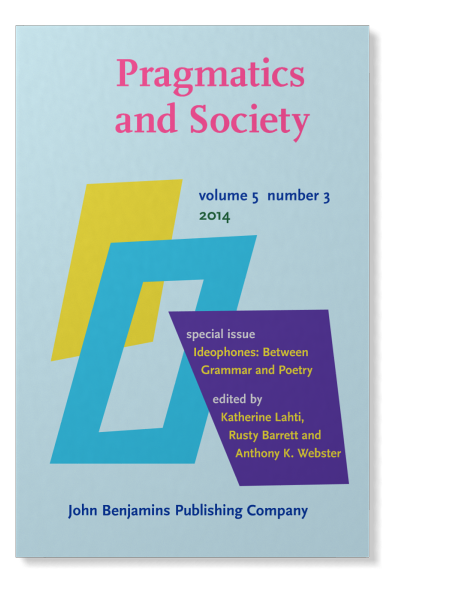
Article published In: Ideophones: Between Grammar and Poetry
Edited by Katherine Lahti, Rusty Barrett and Anthony K. Webster
[Pragmatics and Society 5:3] 2014
► pp. 455–483
Femininity in mixed-sex talk and intercultural communication
Are Japanese women polite and submissive?
Published online: 14 November 2014
https://doi.org/10.1075/ps.5.3.09ita
https://doi.org/10.1075/ps.5.3.09ita
Previous studies of language and gender discuss how men and women use gender-specific conversational styles mainly in relation to English, whereas similar studies for Asian languages remain comparatively few. Moreover, little is known about gender and conversational styles during intercultural communication. This paper explores whether speakers follow similar norms of politeness in mixed-sex talk in their L1 and in intercultural conversations in L2 English, and if femininities are modified, what factors may be involved. It reports findings from a case study of a Japanese female’s conversations with a Japanese male in Japanese and with three male L2 English speakers. It suggests that femininities might be modified to become more ‘immodest’ in English due to factors such as speakers’ varying level of adherence to native cultural norms in L1 and in L2 contexts and the male interlocutors’ ethnicity. For example, female speakers who adhere to native cultural norms in L1 conversations may see L2 intercultural contexts as opportunities to create non-traditional femininities, especially when there is no male interlocutor with shared ethnicity. The construction of L2 femininities may also be shaped by linguistic factors such as L2 proficiency or systemic differences between the two languages.

References (62)
Abe, Hideko Normes. 1995. “From Stereotype to Context: The Study of Japanese Women’s Speech.” Feminist Studies 21 (3): 647–671.
Biber, Douglas, Susan Conrad, and Geoffrey Leech. 2002. The Longman Student Grammar of Spoken and Written English. Harlow: Pearson.
Coates, Jennifer. 1989. “Gossip Revisited: Language in All-female Groups.” In Women in their Speech Communities, ed. by Jennifer Coates and Deborah Cameron, 94–122. London: Longman.
. 2004. Women, Men, and Language: A Sociolinguistic Account of Sex Differences in Language. Harlow: Pearson Longman.
Eckert, Penelope, and Sally McConnell-Ginet. 2003. Language and Gender. New York:
Cambridge University Press.
Fishman, Pamela. 1983. “Interaction: The Work Women Do.” In Language, Gender, and Society, ed. by Barrie Thorne, Cheris Kramarae, and Nancy Henley, 89–101. Rowley, Mass.: Newbury House.
Freed, Alice, and Alice Greenwood. 1996. Women, Men, and Type of talk: What Makes the Difference?” Language in Society 25 (1): 1–26.
Gumperz, John J., and Stephen Levinson. 1996. Rethinking Linguistic Relativity. New York: Cambridge University Press.
Haugh, Michael. 2007. “Emic Conceptualizations of (im)politeness and Face in Japanese: Implications for the Discursive Negotiation of Second Language Learner Identities.” Journal of Pragmatics 39 (4): 657–680.
Holmes, Janet. 1984. “Hedging Your Bets and Sitting on the Fence: Some Evidence for Hedges as Support Structures.” Te Reo 271: 47–62.
. 2006. “Sharing a Laugh: Pragmatic Aspects of Humor and Gender in the Workplace.” Journal of Pragmatics 38 (1): 26–50.
Holmes, Janet, and Miriam Meyerhoff. 2003. The Handbook of Language and Gender. Oxford: Blackwell Publishing.
Holmes, Janet, Sharon Marsden, and Meredith Marra. 2013. “Doing Leadership: One Aspect of Sociopragmatic Competence at Work.” Pragmatics and Society 4 (1): 26–53.
Holmes, Janet, and Stephanie Schnurr. 2006. “Doing Femininity at Work: More than Just Relational Practice.” Journal of Sociolinguistics 10 (1): 31–51.
Ide, Sachiko. 1982. “Japanese Sociolinguistics: Politeness and Women’s Language.” Lingua 57 (2–4): 357–385.
. 1991. “How and Why Do Women Speak More Politely in Japanese.” In Aspects of Japanese Women’s Language, ed. by Sachiko Ide and Naomi Hanaoka McGloin, 63–79. Tokyo: Kuroshio.
Ide, Sachiko, and Megumi Yoshida. 1999. “Sociolinguistics: Honorifics and Gender Differences.” In The Handbook of Japanese Linguistics, ed. by Naoko Tsujimura, 444–480. Malden, Mass.: Blackwell.
Inoue, Miyako. 2006. Vicarious Language: Gender and Linguistic Modernity in Japan. Berkeley: University of California Press.
Itakura, Hiroko. 2001. Conversational Dominance and Gender. Amsterdam: John Benjamins.
Itakura, Hiroko, and Amy B.M. Tsui. 2004. “Gender and Conversational Dominance in Japanese Conversation.” Language in Society 33 (2): 223–248.
James, Deborah, and Janice Drakich. 1993. “Understanding Gender Differences in Amount of Talk: A Critical Review of Research.” In Gender and Conversational Interaction, ed. by Deborah Tannen, 281–312. Oxford: Oxford University Press.
Johnstone, Barbara, and Judith M. Bean. 1997. “Self-expression and Linguistic Variation.” Language in Society 26 (2): 221–246.
Kollock, Peter, Philip Blumstein, and Pepper Schwartz. 1985. “Sex and Power in Interaction: Conversational Privileges and Duties.” American Sociological Review 501: 34–46.
Ladegaard, Hans J. 2012. “Rudeness as a Discursive Strategy in Leadership Discourse: Culture, Power, and Gender in a Hong Kong Workplace.” Journal of Pragmatics 44 (12): 1661–1679.
. 2007. “Politeness: Is there an East-West Divide?” Journal of Politeness Research: Language, Behavior, Culture 3 (2): 167–206.
Leung, Cynthia B. 2009. “Collaborative Narration in Preadolescent Girl Talk: A Saturday Luncheon Conversation among Three Friends.” Journal of Pragmatics 41 (7): 1341–1357.
Levinson, Stephen, and David P. Wilkins. 2006. Grammars of Space: Explorations in Cognitive Diversity. New York: Cambridge University Press.
Makino, Seiichi, and Michio Tsutsui. 1986. A Dictionary of Basic Japanese Grammar. Tokyo: Japan Times.
Maltz, Daniel N., and Ruth A. Borker. 1982. “A Cultural Approach to Male-female Miscommunication.” In Language and Social Identity, ed. by John J. Gumperz, 196–216. Tübingen: Narr.
Matsumoto, Yoshiko. 1988. “Reexamination of the Universality of Face: Politeness Phenomena in Japanese.” Journal of Pragmatics 12 (4): 403–426.
Maynard, Senko K. 1990. An Introduction to Japanese Grammar and Communication Strategies. Tokyo: The Japan Times.
Morita, Emi. 2012. “Dividing the Socio-pragmatic Meanings of the Japanese Interactional Particle ne
.” Journal of Pragmatics 44 (3): 298–314.
Ochs, Elinor, and Carolyn Taylor. 1993. “Mothers’ Role in the Everyday Reconstruction of “Father Knows Best”.” In Locating Power: Proceedings of the 1992 Berkeley Women Language Conference, ed. by Kira Hall, 447–462. Berkeley: University of California Press.
Ochs, Elinor, Ruth Smith, and Carolyn Taylor. 1996. “Detective Stories at Dinner-time: Problem Solving through Co-narration.” In Disorderly Discourse: Narrative, Conflict, and Inequity, ed. by Charles Briggs, 95–113. New York: Oxford University Press.
Okada, Misao. 2006. “Speaker’s Sex or Discourse Activities? A Micro-discourse-based Account of Usage of Non-particle Questions in Japanese.” Language in Society 35 (3): 341–365.
Okamoto, Shigeko. 1995. ““Tasteless” Japanese: Less “Feminine” Speech among Young Japanese Women.” In Gender Articulated Language and the Socially Constructed Self, ed. by Kira Hall and Mary Bucholtz, 297–325. New York: Routledge.
. 2010. “Politeness in East Asia.” In Interpersonal Pragmatics, ed. by Miriam A. Locher and Sage L. Graham, 71–100. Berlin: Mouton de Gruyter.
. 2011. “The Use and Interpretation of Addressee Honorifics and Plain Forms in Japanese: Diversity, Multiplicity, and Ambiguity.” Journal of Pragmatics 43 (15): 3673–3688.
. 2013. “Variability in Societal Norms for Japanese Women’s Speech: Implications for Linguistic Politeness.” Multilingua 32 (2): 203–223.
Okamoto, Shigeko, and Janet Shibamoto Smith. 2004. Japanese Language, Gender, and Ideology: Cultural Models and Real People. New York: Oxford University Press.
. 2008. “Constructing Linguistic Femininity in Contemporary Japan: Scholarly and Popular Representations.” Gender and Language 2 (1): 87–112.
Pichler, Pia. 2006. “Multifunctional Teasing as a Resource for Identity Construction in the Talk of British Bangladeshi Girls.” Journal of Sociolinguistics 10 (2): 225–249.
Peng, Fred C.C., and Makoto Hori. 1981. Nihongo no danjosa [Male/female differences in Japanese]. Tokyo: East-West Sign Language Association.
Saito, Junko. 2010. “Subordinates’ Use of Japanese Plain Forms: An Examination of Superior-subordinate Interactions in the Workplace.” Journal of Pragmatics 42 (12): 3271–3282.
. 2011. “Managing Confrontational Situations: Japanese Male Superiors’ Interactional Styles in Directive Discourse in the Workplace.” Journal of Pragmatics 43 (6): 1689–1706.
Smith, Janet. 1992. “Women in Charge: Politeness and Directives in the Speech of Japanese Women.” Language in Society 21 (1): 59–82.
Shibamoto Smith, Janet. 2004. “Language and Gender in the (hetero)romance: “Reading” the Ideal hero/ine through Lovers’ Dialogue in Japanese Romance Fiction.” In Japanese Language, Gender, and Ideology: Cultural Models and Real People, ed. by Shigeko Okamoto and Janet S. Shibamoto Smith, 113–130. New York: Oxford University Press.
SturtzSreetharan, Cindi L. 2006. “Gentlemanly Gender? Japanese Men’s Use of Clausal-final Politeness in Casual Conversations.” Journal of Sociolinguistics 10 (1): 70–92.
Tanaka, Hiroko. 2000. “The Particle Ne as a Turn-management Device in Japanese Conversation.” Journal of Pragmatics 32 (8): 1135–1176.
Takano, Shoji. 2005. “Re-examining Linguistic Power: Strategic Uses of Directives by Professional Japanese Women in Positions of Authority and Leadership.” Journal of Pragmatics 37 (5): 633–666.
Tannen, Deborah. 1990. You Just Don’t Understand: Women and Men in Conversation. New York: William Morrow.
. 2004. “Talking the Dog: Framing Pets as Interactional Resources in Family Discourse.” Research on Language and Social Interaction 37 (4): 399–420.
Cited by (4)
Cited by four other publications
Jenks, Christopher J.
Duque, Elena, Patricia Melgar, Sara Gómez-Cuevas & Garazi López de Aguileta
Valls-Carol, Rosa, Antonio Madrid-Pérez, Barbara Merrill & Guillermo Legorburo-Torres
This list is based on CrossRef data as of 30 november 2025. Please note that it may not be complete. Sources presented here have been supplied by the respective publishers. Any errors therein should be reported to them.