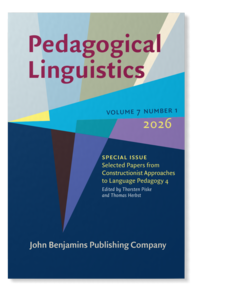
Pedagogical Linguistics

Editors
ORCiD logo with linkAndreas Trotzke | Universität Zürich | trotzke at ds.uzh.ch
ORCiD logo with linkTom Rankin | Masaryk University, Brno | tom.rankin at phil.muni.cz

Journal metrics

Impact Factor: 0.5 (5-year: 0.9)
Journal Citation Indicator: 0.62

This journal is peer reviewed and indexed in: Dimensions ; Scopus ; WoS Emerging Sources Citation Index (ESCI )

Pedagogical Linguistics publishes work on educational applications of theoretical and descriptive linguistics. The general aim of the journal is to bring the formal and the functional strands of linguistics together in order to establish a forum where they can cross-fertilize each other with the aim of discussing and developing linguistics’ potential contribution to language pedagogy. Pedagogical Linguistics publishes research originating in theoretical linguistics, psycholinguistics, and linguistic approaches to acquisition which outlines the didactic and educational relevance of recent research findings. The primary audience for this journal are researchers interested in state-of-the-art approaches to questions of language acquisition and linguistic theory that find applications in pedagogy, as well as a more general audience whose training is in education and pedagogy.


Pedagogical Linguistics publishes its articles Online First.

ISSN: 2665-9581 | E-ISSN: 2665‑959X
DOI logo with link
https://doi.org/10.1075/pl
Latest articles

26 February 2026

  • Pre-service teachers’ beliefs about multilingualism in Türkiye
    Gökhan KayırTobias Schroedler
  • 19 February 2026

  • Multilingual awareness as key factor in multilingual learning and teaching
    Ulrike Jessner
  • 29 January 2026

  • Misanalyses in the (de)learning of passives in Japanese-English interlanguage
    Takayuki KimuraLuna Kohama
  • 5 December 2025

  • Pedagogical construction grammar — the fashion of the day?
    Thomas HerbstThorsten Piske | PL 7:1 (2026) pp. 1–16
  • 17 November 2025

  • Constructicons as resources for language pedagogy — and vice versa : Experiences from Swedish
    Benjamin Lyngfelt, Julia PrenticeAzizah Lenté Degez | PL 7:1 (2026) pp. 38–66
  • Contingency and prototypicality: Observations on the learning of argument structure constructions
    Laurence Romain | PL 7:1 (2026) pp. 147–188
  • 14 November 2025

  • From spatial to abstract: Cross-linguistic convergence and divergence in prepositional use
    Iryna Fokashchuk | PL 7:1 (2026) pp. 189–219
  • Implications of cross-linguistic correspondence for teaching idioms
    Aria Rastegar | PL 7:1 (2026) p. 67
  • The role of input variability in generalizing phrasal constructions featuring non-adjacent dependencies: A German as a foreign language primary school intervention
    Johannes Schulz, Victoria MurphyElizabeth Wonnacott | PL 7:1 (2026) pp. 109–146
  • A comprehensive grammar of spoken and written French as the first fully corpus-informed grammar of French
    Dirk SiepmannChristoph Bürgel | PL 7:1 (2026) pp. 17–37
  • 7 October 2025

  • The influence of L1 conceptual and linguistic knowledge on EFL learners’ comprehension and production of L2 metaphorical expressions
    Sulaiman Alnujaidi
  • 2 October 2025

  • Unified pedagogical linguistics: Bridging generative and usage-based SLA in language teaching
    Thomas Hammond
  • 11 September 2025

  • Swedish medical students’ writing self-efficacy and writing beliefs regarding undergraduate thesis writing: A cross-sectional study using validated instruments
    Emma HanssonMonika Fagevik Olsén
  • 19 June 2025

  • Exploring the integration of Cognitive Linguistics in EFL classrooms: A case study in Belgium
    Eloy Romero MuñozAndreas Wirag
  • 12 June 2025

  • Developing genre awareness in novice academic writers in secondary education: A longitudinal intervention study on students’ academic writing development
    Muhammed Akbulut, Sandra Reitbrecht, Antonia Gösweiner, Ida MendittiSabine Schmölzer-Eibinger
  • 26 May 2025

  • Conceptual change and causal relations: Ontological and epistemological basic concepts within the conceptual change approach using the example of causal relations
    Anja WildemannKatharina Kellermann
  • 13 May 2025

  • How can metalinguistic awareness be operationalized?
    Katharina KellermannAnja Wildemann
  • 6 May 2025

  • On opportunities to study historical linguistics in schools in the United Kingdom
    Benjamin Goddard, Francesca Iezzi, Pavel Iosad, Will ReynoldsGraeme Trousdale | PL 6:2 (2025) pp. 134–154
  • 25 April 2025

  • How to stumble purposefully: Metacognitive and metalinguistic self-regulation on the path from knowledge to skill
    Hans-Georg MüllerFranz Unterholzner
  • 24 April 2025

  • Historical linguistics at school: Theory, practices and challenges
    Theodore MarkopoulosBrian D. Joseph | PL 6:2 (2025) pp. 109–112
  • 22 April 2025

  • Prosody for teaching French as a foreign language: First steps in identifying needs among teachers
    Ingo Feldhausen, Jürgen TrouvainKatharina Zahner-Ritter
  • Greek and Turkish linguistic nationalism in language and history coursebooks: A comparative study
    Konstantinos SampanisDilara Kaplan | PL 6:2 (2025) pp. 211–230
  • Conceptualizing and testing multilingual awareness in multilingual educational contexts
    Birgit Spechtenhauser, Barbara HoferElisabeth Allgäuer-Hackl
  • 18 April 2025

  • Historical linguistics for high school students: The Ohio experience
    Brian D. Joseph, Shuan O. KarimClint K. Awai-Jennings | PL 6:2 (2025) pp. 155–174
  • Russian nominative-accusative case distinction: Usage-based classroom-based study of English‑speaking learners of L2 Russian
    Olesya Kisselev, Angelina RubinaKevin McManus
  • 14 April 2025

  • Historical Linguistics and ancient languages at school: The Greek perspective
    Theodore Markopoulos | PL 6:2 (2025) pp. 193–210
  • 18 March 2025

  • Measuring grammatical understanding: Assessing the usability of the Test for Grammatical Understanding (TGU) through item response theory analyses
    Jimmy van Rijt, Michelle BouwSven De Maeyer
  • 6 January 2025

  • Historical linguistics, the pronunciation of Latin and teaching of classical languages: Outcomes of two projects aimed at Slovenian pupils
    Jerneja KavčičAndreja Inkret | PL 6:2 (2025) pp. 175–192
  • 17 December 2024

  • Linguistics is for everyone: Cross-curricular approaches to historical linguistics in secondary education
    Jessica DeLisi | PL 6:2 (2025) pp. 113–133
  • IssuesOnline-first articles

    Volume 7 (2026)

    Volume 6 (2025)

    Volume 5 (2024)

    Volume 4 (2023)

    Volume 3 (2022)

    Volume 2 (2021)

    Volume 1 (2020)

    Editorial info
    Editors
    ORCiD logo with linkAndreas Trotzke | Universität Zürich | trotzke at ds.uzh.ch
    ORCiD logo with linkTom Rankin | Masaryk University, Brno | tom.rankin at phil.muni.cz
    Editorial Board
    ORCiD logo with linkBert Cappelle | Université de Lille III
    ORCiD logo with linkDaniela Elsner | Pädagogische Hochschule Vorarlberg
    ORCiD logo with linkIngo Feldhausen | ATILF (CNRS & Université de Lorraine)
    ORCiD logo with linkÁngel J. Gallego | Universitat Autònoma de Barcelona
    Kook-Hee Gil | University of Sheffield
    ORCiD logo with linkGaëtanelle Gilquin | Université Catholique de Louvain
    Francis M. Hult | University of Maryland, Baltimore County (UMBC)
    ORCiD logo with linkJane Oakhill | University of Sussex
    ORCiD logo with linkLourdes Ortega | Georgetown University
    ORCiD logo with linkDespina Papadopoulou | Aristotle University of Thessaloniki
    Eloisa Silva Nascimento Pilati | Universidade de Brasilia
    ORCiD logo with linkTanja Rinker | Katholische Universität Eichstätt-Ingolstadt
    Jason Rothman | Lancaster University
    ORCiD logo with linkNeal Snape | Gunma Prefectural Women's University & Chuo University
    Frenette Southwood | Stellenbosch University
    Medadi Ssentanda | Makerere University
    ORCiD logo with linkMarkus Steinbach | Georg-August-Universität Göttingen
    ORCiD logo with linkFrancesca Volpato | Università Ca' Foscari Venezia
    ORCiD logo with linkMelinda Whong | The Hong Kong University of Science and Technology
    Subscription Info
    Current issue: 7:1, available as of February 2026

    General information about our electronic journals.

    Subscription rates

    All prices for print + online include postage/handling.

    Online-onlyPrint + online
    Volume 7 (2026): 2 issues; ca. 240 pp.EUR 173.00EUR 230.00

    Individuals may apply for a special online-only subscription rate of EUR 65.00 per volume.
    Private subscriptions are for personal use only, and must be pre-paid and ordered directly from the publisher.

    Available back-volumes

    Online-onlyPrint + online
    Complete backset
    (Vols. 1‒6; 2020‒2025)
    12 issues;
    1,440 pp.
    EUR 963.00EUR 1,118.00
    Volume 6 (2025) 2 issues; 240 pp.EUR 168.00EUR 217.00
    Volume 5 (2024) 2 issues; 240 pp.EUR 163.00EUR 197.00
    Volume 4 (2023) 2 issues; 240 pp.EUR 158.00EUR 179.00
    Volumes 1‒3 (2020‒2022) 2 issues; avg. 240 pp.EUR 158.00 per volumeEUR 175.00 per volume
    Author info

    Guidelines and general information for authors

    Pedagogical Linguistics offers online submission .

    Before submitting, please consult the guidelines and the Short Guide to EM for Authors .

    If you are not able to submit online, or for any other editorial correspondence, please contact the editors via e-mail: trotzke at ds.uzh.ch and/or tom.rankin at phil.muni.cz.

    Articles under consideration are double-blind peer-reviewed and decisions on all published content are made by the editors.

    Ethics

    John Benjamins journals are committed to maintaining the highest standards of publication ethics and to supporting ethical research practices.

    Authors and reviewers are kindly requested to read this Ethics Statement.

    Please also note the guidance on (the declaration of) the use of Artificial Intelligence.

    Rights and Permissions

    Authors must ensure that they have permission to use any third-party material in their contribution; the permission should include perpetual (not time-limited) world-wide distribution in print and electronic format.

    For information on authors' rights, please consult the rights information page.

    Open Access

    Articles accepted for this journal can be made Open Access through payment of an Article Publication Charge (APC) of EUR 1800 (excl. tax). To arrange this, please contact openaccess at benjamins.nl as soon as your paper has been accepted for publication. More information can be found on the publisher's Open Access Policy page.

    Corresponding authors from institutions with which John Benjamins has a Read & Publish arrangement can publish Open Access without paying a fee. Please consult this list of institutions for up-to-date information on which articles qualify.

    For information about permission to post a version of your article online or in an institutional repository ('green' open access or self-archiving), please consult the rights information page.

    If the article is not (to be made) Open Access, there is no fee for the author to publish in this journal.

    Archiving

    John Benjamins Publishing Company has an agreement in place with Portico for the archiving of all its online journals and e-books.

    Mobile Menu Logo with link to supplementary files background Layer 1 prag Twitter_Logo_Blue