Karin Aijmer
List of John Benjamins publications in which Karin Aijmer is involved.
Journals

ISSN 1874-8767 | E‑ISSN 1874‑8775

Languages in Contrast
International Journal for Contrastive Linguistics
Edited by Kristel Van Goethem and Gudrun Vanderbauwhede
ISSN 1387-6759 | E‑ISSN 1569‑9897

Discourse linguistics: Theory and practice
Edited by Karin Aijmer and Anita Fetzer
Special issue of Functions of Language 21:1 (2014) iii, 137 pp.

Advances in Corpus-based Contrastive Linguistics: Studies in honour of Stig Johansson
Edited by Karin Aijmer and Bengt Altenberg
Contrastive studies have experienced a dramatic revival in the last decades. By combining the methodological advantages of computer corpus linguistics and the possibility of contrasting texts in two or more languages, the structure and use of languages can be explored with greater accuracy, detail… read more[Studies in Corpus Linguistics, 54] 2013. x, 295 pp.

Text-based contrastive linguistics
Guest-edited by Bengt Altenberg and Karin Aijmer
Special issue of Languages in Contrast 13:2 (2013) v, 137 pp.

Contrastive Pragmatics
Edited by Karin Aijmer
We have recently seen a broadening of pragmatics to new areas and to the study of more than one language. This is illustrated by the present volume on Contrastive Pragmatics which brings together a number of articles originally presented at the 10th International Pragmatics Conference in Göteborg… read more[Benjamins Current Topics, 30] 2011. v, 182 pp.

Contrastive Pragmatics
Edited by Karin Aijmer
Special issue of Languages in Contrast 9:1 (2009) 182 pp.

Corpora and Language Teaching
Edited by Karin Aijmer
The articles in this edited volume represent a broad coverage of areas. They discuss the role and effectiveness of corpora and corpus-linguistic techniques for language teaching but also deal with broader issues such as the relationship between corpora and second language teaching and how the… read more[Studies in Corpus Linguistics, 33] 2009. viii, 232 pp.

Contrast in Context
Edited by Karin Aijmer, Hilde Hasselgård and Stig Johansson
Special issue of Languages in Contrast 5:1 (2005) 184 pp.

Discourse Patterns in Spoken and Written Corpora
Edited by Karin Aijmer and Anna-Brita Stenström
This book brings together a number of empirical studies that use corpora to study discourse patterns in speech and writing. It explores new trends in the area of text and discourse characterized by the alliance between text linguistics and areas such as corpus linguistics, genre analysis, literary… read more[Pragmatics & Beyond New Series, 120] 2004. viii, 273 pp.
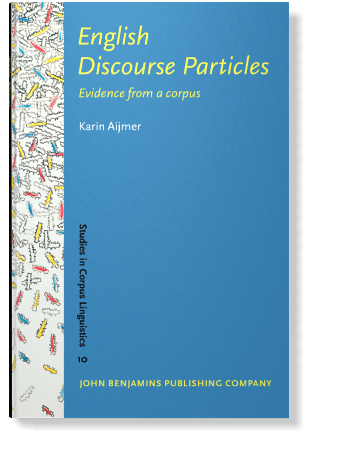
English Discourse Particles: Evidence from a corpus
Karin Aijmer
There are few aspects of language which are more problematic than its discourse particles. The present study of discourse particles draws upon data from the London-Lund Corpus to show how the methods and tools of corpora can sharpen their description. The first part of the book provides a picture… read more[Studies in Corpus Linguistics, 10] 2002. xvi, 298 pp.

2025 A contrastive analysis of (-) ish in English and Swedish blogs Languages in Contrast 25:2, pp. 185–208 | Article
The aim is to investigate whether (-)ish is employed in the same structures and functions in English and Swedish blog data and to describe the adaptations and changes resulting from borrowing. (-)ish is exceptional because it looks like a suffix but can be taken out of its original context with… read more

2022 Review of Heine, Kaltenböck, Kuteva & Long (2021): The rise of discourse markers Functions of Language 29:2, pp. 247–251 | Review

2020 Chapter 15. Sort of and kind of from an English-Swedish perspective Voices Past and Present - Studies of Involved, Speech-related and Spoken Texts: In honor of Merja Kytö, Jonsson, Ewa and Tove Larsson (eds.), pp. 247–264 | Chapter
The aim of this study has been to contribute to the discussion of type nouns by investigating the different meanings and functions of sort of and kind of from an English-Swedish contrastive perspective on the basis of their correspondences (translations or sources) in the English-Swedish Parallel… read more

2020 That’s absolutely fine: An investigation of absolutely in the spoken BNC2014 Corpora and the Changing Society: Studies in the evolution of English, Rautionaho, Paula, Arja Nurmi and Juhani Klemola (eds.), pp. 143–168 | Chapter
This chapter investigates the meanings and functions of the intensifier absolutely, both synchronically and diachronically. The research questions are asked against the background of absolutely becoming more frequent over a short period of time as shown by a comparison of the BNC1994 and the… read more

2019 Chapter 1. Challenges in the contrastive study of discourse markers: The case of then Empirical Studies of the Construction of Discourse, Loureda, Óscar, Inés Recio Fernández, Laura Nadal and Adriana Cruz (eds.), pp. 17–42 | Chapter
I argue that the position of the discourse markers in the utterance should be part of the contrastive analysis on the basis of a corpus case study of then and its Swedish cognate då. The focus for the contrastive analysis has been on then which has been studied both in the left and the right… read more

2018 Epistemic must in an English-Swedish contrastive perspective The Corpus Linguistics Discourse: In honour of Wolfgang Teubert, Čermáková, Anna and Michaela Mahlberg (eds.), pp. 205–221 | Chapter
Must in English and måste in Swedish do not mean quite the same thing and they have different formal and functional properties as can be shown from a translation perspective. They occur for example with different frequencies in the two languages. Must is mainly epistemic while the deontic… read more

2018 Chapter 8. Positioning of self in interaction: Adolescents’ use of attention-getters Positioning the Self and Others: Linguistic perspectives, Beeching, Kate, Chiara Ghezzi and Piera Molinelli (eds.), pp. 177–195 | Chapter
Look, listen, come on, excuse me are examples of imperatives of verbs which have developed into discourse markers with an attention-getting function. It is shown that the functional markers are used by adolescents to position themselves in relation to what is said and other participants in the… read more

2016 Pragmatic markers as constructions. The case of anyway Outside the Clause: Form and function of extra-clausal constituents, Kaltenböck, Gunther, Evelien Keizer and Arne Lohmann (eds.), pp. 29–58 | Article
The aim of the study is to explore the idea that discourse markers are oriented to properties of spoken language and the interaction and have special uses or tasks depending on formal and contextual factors. The empirical data comes from an analysis of anyway in informal conversation in several… read more

2015 Chapter 9. General extenders in learner language Corpora, Grammar and Discourse: In honour of Susan Hunston, Groom, Nicholas, Maggie Charles and Suganthi John (eds.), pp. 211–234 | Article
The aim of the paper is to study how general extenders are used by Swedish factors.learners of English in comparison with native speakers. The study is based on a corpus of Swedish learners’ spoken English compiled within the international LINDSEI project. The analysis is both quantitative and… read more

2015 Ursula Lutzky, Discourse Markers in Early Modern English English Text Construction 8:2, pp. 284–288 | Article
2014 Discourse linguistics: Theory and practice Discourse linguistics: Theory and practice, Aijmer, Karin and Anita Fetzer (eds.), pp. 1–5 | Article

2013 Analyzing modal adverbs as modal particles and discourse markers Discourse Markers and Modal Particles: Categorization and description, Degand, Liesbeth, Bert Cornillie and Paola Pietrandrea (eds.), pp. 89–106 | Chapter

2013 Well I’m not sure I think… The use of well by non-native speakers Errors and Disfluencies in Spoken Corpora, Gilquin, Gaëtanelle and Sylvie De Cock (eds.), pp. 93–116 | Article
Pragmatic markers are an important part of the grammar of conversation and not simply markers of disfluency. They have a number of functions that help the speaker to organize the conversation and to express feelings and attitudes. Advanced EFL learners use frequent pragmatic markers such as well.… read more
2013 Swedish gärna and German gern(e) and their English correspondences: A contrastive study at the crossroads of modality and illocutionary force Text-based contrastive linguistics, Altenberg, Bengt and Karin Aijmer (eds.), pp. 238–259 | Article
The Swedish adverb gärna, related to German gern(e), has no obvious equivalent in English. To explore this cross-linguistic phenomenon the English correspondences of gärna are examined on the basis of the English-Swedish Parallel Corpus, a bidirectional translation corpus. The study shows that… read more
2013 Introduction Advances in Corpus-based Contrastive Linguistics: Studies in honour of Stig Johansson, Aijmer, Karin and Bengt Altenberg (eds.), pp. 1–6 | Article
2013 Introduction Text-based contrastive linguistics, Altenberg, Bengt and Karin Aijmer (eds.), pp. 137–138 | Article

2011 Well I’m not sure I think… The use of well by non-native speakers Errors and Disfluencies in Spoken Corpora, Gilquin, Gaëtanelle and Sylvie De Cock (eds.), pp. 231–254 | Article
Pragmatic markers are an important part of the grammar of conversation and not simply markers of disfluency. They have a number of functions that help the speaker to organise the conversation and to express feelings and attitudes. Advanced EFL learners use frequent pragmatic markers such as well.… read more

2011 Pragmatic markers Discursive Pragmatics, Zienkowski, Jan, Jan-Ola Östman and Jef Verschueren (eds.), pp. 223–247 | Article

2010 In memory of Göran Kjellmer International Journal of Corpus Linguistics 15:1, pp. 3–4 | Article

2009 Seem and evidentiality Evidentiality in language and cognition, Ekberg, Lena and Carita Paradis (eds.), pp. 63–88 | Article
The paper is an empirical, corpus-based analysis of the functions of seem with different complementation structures and in impersonal constructions as well as in combinations with an experiencer. The focus is on describing how evidentiality (e.g. inferencing/observation or hearsay evidence)… read more
2009 Introduction: Corpora and language teaching Corpora and Language Teaching, Aijmer, Karin (ed.), pp. 1–10 | Miscellaneous


2009 Pragmatic markers Handbook of Pragmatics: 2009 Installment, Östman, Jan-Ola and Jef Verschueren (eds.), pp. 1–29 | Article

2008 Modal adverbs in interaction – obviously and definitely in adolescent speech The Dynamics of Linguistic Variation: Corpus evidence on English past and present, Nevalainen, Terttu, Irma Taavitsainen, Päivi Pahta and Minna Korhonen (eds.), pp. 61–83 | Article
When we compare corpora compiled at different periods we can notice that the overall frequency of the adverbs of certainty is different. For example, certainly and surely do not have such a strong position in the Bergen Corpus of London Teenage Language (COLT) as in the London-Lund Corpus (LLC). On… read more

2007 The interface between discourse and grammar: The fact is that Connectives as Discourse Landmarks, Celle, Agnès and Ruth Huart (eds.), pp. 31–46 | Article

2007 Modal adverbs as discourse markers: A bilingual approach to the study of indeed Connectivity in Grammar and Discourse, Rehbein, Jochen, Christiane Hohenstein and Lukas Pietsch (eds.), pp. 329–344 | Article
Indeed has many meanings and is sometimes regarded as a discourse marker. There are several approaches to analyse the meaning and uses of indeed. One method involves viewing synchronic variation as resulting from semantic and pragmatic change in the framework of grammaticalization theory. The focus… read more

2007 The discourse functionality of adjectival and adverbial epistemic expressions: Evidence from present-day English Functional Perspectives on Grammar and Discourse: In honour of Angela Downing, Butler, Christopher S., Raquel Hidalgo Downing and Julia Lavid-López (eds.), pp. 419–446 | Article
In this article we examine the adjectival and adverbial expressions it is certain/certainly, it is clear/clearly and it is obvious/obviously in a corpus of present-day English, the British National Corpus. We aim to answer two questions. One is the question of how the constructional properties of… read more

2007 Presupposition and ‘taking-for-granted’ in mass communicated political argument. An illustration from British, Flemish and Swedish political colloquy Political Discourse in the Media: Cross-cultural perspectives, Fetzer, Anita and Gerda Eva Lauerbach (eds.), pp. 31–74 | Article

2005 Evaluation and pragmatic markers Strategies in Academic Discourse, Tognini-Bonelli, Elena and Gabriella Del Lungo Camiciotti (eds.), pp. 83–96 | Article
2005 Introduction Contrast in Context, Aijmer, Karin, Hilde Hasselgård and Stig Johansson (eds.), pp. 1–2 | Miscellaneous

2004 The semantic path from modality to aspect: be able to in a cross-linguistic perspective Corpus Approaches to Grammaticalization in English, Lindquist, Hans and Christian Mair (eds.), pp. 57–78 | Article
Ability has a number of lexical sources including dynamic, telic verbs of various sorts. For example, manage to, a verb implying that there were difficulties to overcome can come to mean ‘ability’, a development which has parallels in other languages. In this paper translations into Swedish are… read more

2004 Interjections in a contrastive perspective Emotion in Dialogic Interaction: Advances in the complex, Weigand, Edda (ed.), pp. 99–120 | Article
2004 Discourse Patterns in Spoken and Written Corpora Discourse Patterns in Spoken and Written Corpora, Aijmer, Karin and Anna-Brita Stenström (eds.), pp. 1–13 | Article

2004 The expectation marker of course in a cross-linguistic perspective Functional Linguistics and Contrastive Description, Davidse, Kristin and Liesbet Heyvaert (eds.), pp. 13–43 | Article
The study of of course presented in this article has an applied, a descriptive and a theoretical aim. Since of course proves to be very frequent in English, learners will need to know what meanings the item has and in what pragmatic contexts it is used. It has indeed been shown that some learners… read more

2003 Review of Hunston ((2002)): Corpora in Applied Linguistics International Journal of Corpus Linguistics 8:2, pp. 327–330 | Review

2003 Review of Andersen (2001): Pragmatic markers and sociolinguistic variation Functions of Language 10:1, pp. 143–146 | Review

2002 Modality in advanced Swedish learners’ written interlanguage Computer Learner Corpora, Second Language Acquisition and Foreign Language Teaching, Granger, Sylviane, Joseph Hung and Stephanie Petch-Tyson (eds.), pp. 55–76 | Article

1998 Editorial Languages in Contrast 1:1, pp. v–xii | Miscellaneous