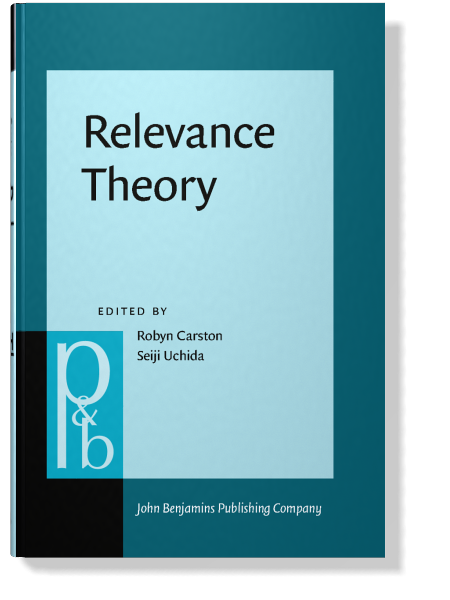
In:Relevance Theory: Applications and implications
Edited by Robyn Carston and Seiji Uchida
[Pragmatics & Beyond New Series 37] 1998
► pp. 283–294
Irony and relevance
A reply to Seto, Hamamoto and Yamanashi
Published online: 15 March 1998
https://doi.org/10.1075/pbns.37.16spe
https://doi.org/10.1075/pbns.37.16spe

Cited by (53)
Cited by 53 other publications
Wen, Zhiyuan, Rui Wang, Qianlong Wang, Lin Gui, Yunfei Long, Shiwei Chen, Bin Liang, Min Yang & Ruifeng Xu
Athanasiadou, Angeliki
Athanasiadou, Angeliki
Jodłowiec, Maria & Agnieszka Piskorska
Ogoanah, Felix Nwabeze
2024. ‘It seems my enemy is about having malaria’. Pragmatics. Quarterly Publication of the International Pragmatics Association (IPrA) 34:2 ► pp. 215 ff.
Mendoza Ibáñez, Francisco José Ruiz de
Ruiz de Mendoza Ibáñez, Francisco José
2014. Mapping concepts. Revista Española de Lingüística Aplicada/Spanish Journal of Applied Linguistics 27:1 ► pp. 187 ff.
Mestre-Mestre, Eva M.
Sasamoto, Ryoko
2023. Perceptual resemblance and the communication of emotion in digital contexts. Pragmatics. Quarterly Publication of the International Pragmatics Association (IPrA) 33:3 ► pp. 393 ff.
Richter, Sandra & Hartmut Leuthold
Katamadze, Mariya Olegovna
Tobin, Vera
Kamyanets, Angela
Piskorska, Agnieszka
2020. Introduction. In Relevance Theory, Figuration and Continuity in Pragmatics [Figurative Thought and Language, 8], ► pp. 1 ff.
Walczak, Agnieszka
2020. Echoic irony in Philip Larkin’s poetry and its preservation in Polish translations. In Relevance Theory, Figuration and Continuity in Pragmatics [Figurative Thought and Language, 8], ► pp. 309 ff.
Ruiz-Moneva, María Ángeles
Willison, Robert
2017. In defense of an ecumenical approach to irony. In Irony in language use and communication [Figurative Thought and Language, 1], ► pp. 61 ff.
Dynel, Marta
Dynel, Marta
Dynel, Marta
2018. Deconstructing the myth of positively evaluative irony. In The Pragmatics of Irony and Banter [Linguistic Approaches to Literature, 30], ► pp. 41 ff.
Yus, Francisco
2016. Relevance theory and contextual sources-centred analysis of irony. In Relevance Theory [Pragmatics & Beyond New Series, 268], ► pp. 147 ff.
Bromberek-Dyzman, Katarzyna
Akimoto, Yoritaka, Motoaki Sugiura, Yukihito Yomogida, Carlos Makoto Miyauchi, Shiho Miyazawa & Ryuta Kawashima
Escandell-Vidal, M. Victoria & Manuel Leonetti
2014. Chapter 11. Fronting and irony in Spanish. In Left Sentence Peripheries in Spanish [Linguistik Aktuell/Linguistics Today, 214], ► pp. 309 ff.
Hopkinson, Christopher
Pálinkás, István
2014. Blending and folk theory in an explanation of irony. Review of Cognitive Linguistics 12:1 ► pp. 64 ff.
Allott, Nicholas
Allott, Nicholas
Allott, Nicholas
Tobin, Vera & Michael Israel
Garmendia, Joana
Partington, Alan
Morini, Massimiliano
Eggs, Ekkehard
Wilson, Deirdre
Halloy, Arnaud
[no author supplied]
[no author supplied]
2014. Chapter 4. Cognitive operations. In Cognitive Modeling [Human Cognitive Processing, 45], ► pp. 85 ff.
[no author supplied]
[no author supplied]
[no author supplied]
2014. Chapter 3. Cognitive models. In Cognitive Modeling [Human Cognitive Processing, 45], ► pp. 59 ff.
[no author supplied]
[no author supplied]
[no author supplied]
[no author supplied]
[no author supplied]
2014. Chapter 5. Content operations across levels of representation. In Cognitive Modeling [Human Cognitive Processing, 45], ► pp. 147 ff.
[no author supplied]
2014. Chapter 2. Theoretical pre-requisites. In Cognitive Modeling [Human Cognitive Processing, 45], ► pp. 17 ff.
[no author supplied]
[no author supplied]
[no author supplied]
This list is based on CrossRef data as of 29 november 2025. Please note that it may not be complete. Sources presented here have been supplied by the respective publishers. Any errors therein should be reported to them.