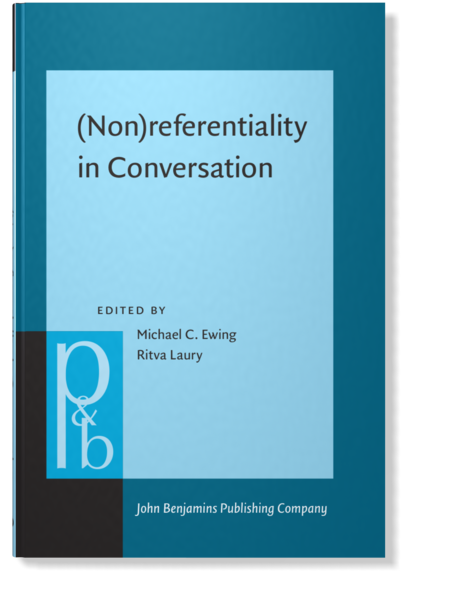
In:(Non)referentiality in Conversation
Edited by Michael C. Ewing and Ritva Laury
[Pragmatics & Beyond New Series 344] 2024
► pp. 167–202
Chapter 9An interactional approach to generic second person expressions in Mandarin conversation
Published online: 1 August 2024
https://doi.org/10.1075/pbns.344.09tao
https://doi.org/10.1075/pbns.344.09tao
Abstract
This chapter tackles the hitherto under-explored question of when and why conversationalists deploy second
person generic expressions that feature a general and vague referential scope. I show that the conversational contexts in
which they appear are usually characterized most prominently by their relatively complex and/or controversial subject matters,
participants’ incongruent stances, and/or opposing positions to be contested. These contexts and their associated
interactional demands are argued to give rise to the patterning of clustering (multiplicity of instances in adjacent units),
limited generality (as good-enough-yet-not-too-broad general statements), and primary (or attempted primary) speakership. In
general, second person generic statements can be seen as a special and powerful rhetorical device designed for marked
interactional occasions.
Article outline
- 1.Introduction
- 2.Materials and methodology
- 3.General broad patterns in conversation
- 3.1Clustering
- 3.2Locally conditioned generalities
- 3.3Primary speaker roles
- 4.Social activities: When and why speakers deploy second person generic expressions?
- 4.1Complex informing
- 4.2Persuasion
- 4.3Argumentation
- 5.Discussion
- 5.1The preference for clusters
- 5.2Limited generality
- 5.3The association with a primary speaker role (or lack thereof if primary speakership is more dynamically negotiated)
- 6.Conclusions
Acknowledgements Notes References Appendix

References (44)
Berry, Roger. 2009. “You
Could Say That: The Generic Second-Person Pronoun in Modern English.” English
Today 25 (3): 29–34.
Biq, Yung-O. 1991. “The
Multiple Uses of the Second Person Singular Pronoun Ni in Conversational
Mandarin.” Journal of
Pragmatics 16 (4): 307–321.
Boersma, Paul and David J. M. Weenink. 2021. Praat:
Doing Phonetics by Computer. [URL]. Last retrieved January 2021.
. 1979b. “Pronouns
in Discourse.” In Discourse and
Syntax, ed. by Talmy Givon, 287–309. New York: Academic Press.
Brown, Penelope. 2007. “Principles
of Person Reference in Tzeltal Conversation.” In Person
Reference in Interaction: Linguistic, Cultural and Social Perspectives, ed.
by N. J. Enfield and Tanya Stivers, 172–202. Cambridge: Cambridge University Press.
Canavan, Alexandra and George Zipperlen. 1996. CALLFRIEND
Mandarin Chinese-Mainland Dialect. Linguistic Data Consortium, Philadelphia.
Chafe, Wallace. 1987. “Cognitive
Constraints on Information Flow.” In Coherence and Grounding
in Discourse, ed. by Russell Tomlin, 21–51. Amsterdam: John Benjamins.
. 1994. Discourse,
Consciousness, and Time: The Flow and Displacement of Conscious Experience in Speaking and
Writing. Chicago: University of Chicago Press.
Couper-Kuhlen, Elizabeth and Margret Selting. 2018. Interactional
Linguistics: An Introduction to Language in Social
Interaction. Cambridge: Cambridge University Press.
Dahmen, Josua, and Joe Blythe. 2022. “Calibrating
Recipiency through Pronominal Reference”. Interactional
Linguistics 2 (2): 190–224.
Du Bois, John W. 1980. “Beyond Definiteness:
The Trace of Identity in Discourse.” In The Pear Stories:
Cognitive, Cultural, and Linguistic Aspects of Narrative Production, ed.
by Wallace L. Chafe, 203–74. Norwood, NJ: Ablex.
2006. Transcription in Action:
Resources for the Representation of Linguistic Interaction. [URL]. Last
accessed May 22,
2021.
2007. “The Stance
Triangle.” In Stancetaking in Discourse: Subjectivity,
Evaluation, Interaction, ed. by Robert Englebretson, 139–182. Amsterdam: Benjamins.
Du Bois, John W., Stephan Schuetze-Coburn, Susanna Cumming, and Danae Paolino. 1993. “Outline
of Discourse Transcription.” In Talking
Data, ed. by Jane Edwards and Martin Lampert, 45–89. Hillsdale, NJ: Lawrence Erbaum Associates.
Ford, Cecilia E. 1994. “Dialogic Aspects of
Talk and Writing: Because on the Interactive-Edited
Continuum.” Text 14 (4): 531–554.
Goodwin, M. H. 1996. “Informings
and Announcements in Their Environment: Prosody within a Multi-Activity Work
Setting.” In Prosody in Conversation: Interactional
Studies, ed. by E. Couper-Kuhlen and M. Selting, 436–461. Cambridge: Cambridge University Press.
Hanks, William. 2007. “Person
Reference in Yucatec Maya Conversation.” In Person Reference
in Interaction: Linguistic, Cultural and Social Perspectives, ed. by N. J. Enfield and Tanya Stivers, 149–171. Cambridge: Cambridge University Press.
Heritage, John. 1984. “A
Change-of-State Token and Aspects of Its Sequential
Placement.” In Structures of Social Action: Studies in
Conversation Analysis, ed. by J. Maxwell Atkinson and John Heritage, 299–345. Cambridge: Cambridge University Press.
. 2007. “Intersubjectivity
and Progressivity in Person (and Place) Reference.” In Person
Reference in Interaction: Linguistic, Cultural and Social Perspectives, ed.
by N. J. Enfield and Tanya Stivers, 255–280. Cambridge: Cambridge University Press.
. 2012. “Epistemics
in Action: Action Formation and Territories of Knowledge.” Research on Language and
Social
Interaction 45 (1): 1–29.
Hsiao, Chi-hua. 2011. “Personal
Pronoun Interchanges in Mandarin Chinese Conversation.” Language
Sciences 33 (5): 799–821.
Kitagawa, Chisato and Adrienne Lehrer. 1990. “Impersonal
Uses of Personal Pronouns.” Journal of
Pragmatics 14 (5): 739–759.
Kuo, Sai-Hua. 2002. “From
Solidarity to Antagonism: The Uses of the Second-Person Singular Pronoun in Chinese Political
Discourse.” Text 22 (1): 29–55.
Laberge, Suzanne and Gillian Sankoff. 1979. “Anything
You Can Do.” In Discourse and
Syntax, ed. by Talmy Givon, 419–440. New York: Academic Press.
Labov, William and David Fanshel. 1977. Therapeutic
Discourse: Psychotherapy as Conversation. New York: Academic Press.
Lerner, Gene. 1996. “On
the Place of Linguistic Resources in The Organization of Talk-in-Interaction: ‘Second Person’ Reference in Multi-Party
Conversation.” Pragmatics 6 (3): 281–294.
Lü, Shuxiang. 1985. Jindai Hanyu Zhidaici [Demonstratives and Pronouns in
Modern Chinese], Shanghai: Xuelin Publishing Company.
Rubba, Jo. 1996. “Alternate
Grounds in the Interpretation of Deictic
Expressions.” In Spaces, Worlds, and
Grammar, ed. by G. Fauconnier and E. Sweetser, 227–261. Chicago: Chicago University Press.
Sacks, Harvey. 1965/1992. Part
II, Lecture 6, “‘You’.” In Lectures on
Conversation Vol 1, ed.
by Gail Jefferson, with
an introduction by Emanuel A. Schegloff, 163–168. Cambridge, MA: Blackwell.
. 1966/1992. Part
III, Lecture 11, “‘You’.” In Lectures on
Conversation Vol. 1, ed.
by Gail Jefferson, with
an introduction by Emanuel A. Schegloff, 348–353. Cambridge, MA: Blackwell.
. 1969/1992. Part
II, Lecture 9, “Sound Shifts; Showing Understanding; Dealing with ‘Utterance Completion; Practical
Mysticism.” In Lectures on
Conversation Vol. 2 (Winter
1969), ed. by Gail Jefferson, 137–149. Oxford: Blackwell.
. 1975. “Everyone
Has to Lie.” In Sociocultural Dimensions of Language
Use, ed. by Ben G. Blount and Mary Sanches, 57–79. New York: Academic Press.
Sacks, H. and Schegloff, E. A. 1979. “Two
Preferences in The Organization of Reference to Persons in Conversation And Their
Interaction.” In Everyday Language: Studies in
Ethnomethodology, ed. by George Psathas, 15–21. New York: Irvington.
Sacks, Harvey, Emanuel Schegloff, and Gail Jefferson. 1974. “A
Simplest Systematics for the Organization of Turn-Taking for
Conversation.” Language 50 (4): 696–735.
Song, Zuoyan and Hongyin Tao. 2009. “A
Unified Account of Causal Clause Sequences in Mandarin Chinese and Its
Implications.” Studies in
Language 33 (1): 69–102.
Sperber, Dan and D. Wilson. 1995. Relevance:
Communication and Cognition (2nd
edition). Oxford: Blackwell.
Stirling, Lesley, and Lenore Manderson. 2011. “About
You: Empathy, Objectivity and Authority.” Journal of
Pragmatics 43 (6): 1581–1602.
Stivers, Tanya, N. J. Enfield, and Stephen C. Levinson. 2007. “Person
Reference in Interaction.” In Person Reference in
Interaction: Linguistic, Cultural and Social Perspectives, ed. by N. J. Enfield and Tanya Stivers, 1–20. Cambridge: Cambridge University Press.
Tao, Hongyin. 1996. Units
in Mandarin Conversation: Prosody, Discourse, and
Grammar. Amsterdam: John Benjamins.
Cited by (1)
Cited by one other publication
Liu, Yingsheng & Hongyin Tao
2025. More than a summarizing conjunction. Chinese Language and Discourse. An International and Interdisciplinary Journal
This list is based on CrossRef data as of 29 november 2025. Please note that it may not be complete. Sources presented here have been supplied by the respective publishers. Any errors therein should be reported to them.