In:(Non)referentiality in Conversation
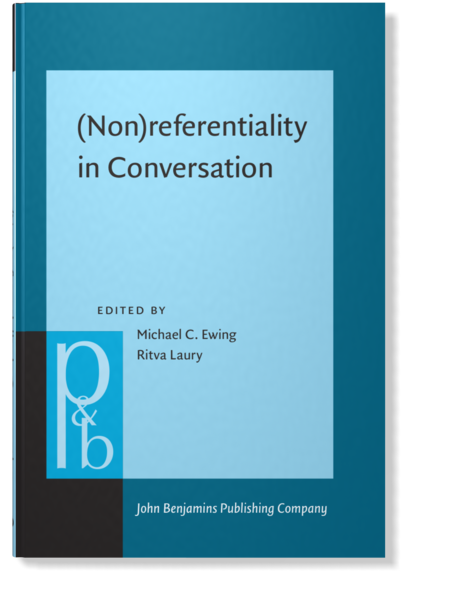
Edited by Michael C. Ewing and Ritva Laury
[Pragmatics & Beyond New Series 344] 2024
► pp. 123–140
Chapter 7The indeterminacy and fluidity of reference in everyday conversation
Published online: 1 August 2024
https://doi.org/10.1075/pbns.344.07ono
https://doi.org/10.1075/pbns.344.07ono
Abstract
We focus on (a) the indeterminacy of reference, i.e., noun phrases which are described as having a ‘given’,
‘old’ or ‘definite’ referent, where that referent is unspecified; (b) the ways in which speakers shift reference between
categorial and specific designations. The data reveal that talk displaying indeterminate and shifting reference is
consistently accepted without being challenged. These facts show that reference can only be understood by considering how
speakers refer locally, in the unfolding of social action, and that referential common ground is generally established despite
the referential indeterminacy and fluidity. We thus promote the view that reference is a deeply social phenomenon, an emergent
set of practices that is used and negotiated by people in real time.
Keywords: indeterminacy, fluidity, reference, conversation
Article outline
- 1.Background
- 2.Findings
- 2.1Indeterminacy
- 2.2Fluidity
- 2.3Indeterminacy and fluidity
- 3.Summary and discussion
Acknowledgements Notes References

References (63)
Blythe, Joe. 2009. Doing
Referring in Murriny Patha Conversation. Ph.D.
thesis, University of Sydney.
Chafe, Wallace. 1994. Discourse,
Consciousness, and Time: The Flow and Displacement of Conscious Experience in Speaking and
Writing. Chicago: University of Chicago Press.
(ed). 1980. The
Pear Stories: Cognitive, Cultural, and Linguistic Aspects of Narrative
Production. Norwood, New Jersey: Ablex.
Cornish, Francis. 2011. “‘Strict’
Anadeixis, Discourse Deixis and Text Structuring.” Language
Sciences 33 (5): 753–767.
Couper-Kuhlen, Elizabeth and Sandra A. Thompson. 2008. “On
Assessing Situations and Events in Conversation: Extraposition and Its
Relatives.” Discourse
Studies 10 (4): 443–467.
. Forthcoming. “Action
Ascription in Everyday Advice-giving Sequences.” In Action
Ascription: Interaction in Context, ed. by Arnulf Deppermann and Michael Haugh. Cambridge: Cambridge University Press.
Cutfield, Sarah. 2018. “Dalabon
Exophoric Uses of Demonstratives.” In Demonstratives in
Cross-Linguistic Perspective, ed. by Stephen C. Levinson, Sarah Cutfield, Michael Dunn, N. J. Enfield, and Sérgio Meira, 90–115. Cambridge: Cambridge University Press.
Deppermann, Arnulf. 2005. “Conversational
Interpretation of Lexical Items and Conversational
Contrasting.” In Syntax and lexis in
conversation, ed. by Auli Hakulinen and Margret Selting, 289–317. Amsterdam: Benjamins.
. 2011a. “The
Study of Formulations as a Key to an Interactional Semantics.” Human
Studies 34: 115–128.
. 2011b. “Notionalization:
The Transformation of Descriptions into Categorizations.” Human
Studies 34: 155–181.
. 2018. “Inferential
Practices in Social Interaction: A Conversation-Analytic Account.” Open
Linguistics 4: 35–55.
Djenar, Dwi Noverini, Michael C. Ewing and Howard Manns. 2018. Style
and Intersubjectivity in Youth
Interaction. Berlin: De Gruyter Mouton.
Du Bois, John W. 1980. “Beyond Definiteness:
The Trace of Identity in Discourse.” In The Pear
Stories, ed. by Wallace Chafe, 9–50. Norwood, NJ: Ablex.
Enfield, N. J. and Tanya Stivers (eds). 2007. Person
Reference in Interaction: Linguistic, Cultural and Social
Perspectives. Cambridge: Cambridge University Press.
Epstein, Richard. 2002. “The
Definite Article, Accessibility, and the Construction of Discourse
Referents.” Cognitive
Linguistics 12 (4): 333–378.
Evans, Gareth. 1982. The
Varieties of Reference, edited by John McDowell, Oxford: Oxford University Press.
Ewing, Michael C. 2005. Grammar and Inference in
Conversation: Identifying Clause Structure in Spoken
Javanese. Amsterdam: Benjamins.
2015. “Localising Person
Reference among Indonesian Youth.” In Margins, Hubs, and
Peripheries in a Decentralizing Indonesia, ed. by Zane Goebel, Deborah Cole, and Howard Manns. Tilburg
Papers in Culture Studies Special
Issue 162: 26–41.
Ewing, Michael C. 2018. “Investigating
Indonesian Conversation: Approach and
Rationale.” Wacana 19 (2): 342–374.
Ewing, Michael C. 2019. “The Predicate as a
Locus of Grammar and Interaction in Colloquial
Indonesian.” In Special Issue “Usage-based and Typological
Approaches to Linguistic Units” ed. by Ritva Laury Tsuyoshi Ono and Ryoko Suzuki. Studies
in
Language 43 (2): 402–443.
Ford, Cecilia E. and Barbara A. Fox. 1996. “Interactional
Motivations for Reference Formulation: He had. This guy had, a beautiful, thirty-two
O:lds.” In Studies in Anaphora, ed.
by Barbara A. Fox, 145–168. Amsterdam: John Benjamins.
Fox, Barbara A. (ed.) 1996. Studies
in
anaphora. Amsterdam: Benjamins.
Frege, Gottlieb. 1892. Über
Sinn und Bedeutung. Zeitschrift für Philosophie und Philosophische Kritik 100 (1892):
25–50. In Collected Papers on Mathematics, Logic and
Philosophy, 157–177, translated
by M. Black, V. Dudman, P. Geach, H. Kaal, E.-H. W. Kluge, B. McGuinness and R. H. Stoothoff. New York: Basil Blackwell, 1984.
Gernsbacher, Morton A., and Suzanne Shroyer. 1989. “The
Cataphoric Use of the Indefinite this in Spoken Narratives.” Memory
and Cognition 17: 536–540.
Givon, T. (ed). 1983. Topic
Continuity in Discourse: A quantitative cross-language
study. Amsterdam: John Benjamins.
Goffman, Erving. 1974. Frame
Analysis: An Essay on the Organization of
Experience. Boston: Northeastern University Press.
Goodwin, Charles. 1996. “Transparent
Vision.” In Interaction and
Grammar. ed. by Elinor Ochs, Emanuel A. Schegloff and Sandra Thompson, 370–404. Cambridge: Cambridge University Press.
Hanks, William. 1990. Referential
Practice: Language and Lived Space among the
Maya. Chicago: The University of Chicago Press.
. 1992. “The
Indexical Ground of Deictic Reference.” In Rethinking
Context, ed. by Alessandro Duranti and Charles Goodwin 43–77. Cambridge: Cambridge University Press.
Kaiser, Elsi. 2015. “Impersonal
and Generic Reference: A Cross-linguistic Look at Finnish and English
Narratives.” Eesti ja soome-ugri keeleteaduse ajakiri. Journal of Estonian and
Finno-Ugric
Linguistics, 6 (2): 9–42.
Kaplan, David. 1989. “Afterthoughts.” In Themes
from Kaplan, ed. by Joseph Almog, John Perry, and Howard Wettstein, eds., 565–614. Oxford: Oxford University Press
Karimi, Hossein, and Fernanda Ferreira.. 2016. Good-enough
linguistic representations and online cognitive equilibrium in language processing. The
Quarterly Journal of Experimental
Psychology (69:5):1013–1040
Kripke, Saul. 1972. “Naming
and Necessity.” In Semantics of Natural
Language, ed. by Donald Davidson and Gilbert Harman, 253–355. Boston: Reidel. (Published
on its own as a book in
1980, Cambridge: Harvard University Press.)
Laury, Ritva. 1997. Demonstratives
in Interaction. Amsterdam: John Benjamins.
Linell, Per. 2017. “Intersubjectivity
in Dialogue.” In The Routledge Handbook of Language and
Dialogue, ed. by Edda Weigand, 109–126. New York: Routledge.
Linell, Per and Jan Lindström. 2016. “Partial
Intersubjectivity and Sufficient Understandings for Current Practical Purposes: On a Specialized Practice in Swedish
Conversation.” Nordic Journal of
Linguistics 39 (2): 113–133.
Ochs, Elinor, Patrick Gonzales, and Sally Jacoby. 1996. “When
I come Down I’m in the Domain State.” In Interaction and
Grammar, ed. by Elinor Ochs, Emanuel A. Schegloff, and Sandra A. Thompson, 328–369. Cambridge: Cambridge University Press.
Oh, Sun-Young. 2005. “English
Zero Anaphora as an Interactional Resource.” Research on Language and Social
Interaction 38 (3): 267–302.
Ono, Tsuyoshi and Sandra Thompson. 1997. Deconstructing
“Zero Anaphora” in Japanese. Proceedings of the Twenty-Third Annual Meeting of the
Berkeley Linguistics Society: General Session and Parasession on Pragmatics and Grammatical
Structure.
Ono, Tsuyoshi and Ryoko Suzuki. 2020. “Exploration
into a New Understanding of ‘Zero Anaphora’ in Japanese Everyday
Talk.” In Fixed expressions: Building Language Structure and
Action, ed. by Ritva Laury and Tsuyoshi Ono, 41–70. Amsterdam: Benjamins.
Prince, Ellen. 1981. “Toward
a Typology of Given-New Information.” In Radical
Pragmatics, ed. by Peter Cole, 223–255. New York: Academic Press.
Raymond, Chase W. 2019. “Intersubjectivity,
Normativity, and Grammar.” Social Psychology
Quarterly 82 (2): 182–204.
Raymond, Chase Wesley, and Anne Elizabeth Clark White. 2017. “Time
Reference in the Service of Social Action.” Social Psychology
Quarterly 80 (2): 109–131.
Sacks, Harvey. 1987. “You
Want to Find out if Anybody Really Does Care”. In Talk and
Social Organisation, ed. by Graham Button and John R. E. Lee, eds., 217–225. Philadelphia: Multilingual Matters.
Schegloff, Emanuel A. 1982. “Discourse as an
Interactional Achievement: Some Uses of ‘uh huh’ and Other Things that Come between
Sentences.” In Analyzing Discourse: Text and
Talk, ed. by Deborah Tannen, 71–93. Georgetown: Georgetown University Press.
1988. “Description in the
Social Sciences I: Talk-in-Interaction.” IPrA Papers in
Pragmatics 2 (1): 1–24.
1996. “Some Practices for
Referring to Persons in Talk-in-Interaction.” In Typological
Studies in
Language 33: 437–486.
Schütz, Alfred. 1953. “Common-sense
and Scientific Interpretation of Human Action.” Philosophy and Phenomenological
Research 14:1–38.
Siewierska, Anna and M. Papastathi. 2011. “Third
Person Plurals in the Languages of Europe: Typological and Methodological
Issues”. Linguistics 43 (2): 575–610.
Stivers, Tanya and Jeffrey D. Robinson. 2006. A
preference for progressivity in interaction. Language in
Society 35.3:367–392.
Tao, Hongyin. 1996. Units
in Mandarin Conversation: Prosody, Discourse and
Grammar. Amsterdam: Benjamins.
Thompson, Sandra A. and Elizabeth Couper-Kuhlen. 2020. “English
why don’t you X as a Formulaic
Expression.” In Fixed Expressions: Building Social Action
from :anguage Structure, ed. by Ritva Laury and Tsuyoshi Ono, 99–132. Amsterdam: Benjamins.
Cited by (1)
Cited by one other publication
This list is based on CrossRef data as of 29 november 2025. Please note that it may not be complete. Sources presented here have been supplied by the respective publishers. Any errors therein should be reported to them.