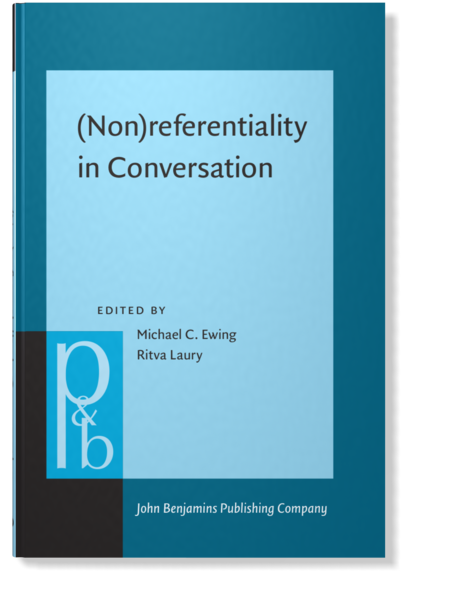
In:(Non)referentiality in Conversation
Edited by Michael C. Ewing and Ritva Laury
[Pragmatics & Beyond New Series 344] 2024
► pp. 11–34
Chapter 2Elusive referentiality and allusive reference in Indonesian conversation
Published online: 1 August 2024
https://doi.org/10.1075/pbns.344.02ewi
https://doi.org/10.1075/pbns.344.02ewi
Abstract
This chapter examines referential practices in a corpus of colloquial Indonesian conversation and attempts
to address the question: “Does referentiality matter to speakers?” I take referentiality to be a multi-dimensional phenomenon
involving (at least) whether referents are construed as general or particular and whether they are tracked through discourse.
Through close examination of excerpts from conversational interaction, I show that there is often a blurring between the
general and the particular, that referents are often indeterminate, and that referentiality as a discrete and classifiable
linguistic property often does not seem to be relevant to participants in ongoing interaction. In this sense, referentiality
does not always appear to matter to speakers. At the same time, referential practices do appear to be exploitable by speakers
as resources for social action. Specifically, I show that a shift in referential practices regularly coincides with a shift in
alignment, understood in terms of footing. These may involve shifts between generalising and exemplifying or moving from
narratorial to quoted speech. To the extent that shifts in referentiality coincide with shifts in footing, then it can be said
that referentiality does matter to speakers.
Keywords: interactional linguistics, referentiality, conversation, Indonesian
Article outline
- 1.Introduction
- 2.Theoretical background
- 3.The data
- 4.Allusive reference and indeterminacy
- 4.1Indeterminate particular reference
- 4.2Indeterminate reference in sequence
- 4.3Referential fluidity
- 5.Changes in referentiality and footing with explicit reference
- 5.1General to particular reference and change of footing
- 5.2Change of footing through fluid generality
- 6.Discussion: Referentiality, indeterminacy, and social action
Acknowledgements Notes References

References (27)
Djenar, Dwi Noverini, Michael C. Ewing and Howard Manns. 2018. Style
and Intersubjectivity in Youth
Interaction. Berlin: De Gruyter.
Donnellan, Keith. 1966. “Reference
and Definite
Descriptions.” In Semantics, ed.
by Danny D. Steinberg & Leon A. Jakobovits, 100–114. Cambridge: Cambridge University Press.
Du Bois, John W. 1980. “Beyond Definiteness:
The Trace of Identity in Discourse.” In The Pear Stories:
Cognitive, Cultural, and Linguistic Aspects of Narrative Production, ed.
by Wallace L. Chafe, 203–274. Norwood, N.J.: Ablex.
Du Bois, John W. and Sandra A. Thompson. 1991. “Dimensions
of a Theory of Information Flow.” Unpublished
Ms. University of California at Santa Barbara.
Du Bois, John W., Stephan Schuetze-Coburn, Susanna Cumming, and Danae Paolino. 1993. “Outline
of Discourse Transcription.” In Talking Data: Transcription
and Coding in Discourse Research, ed. by Jane A. Edwards and Martin D. Lampert, 45–89. Hillsdale, N.J.: Lawrence Erlbaum Associates.
Ewing, Michael C. 2005. “Colloquial
Indonesian.” In The Austronesian Languages of Asia and
Madagascar, ed. by Alexander Adelaar and Nikolaus P. Himmelmann, 227–258. Routledge: London.
2014. “Motivations for First
and Second Person Subject Expression and Ellipsis in Javanese Conversation.” Journal of
Pragmatics 63: 48–62.
2015. “The
Kalau Framing Construction in Indonesian Comics.” NUSA: Linguistic
Studies of Languages in and around
Indonesia 58: 51–72.
2019. “The Predicate as a
Locus of Grammar and Interaction in Colloquial Indonesian.” Studies in
Language 43 (2): 402–443.
Ewing, Michael C., and Dwi Noverini Djenar. 2019. “Address,
Reference and Sequentiality in Indonesian Conversation.” The Social Dynamics of
Pronominal Systems: A Comparative Approach, ed. by Paul Bouissac, 253–287. Amsterdam: John Benjamins.
Fox, Barbara A. 1994. “Contextualization,
Indexicality, and the Distributed Nature of Grammar.” Language
Sciences 16 (1): 1–37.
Frege, Gottlieb. 1892. “Über
Sinn und Bedeutung.” Zeitschrift für Philosophie und philosophische
Kritik 100 (1892): 25–50.
Goffman, Erving. 1981. “Footing.” In Forms
of Talk, ed. by Erving Goffman, 124–159. Oxford: Blackwell.
Gundel, Jeanette K. 2010. “Reference and
Accessibility from a Givenness Hierarchy Perspective.” International Review of
Pragmatics 2: 148–168.
Gundel, Jeanette K., Nancy Hedberg and Ron Zacharski. 1993. “Cognitive
Status and the Form of Referring Expressions in
Discourse.” Language 69 (2): 274–307.
Nagaya, Naonori. 2011. “Rise
and Fall of Referentiality: Articles in Philippine
Languages.” In Nominalization in Asian Languages: Diachronic
and Typological Perspectives, ed. by Foong Ha Yap, Karen Grunow-Hårsta and Janick Wrona, 549–626. Amsterdam: John Benjamins.
Nariyama, Shigeko. 2003. Ellipsis
and Referent Tracking in
Japanese. Amsterdam: John Benjamins.
Oh, Sun-Young. 2007. “Overt
Reference to Speaker and Recipient in Korean.” Discourse
Studies 9 (4): 462–492.
Ono, Tsuyoshi and Ryoko Suzuki. 2020. “Exploration
into a New Understanding of ‘Zero Anaphora’ in Japanese Everyday
Talk.” In Fixed Expressions: Building Language Structure and
Social Action, ed. by Ritva Laury and Tsuyoshi Ono, 41–70. Amsterdam: John Benjamins.
Ono, Tsuyoshi and Sandra A. Thompson. 1997. “Deconstructing
‘Zero Anaphora’ in Japanese.” Proceedings of the Twenty-Third Annual Meeting of the
Berkeley Linguistics Society: General Session and Parasession on Pragmatics and Grammatical
Structure (1997): 481–491.
Cited by (1)
Cited by one other publication
This list is based on CrossRef data as of 29 november 2025. Please note that it may not be complete. Sources presented here have been supplied by the respective publishers. Any errors therein should be reported to them.