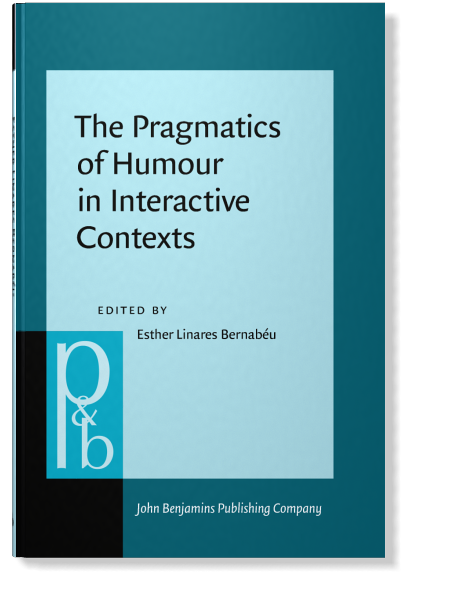
In:The Pragmatics of Humour in Interactive Contexts
Edited by Esther Linares Bernabéu
[Pragmatics & Beyond New Series 335] 2023
► pp. 110–132
Epistemics and conversational humour in intercultural first conversations
Published online: 24 May 2023
https://doi.org/10.1075/pbns.335.05she
https://doi.org/10.1075/pbns.335.05she
Abstract
In this paper, we examine conversational humour in
intercultural initial interactions, in which participants not only
do not know each other, but also come from different cultural
backgrounds, through the lens of epistemics. Our
analysis examines episodes of conversational humour identified in
the Video-Mediated English as a Lingua Franca Conversations (ViMELF)
corpus (ViMELF 2018). The analysis focuses on the design of these humour
episodes, the negotiation of shared knowledge prior to and during
these episodes, and responses to humour bids. Results indicate that
whether and how an attempt at humour is responded to reflects the
epistemic stance/status of participants in that conversation. When
the speaker assumes K- status for the recipient or there is no local
negotiation of relevant knowledge, the laughable is generally
disattended. On the other hand, when K+ status is assumed for the
recipient or the laughable is based on locally co-constructed shared
knowledge and/or knowledge is negotiated, the humour episode is
expanded upon by the recipient. We conclude that the role of
epistemics needs to be more explicitly attended to in the
theorisation of humour more broadly.
Article outline
- 1.Introduction
- 2.Conversational humour in intercultural and initial interactions
- 3.The role of knowledge in theorising conversational humour
- 4.Data and method
- 5.The epistemics of conversational humour
- 6.Conclusion
Notes References

References (82)
Arundale, Robert B. (2010). Constituting
face in conversation: Face, facework, and interactional
achievement. Journal
of
Pragmatics 42: 2078–2105.
(2012). Smiling,
laughter and
humour. In Paolo Santacangelo (ed.), Laughing
in
Chinese (pp.421–436). Rome: Aracne.
(2019). Humour
and mirth. Emotions, embodied cognition, and sustained
humour. In J. Lachlan Mackenzie and Laura Alba-Juez (eds.), Emotion
in
Discourse (pp.198–211). Amsterdam: John Benjamins.
Attardo, Salvatore, Jodi Eisterhold, Jennifer Hay and Isabella Poggi (2003). Multimodal
markers of irony and
sarcasm. HUMOR:
International Journal of Humor
Research 16(2): 243–260
Barsalou, Lawrence W. (2003). Situated
simulation in the human conceptual
system. Language
and Cognitive
Processes 5(6): 513–562.
Bateson, Gregory (1955). A
theory of play and
fantasy. In Approaches
to the Study of Human
Personality (pp.39–51). Washington, D.C.: American Psychiatric Association.
Bell, Nancy (2006). Interactional
adjustments in humorous intercultural
communication. Intercultural
Pragmatics 3(1): 1–28.
(2007). How native and non-native English speakers adapt to humor in intercultural interaction. HUMOR: International Journal of Humor Research 20(1): 27-48.
Bell, Nancy and Anne Pomerantz (2019). Humour
in L2 pragmatics
research. In Naoko Taguchi (ed.), Routledge
Handbook of Second Language Acquisition and
Pragmatics (pp.63–77). London: Routledge.
Bolden, Galina (2009). Implementing
incipient actions: The discourse marker ‘so’ in English
conversation. Journal
of
Pragmatics 41: 974–998.
Brunner, Marie-Louise, Stefan Diemer and Selina Schmidt (2018). CASE
Transcription
Conventions. Birkenfeld: Trier University of Applied Sciences. Available
at [URL].
Davies, Catherine Evans (1984). Joint
joking. Improvisational humorous episodes in
conversation. Berkley
Linguistics
Society 10: 360–371.
(2003). How
English-learners joke with native speakers: an interactional
sociolinguistic perspective on humour as collaborative
discourse across
cultures. Journal
of
Pragmatics 35: 1361–1385.
DiCioccio, Rachel and Nathan Miczo (2014). Intercultural
humor. In Salvatore Attardo (ed.), Encyclopedia
of Humour
Studies (pp.387–388). Thousand Oaks, CA: Sage.
Drew, Paul and Elizabeth Holt (1998). Figures
of speech: Figurative expressions and the management of
topic transition in
conversation. Language
in
Society 27: 495–522.
Dynel, Marta (2009). Beyond
a joke: types of conversational
humour. Language
and Linguistics
Compass 3, 5: 1284–1299.
(2011). Joker
in the pack. Towards determining the status of humorous
framing in
conversation. In Marta Dynel (ed.), The
Pragmatics of Humour across Discourse
Domains (pp.217–241). Amsterdam: John Benjamins.
(2017). “Is
there a tumour in your humour?”: On misunderstanding and
miscommunication in conversational
humour. In Rachel Giora and Michael
Haugh (eds.), Doing
Pragmatics Interculturally. Cognitive, Philosophical and
Sociopragmatic
Perspecdtives (pp.55–78). Berlin: Mouton de Gruyter.
Everts, Elisa (2003). Identifying
a particular family humour style: a sociolinguistic
discourse
analysis. HUMOR:
International Journal of Humor
Research 16(4): 369–412.
Fauconnier, Gilles and Mark Turner (2003). The
Way We Think: Conceptual Blending and the Mind’s Hidden
Complexities. New York: Basic Books.
Goddard, Cliff (2006). “Lift
your game Martina!”: deadpan jocular irony and the
ethnopragmatics of Australian
English. In Cliff Goddard (ed.), Ethnopragmatics:
Understanding Discourse in Cultural
Context (pp.65–97). Berlin: Mouton de Gruyter.
Goffman, Erving (1974). Frame
Analysis: An Essay on the Organisation of
Experience. Boston, MA: Northeastern University Press.
Haugh, Michael (2011). Humour,
face and im/politeness in getting
acquainted. Bethan Davies, Michael Haugh and Andrew John Merrison (eds.), Situated
Politeness (pp.165–184). London: Continuum.
(2012). Conversational
interaction. In Keith Allan and Kasia M. Jaszczolt (eds.), Cambridge
Handbook of
Pragmatics (pp.251–274). Cambridge: Cambridge University Press.
(2014). Jocular
mockery as interactional practice in everyday
Anglo-Australian
conversation. Australian
Journal of
Linguistics 34(1): 76–99.
(2016). Mocking
and (non-)seriousness in initial interactions amongst
American and Australian speakers of
English. In Donal Carbaugh (ed.), Handbook
of Communication in Cross-Cultural
Perspective (pp.104–117). London: Routledge.
(2022). (Im)politeness
in video-mediated first conversations amongst speakers of
English as a lingua
franca. In Ian Walkinshaw (ed.), Pragmatics
in English as a Lingua
Franca (pp.81–103). Berlin: Mouton de Gruyter.
Haugh, Michael and Donal Carbaugh (2015). Self-disclosure
in initial interactions amongst speakers of American and
Australian
English. Multilingua 34: 461–493.
Haugh, Michael and Simon Musgrave (2019). Conversational
lapses and laughter: towards a combinatorial approach to
building collections in conversation
analysis. Journal
of
Pragmatics 143: 279–291.
Haugh, Michael and Danielle Pillet-Shore (2018). Getting
to know you: Teasing as an invitation to
intimacy. Discourse
Studies 20: 246–269.
Haugh, Michael and Valeria Sinkeviciute (2021). The
pragmatics of initial interactions: cross-cultural and
intercultural
perspectives. Journal
of
Pragmatics 185: 35–39.
Haugh, Michael and Lara Weinglass (2018). Divided
by a common language? Jocular quips and (non-)affiliative
responses in initial interactions among American and
Australian speakers of
English. Intercultural
Pragmatics 15: 533–562.
Heritage, John (1984). A
change-of-state token and aspects of its sequential
placement. In: J. M. Atkinson and John Heritage (eds.), Structures
of Social
Action (pp.299–345). Cambridge: Cambridge University Press.
(2002). The
limits of questioning: negative interrogatives and hostile
question
content. Journal
of
Pragmatics 34: 1427–1446.
(2012). The
epistemic engine: sequence organisation and territories of
knowledge. Research
on Language and Social
Interaction 45(1): 30–52.
(2013). Action
formation and its epistemic (and other)
backgrounds. Discourse
Studies 15(5): 551–578.
Heritage, John and Geoffrey Raymond (2005). The
terms of agreement: indexing epistemic authority and
subordination in
talk-in-interaction. Social
Psychology
Quarterly 68(1): 15–38.
Jefferson, Gail (1979). A
technique for inviting laughter and its subsequent
acceptance
declination. In George Psathas (ed.), Everyday
Language. Studies in
Ethnomethodology (pp.79–95). New York: Irvington.
(2004). Glossary
of transcript symbols with an
introduction. In Gene Lerner (ed.), Conversation
Analysis: Studies from the First
Generation (pp.13–23). Amsterdam: John Benjamins.
Kamio, Akio (1997). Territory
of
Information. Amsterdam: John Benjamins.
Kotthoff, Helga (2006). Pragmatics
of performance and the analysis of conversational
humour. Humor 19(3): 271–304.
Labov, William and David Fanshel (1977). Therapeutic
discourse: Psychotherapy as
conversation. New York: Academic Press.
Ladilova, Anna and Ulrike Schröder (2022). Humour
in intercultural interaction: a source for misunderstanding
or a common ground
builder? Intercultural
Pragmatics 19(1): 71–101.
Langlotz, Andreas (2015). Creating
Social Orientation through
Language. Amsterdam: John Benjamins.
Li, Xiaoting (2020). Interpersonal
touch in conversational
joking. Research
on Language and Social
Interaction 53: 357–379.
Martin, Rod A. (2007). The
Psychology of Humour: An Integrative
Approach. Burlington, MA: Elsevier Academic.
Matsumoto, Yumi (2014). Collaborative
co-construction of humorous interaction among ELF
speakers. Journal
of English as a Lingua
Franca 3(1): 81–107.
Mullan, Kerry (2020). Humour
in French and Australian English initial
interactions. Journal
of
Pragmatics 169: 86–99.
(2000). Conversational
Narrative: Storytelling in Everyday
Talk. Amsterdam: John Benjamins.
(2007). Interdiscourse
humor: contrast, merging,
accommodation. HUMOR:
International Journal of Humor
Research 20(4): 389–413.
O’Donnell-Trujillo, Nick and Katherine Adams (1983). Heheh in conversation: some
coordinating accomplishments of
laughter. Western
Journal of Speech
Communication 47: 175–191.
Okada, Yusuke (2015). Building
rapport through sequentially linked joke-serious responses
in second language job
interviews. Pragmatics
and
Society 6(4): 593–614.
Priego-Valverde, Béatrice (2003). L’humour
dans la Conversation Familière: Description et Analyse
Linguistiques. France: L’harmattan.
(2009). Failed
humour in conversation: a double voicing
analysis. In Neal Norrick and Delia Chiaro (eds.), Humour
in
Interaction (pp.165–183). Amsterdam: John Benjamins.
(2016). Teasing
in casual conversations: an opportunistic discursive
strategy. In Leonor Ruiz-Gurillo (ed.), Metapragmatics
of Humor: Current Research
Trends (pp.215–253). Amsterdam: John Benjamins.
Pullin, Patricia (2011). Humour
and the integration of new staff in the
workplace. In Marta Dynel (ed.), Pragmatics
of Humour across Discourse
Domains (pp.265–287). Amsterdam: John Benjamins.
(2018). Humour
in ELF
interaction. In Jennifer Jenkins, Will Baker and Martin Dewey (eds.), Routledge
Handbook of English as a Lingua
Franca (pp.333–343). London: Routledge.
Raymond, Geoffrey and John Heritage (2006). The
epistemics of social relations: owning
grandchildren. Language
in
Society 35(5): 677–705.
Rogerson-Revell, Pamela (2007). Humour
in business: a double-edged sword. A study of humour and
style shifting in intercultural business
meetings. Journal
of
Pragmatics 39: 4–28.
Schank, Roger C. and Robert Abelson (1977). Scripts,
Plans, Goals and
Understanding. New York: Wiley.
Schegloff, Emanuel A. (2007) Sequence
Organization in
Interaction. Cambridge: Cambridge University Press.
Schenkein, James N. (1972). Towards
an analysis of natural conversation and the sense of
heheh. Semiotica 6(4): 344–377.
Stivers, Tanya, Lorenza Mondada and Jakob Steensig (eds.) (2011). The
Morality of Knowledge in
Interaction. Cambridge: Cambridge University Press.
Suls, Jerry (1972). A
two-stage model for the appreciation of jokes and
cartoons. In Jefferey Goldstein and Paul McGhee (eds.), The
Psychology of
Humour (pp.81–100). New York: Academic Press.
Thielemann, Nadine (2020). Understanding
Conversational Joking. A Cognitive-Pragmatic Study based on
Russian
Interactions. Amsterdam: John Benjamins.
ViMELF (2018). Corpus
of Video-Mediated English as a Lingua Franca
Conversations. Birkenfeld: Trier University of Applied Sciences. Available
at: [URL].
Yus, Francisco (2016). Humour
and
Relevance. Amsterdam: John Benjamins.
Cited by (4)
Cited by four other publications
Haugh, Michael & Wei-Lin Melody Chang
Mendes de Oliveira, Milene, Tiina Räisänen & Tuire Oittinen
Lin, Bingbing & Jagdish Kaur
[no author supplied]
This list is based on CrossRef data as of 29 november 2025. Please note that it may not be complete. Sources presented here have been supplied by the respective publishers. Any errors therein should be reported to them.