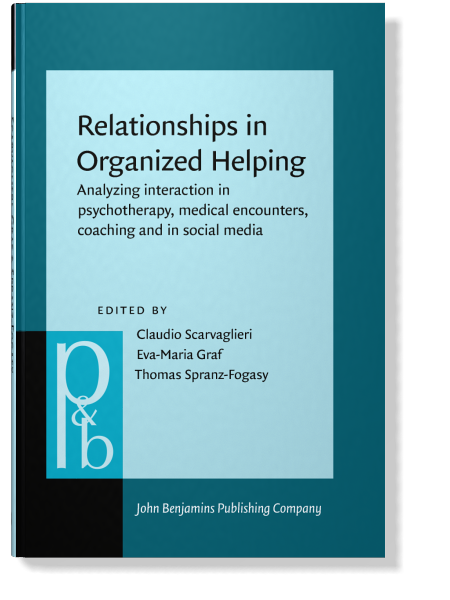
In:Relationships in Organized Helping: Analyzing interaction in psychotherapy, medical encounters, coaching and in social media
Edited by Claudio Scarvaglieri, Eva-Maria Graf and Thomas Spranz-Fogasy
[Pragmatics & Beyond New Series 331] 2022
► pp. 171–194
Working alliance and client design as discursive achievements in first sessions of executive coaching
Published online: 7 September 2022
https://doi.org/10.1075/pbns.331.08gra
https://doi.org/10.1075/pbns.331.08gra
Abstract
While outcome research has convincingly proven that the working alliance is a key success factor in coaching,
qualitative process-oriented insights are so far missing. We strive to fill this gap by shifting the focus from ‘the working
alliance is crucial’ to ‘how is the working alliance discursively accomplished in authentic coaching interactions?’. The
guiding assumption is that the coaching alliance emerges locally as a joint product of coach and clients’ negotiation process.
We analyze the first sessions of two different coach-client dyads from the executive coaching protocol Emotional Intelligentes Coaching within an integrative discourse analytic framework. Our analyses demonstrate
that the coach displays a specific ‘client design’ in the local discursive management of the working alliance.
Article outline
- 1.The relevance of the working alliance in coaching: An introduction
- 2.The coaching alliance: Relevant theoretical and empirical perspectives
- 3.The coaching alliance: A linguistic approximation via the Basic Activity Model
- 4.Methodology and data
- 5.Working on the working alliance: Analysis and findings
- 5.1Getting started
- Summary: Getting started
- 5.2Voicing expectations regarding coach, coaching and coaching alliance
- Summary: Voicing expectations regarding coach, coaching and coaching alliance
- 5.3Negotiating the expectations
- Summary: Negotiating the expectations
- 5.1Getting started
- 6.The dynamics of the working alliance and client design in coaching: Summary and outlook
Notes References

References (47)
Behn-Taran, Angelika. 2014. “I Am My Worst Enemy”. A Linguistic Analysis of Interactive Dynamics or Relational Patterns in Business Coaching
Conversations. Dissertation. Ludwig-Maximilians-Universität München.
Böhringer, Daniela, Sarah Hitzler, and Martina Richter (eds.). 2022. Helfen. Situative und organisationale Ausprägungen einer unterbestimmten Praxis. Bielefeld: Transcript Verlag.
Bordin, Edward S. 1979. “The Generalizability of the Psychoanalytic Concept of the Working Alliance.” Psychotherapy: Theory, Research and Practice 16 (3): 252–260.
Fischer, Kerstin. 2016. Designing Speech for a Recipient. The Roles of Partner Modeling, Alignment and Feedback in So-Called ‘Simplified
Registers’. Amsterdam: John Benjamins.
Gessnitzer, Sina, and Simone Kauffeld. 2015. “The Working Alliance in Coaching: Why Behavior is the Key to Success.” The Journal of Applied Behavioral Science 51 (2): 177–197.
Goffman, Erving. 1974. Frame Analysis: An Essay on the Organization of Experience. Cambridge, Mass.: Harvard University Press.
Graf, Eva-Maria. 2019. The Pragmatics of Executive Coaching. Amsterdam: John Benjamins.
Graf, Eva-Maria, and Sabine Jautz. 2019. “‘und wie wie entsteht veränderung und damit haben_s wir ja auch mit dir zu tun’ – Einblicke in die inter-
und intra-aktivitätsspezifische Dimension der kommunikativen Basisaktivität ‘Ko-Konstruieren von Veränderung’ im
Führungskräfte-Coaching.” In Pragmatik der Veränderung, ed. by Eva-Maria Graf, Claudio Scarvaglieri, and Thomas Spranz-Fogasy, 209–237. Tübingen: Narr/ Francke/ Attempto.
Graf, Eva-Maria, and Joanna Pawelczyk. 2014. “The Interactional Accomplishment of Feelings-Talk in Psychotherapy and Executive Coaching. Same Format,
Different Functions?” In Discourses of Helping Professions, ed. by Eva-Maria Graf, Marlene Sator, and Thomas Spranz-Fogasy, 59–89. Amsterdam: John Benjamins.
Graf, Eva-Maria, and Thomas Spranz-Fogasy. 2018. “Helfende Berufe – Helfende Interaktionen.” In Handbuch Text und Gespräch, ed. by Karin Birkner, and Nina Janich, 418–442. Amsterdam: Mouton de Gruyter.
Graßmann, Carolin, Franziska Schölmerich, and Carsten C. Schermuly. 2019. “The Relationship between Working Alliance and Client Outcomes in Coaching: A Meta-Analysis.” Human Relations 73 (1): 35–58.
Greenson, Ralph R. 1965. “The Working alliance and the transference neurosis.” Psychoanalytic Quarterly 34: 155–181.
Gülich, Elisabeth. 2003. “Conversational Techniques Used in Transferring Knowledge between Medical Experts and
Non-Experts.” Discourse Studies 5 (2): 235–263.
Gumperz, John. 2001. “Contextualization and Ideology in Intercultural Communication.” In Culture in Communication: Analyses of Intercultural Situations, ed. by Aldo Di Luzio, Susanne Günthner, and Franca Orletti, 35–54. Amsterdam: John Benjamins.
Haakana, Markku. 2001. “Laughter as a Patient’s Resource: Dealing with Delicate Aspects of Medical Interaction.” Text 21 (1 & 2): 187–219.
Heritage, John. 2011. “Territories of Knowledge, Territories of Experience: Empathic Moments in Interaction.” In The Morality of Knowledge in Conversation, ed. by Tanya Stivers, Lorenza Mondada, and Jakob Steensig, 159–183. Cambridge: Cambridge University Press.
. 2013. “Action Formation and its Epistemic (and Other) Backgrounds.” Discourse Studies 15 (5): 551–578.
Heritage, John, and Jeffrey D. Robinson. 2006. “Accounting for the Visit: Giving Reasons for Seeking Medical Care.” In Communication in Medical Care: Interaction between Primary Care Physicians and Patients, ed. by John Heritage, and Douglas Maynard, 48–85. Cambridge: Cambridge University Press.
Horvath Adam O., and Peter Muntigl. 2018. “The Alliance as a Discursive Achievement: A Conversation Analytical Perspective.” In Therapy as Discourse. The Language of Mental Health, ed. by Olga Smoliak, and Tom Strong, 71–93. Basingstoke: Palgrave Macmillan, Cham.
Ianiro, Patrizia M., Nale Lehmann-Willenbrock, and Simone Kauffeld. 2015. “Coaches and Clients in Action: A Sequential Analysis of Nonverbal Interpersonal Styles in Coach-Client
Interactions.” Journal of Business and Psychology 30: 435–456.
Jautz, Sabine. 2017. “Immer auf Augenhöhe? Ein Blick in den sprachlichen Werkzeugkoffer im Coaching.” In Sprache in Rede, Gespräch und Kommunikation. Linguistisches Wissen in der Kommunikationsberatung, ed. by Marcel Dräger, and Martha Kuhnhenn, 47–64. Frankfurt am Main etc.: Peter Lang.
Kilburg, Richard R. 2000. Executive Coaching. Developing Managerial Wisdom in a World of Chaos. Washington D.C.: American Psychological Association.
Mondada, Lorenza. 2011. “The Management of Knowledge Discrepancies and of Epistemic Changes in Institutional
Interactions.” In The Morality of Knowledge in Conversation, ed. by Tanya Stivers, Lorenza Mondada, and Jakob Steensig, 27–57. Cambridge: Cambridge University Press.
Neukom, Marius, Katrin Schnell, and Brigitte Boothe. 2011. “Die Arbeitsbeziehung im Coaching – ein Stiefkind der Forschung.” Organisationsberatung, Supervision, Coaching 18 (3): 317–332.
Nowak, Peter. 2010. Eine Systematik der Arzt-Patient-Interaktion. Frankfurt am Main etc.: Peter Lang.
Peräkylä, Anssi: 1995. AIDS Counseling. Institutional Interaction and Clinical Practice. Cambridge: Cambridge University Press.
Pomerantz, Anita, and John Heritage. 2013. “Preference.” In The Handbook of Conversation Analysis, ed. by Jack Sidnell, and Tanya Stivers, 210–228. Chichester, U.K.: Wiley Blackwell.
Rettinger, Sabine. 2011. “Das Coaching-Erstgespräch: ‘Handlungsidentitäten’ in der Beziehungsgestaltung zwischen Coach und
Klient.” In Beratung, Coaching, Supervision: Multidisziplinäre Perspektiven vernetzt, ed. by Eva-Maria Graf, Yasmin Aksu, Ina Pick, and Sabine Rettinger, 149–166. VS Verlag für Sozialwissenschaften, Wiesbaden.
Roberts, Celia, and Srikant Sarangi. 2005. “Theme-Oriented Discourse Analysis of Medical Encounters.” Medical Education 39: 632–640.
Sacks, Harvey. 1972. “An Initial Investigation of the Usability of Conversational Data for Doing Sociology.” In Studies in Social Interaction, ed. by David Sudnow, 31–74. New York: Free Press.
Sacks, Harvey, Emanuel A. Schegloff, and Gail Jefferson. 1974. “A Simplest Systematics for the Organization of Turn-Taking for Conversation.” Language 50 (4): 696–735.
Sarangi, Srikant. 2001. “On Demarcating the Space between ‘Lay Expertise’ and ‘Expert Laity’.” Text 21 (1 & 2): 3–11.
. 2005. “Activity Analysis in Professional Discourse Settings: The Framing of Risk and Responsibility in Genetic
Counselling.” Hermès 41: 110–120.
. 2010. “Practising Discourse Analysis in Healthcare Settings.” In The SAGE Handbook of Qualitative Methods in Health Research, ed. by Ivy Bourgeault, Robert Dingwall, and Ray de Vries, 397–416. Los Angeles: SAGE Publications.
Schegloff, Emanuel. 2007. Sequence Organization in Interaction. A Primer in Conversation Analysis. Cambridge: Cambridge University Press.
Selting, Margret et al.. 2009. “Gesprächsanalytisches Transkriptionssystem 2 (GAT2).” Gesprächsforschung – Online-Zeitschrift zur verbalen Interaktion ([URL]) 10: 353–402.
Sills, Charlotte. 2021. “Understanding the Coaching Relationship.” In The Coaches’ Handbook. The Complete Practitioner Guide for Professional Coaches, ed. by Jonathan Passmore, 68–76. New York: Routledge.
Silverman, David. 1997. Discourses of Counselling: HIV Counselling as Social Interaction. London: SAGE Publications.
Spranz-Fogasy, Thomas. 1992. “Ärztliche Gesprächsführung – Inhalte und Erfahrungen gesprächsanalytisch fundierter
Weiterbildung.“ In Kommunikationsberatung und Kommunikationstraining. Anwendungsfelder der Diskursforschung, ed. by Reinhard Fiehler, and Wolfgang Sucharowski, 68–78. Opladen: Westdeutscher Verlag.
Stivers, Tanya, Lorenza Mondada, and Jakob Steensig. 2011. “Knowledge, Morality and Affiliation in Social Interaction.” In The Morality of Knowledge in Conversation, ed. by Tanya Stivers, Lorenza Mondada, and Jakob Steensig, 3–24. Cambridge: Cambridge University Press.
Theebom, Tim, Bianca Beersma, and Annelies E. M. van Vianen. 2014. “Does Coaching Work? A Meta-Analysis on the Effects of Coaching on Individual Level Outcomes in an
Organizational Context.” The Journal of Positive Psychology 9 (1): 1–18.
Weidner, M. 2012. "On
the organization of Polish doctor–patient communication". PhD
dissertation, Department of Linguistics, University of Antwerp.
Cited by (4)
Cited by four other publications
Fleischhacker, Melanie & Eva-Maria Graf
Fleischhacker, Melanie, Eva-Maria Graf & Susanne Kabatnik
Kabatnik, Susanne
This list is based on CrossRef data as of 29 november 2025. Please note that it may not be complete. Sources presented here have been supplied by the respective publishers. Any errors therein should be reported to them.