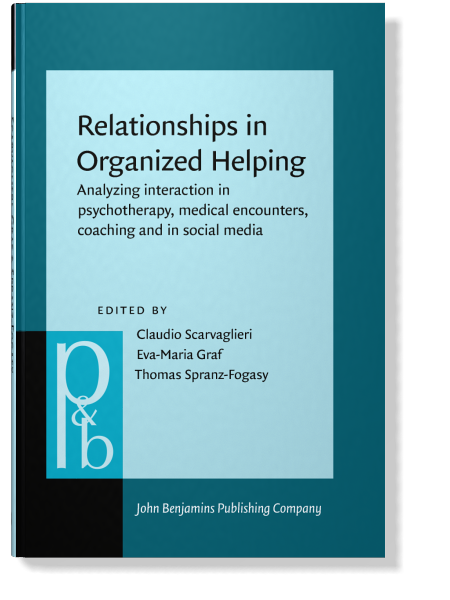
In:Relationships in Organized Helping: Analyzing interaction in psychotherapy, medical encounters, coaching and in social media
Edited by Claudio Scarvaglieri, Eva-Maria Graf and Thomas Spranz-Fogasy
[Pragmatics & Beyond New Series 331] 2022
► pp. 151–170
The role of semi-responsive answers for relationship building in coaching
Published online: 7 September 2022
https://doi.org/10.1075/pbns.331.07win
https://doi.org/10.1075/pbns.331.07win
Abstract
This paper discusses the role of semi-responsive answers of clients for relationship building in coaching. Coaching
is a process-oriented type of counseling in which a coach and a coachee collaboratively work on solving a particular worklife
or daily life related concern of the coachee. The paper aims at identifying and analyzing semi-responsive answers of coachees
(second pair part) as reactions to initiating turns of coaches (first pair part). It is hypothesized that semi-responsive
answers are of particular relevance for any coaching process as they reveal ambivalences, (inner) conflicts, uncertainties
and/or opposition on the client’s side which ought to be noticed and appropriately addressed by the coach. A conversation
analysis manual was developed in order to systematically identify and analyze the linguistic characteristics of
semi-responsiveness in coachee’s answers. First, theoretical and methodological aspects regarding a conversation analysis
manual to study structures of social interaction are discussed. Second, a code-system to identify semi-responsive answers is
demonstrated. Finally, based on the transcribed data, semi-responsive answers are analyzed with respect to how they are
addressed by the coaches in third position. The data consists of 21 face-to-face coaching sessions (64 hours) in Swiss and
Standard German. The analysis demonstrates that semi-responsive answers are both a valuable source of information and a
challenge as they require the coach to maintain a balance between facilitating the process and maintaining a good relationship
with the client.
Article outline
- 1.Introduction
- 2.Theory
- 2.1Helping conversation
- 2.2Conversation analysis and responsiveness
- 2.3Semi-responsive answers in coaching
- 2.4Third position actions and the coach-client-relationship
- 2.5Research question
- 3.Method
- 3.1CA-grounded manual
- 3.2Sample
- 3.3Developing categories (Codes)
- 3.4Applying the codes
- 4.Results
- 5.Discussion
- 6.Conclusions
Notes References

References (35)
Behn-Taran, Angelika. 2014. “I am my own worst enemy.” A linguistic analysis of interactive dynamics of relational patterns in business
coaching conversations. [URL].
Brinker, Karl, and Sven Frederik Sager. 2010. Linguistische Gesprächsanalyse. Eine Einführung. Berlin: Schmidt.
Burt, Daniel, and Zenobia Talati. 2017. “The unsolved value of executive coaching: A meta-analyses of outcome using randomized control trial
studies.” International Journal of Evidence Based Coaching and Mentoring 15 (2): 17–24.
De Haan, Erik, and Judie Gannon. 2016. “The
Coaching
Relationship.” In The
SAGE Handbook of Coaching, ed.
by. Tatiana Bachkirova, Gordon Spence, and David Drake, 195–216. London: SAGE Publications Ltd, doi.org/10.4135/9781473983861.n11
De Meuse, Kenneth P., Dai, Guangrong, and Robert J. Lee. 2009. “Evaluating the effectiveness of executive coaching: beyond ROI?” Coaching, 2(2): 117–134.
Deplazes, Silvia, Eva-Maria Graf, and Hansjörg Künzli. 2018. “Das TSPP-Modell – Eine Blaupause für die Coaching-Prozessforschung.” Coaching | Theorie & Praxis 4: 69–82. .
Graf, Eva-Maria. 2015. “Kommunikative Basisaktivitäten im Coaching-Gespräch: Ein linguistischer Beitrag zur
Coaching-Prozessforschung.” Coaching | Theorie & Praxis 1: 5–14. .
. 2018. “Äußerung für Äußerung zum Coaching-Prozess: Das Potential einer gesprächsanalytisch fundierten
Coaching-Prozessforschung.“ In Coaching-Prozessforschung. Forschung und Praxis im Dialog, ed. by Robert Wegener, Michael Loebbert, Agnes Fritze, and Marianne Hänseler, 141–161. Göttingen: Vandenhoeck & Ruprecht.
Graf, Eva-Maria, and Thomas Spranz-Fogasy. 2018. “Welche Frage, wann und warum? – Eine qualitativ-linguistische Programmatik zur Erforschung von
Frage-Sequenzen als zentrale Veränderungspraktik im Coaching.” Coaching | Theorie & Praxis 4: 17–32. .
Graf, Eva-Maria. 2019. The Pragmatics of Executive Coaching. Amsterdam/Philadelphia: John Benjamins.
Jones, Rebecca J., Stephen A. Woods, and Yves R. F. Guillaume. 2015. “The effectiveness of workplace coaching: a meta analysis of learning and performance outcomes from
coaching.” Journal of Occupational and Organizational Psychology 89: 249–277. .
Kramer, Ueli, and Williams Stiles 2015. “The Responsiveness Problem in Psychotherapy: A Review of Proposed Solutions.” Clincal Psychology Science and Practice 22(3): 277–295. .
Mannhardt, Sonja, and Erik De Haan. 2018. ”Coaching-Beziehung”. In Handbuch Schlüsselkonzepte im Coaching, ed. by. Siegfried Greif, Heidi Möller, and Wolfgang Scholl, 85–94. Berlin: Springer. .
Nothdurft, Werner, Ulrich Reitmeier, and Peter Schröder. 1994. Beratungsgespräche. Analyse asymmetrischer Dialoge. Tübingen: Narr.
Oxford Dictionaries. 2022. “Responsiveness.” [URL]
Peräkylä, Anssi, Charles Antaki, Sanna Vehviläinen, and Ivan Leudar (eds). 2008. Conversation Analysis of Psychotherapy. Cambridge: Cambridge University Press.
Peräkylä, Anssi. 2013. “Conversation Analysis in Psychotherapy.” In The Handbook of Conversation Analysis, ed. by. Jack Sidnell, and Tanya Stivers, 551–574. Hoboken, NJ: Wiley-Blackwell Publishing.
. 2019. “Conversation
Analysis and Psychotherapy: Identifying transformative
sequences.” Research on Language and Social
Interaction 52:3: 257–280, .
Pick, Ina (ed.). 2017. Beraten in Interaktion. Eine gesprächslinguistische Typologie des Beratens. Frankfurt am M.: Lang.
Sarangi, Srikant. 2002. “The Language of Likelihood in Genetic Counselling Discourse.” Journal for Language and Social Psychology 21(1): 7–31. .
Scarvaglieri, Claudio. 2013. “Nichts anderes als ein Austausch von Worten. Sprachliches Handeln in der Psychotherapie.” Berlin/Bosten: de Gruyter.
Schegloff, Emanuel. 2007. Sequence Organization in Interaction. A Primer in Conversation Analysis. Cambridge: Cambridge University Press.
Schwitalla, Johannes (1979). "Nonresponsive
Antworten." Deutsche Sprache, Zeitschrift für
Theorie, Praxis, Dokumentation. 7.
Jahrgang. 193-211.
Selting, Margret et al.. 2009. “Gesprächsanalytisches Transkriptionssystem 2 (GAT 2).” Gesprächsforschung – Online-Zeitschrift zur verbalen Interaktion 10: 353–402.
Sonesh, Shirley C., Chris W. Coultas, Christina N. Lacerenza, Shannon L. Marlow, Lauren E. Benishek, and Eduardo Salas. 2015. “The power of coaching: a meta-analytic investigation.” Coaching 8(2): 73–95.
Stivers, Tanja. 2015. "Coding
Social Interaction: A Heretical Approach in Conversation Analysis?" Research on
Language and Social
Interaction 48:1: 1-19.
Theeboom, Tim, Bianca Beersma, and Annelies van Vianen. 2014. “Does coaching work? A meta-analysis on the effects of coaching on individual level outcomes in an
organizational context.” The Journal of Positive Psychology 9(1): 1–18.
Vehviläinen, Sanna. 1999. Structures of Counselling Interaction. A Conversation Analytic Study of Counselling Encounters in Career Guidance
Training. Helsinki: University of Helsinki.
Voutilainen Liisa, Anssi Peräkylä, and Johanna Ruusuvuori. 2010. “Recognition and Interpretation: Responding to Emotional Experience in Psychotherapy.” Research on Language & Social Interaction 43(1): 85–107. 10.1080/08351810903474799.
Cited by (4)
Cited by four other publications
Mikkola, Piia, Riikka Nissi & Esa Lehtinen
Fleischhacker, Melanie & Eva-Maria Graf
Fleischhacker, Melanie & Eva-Maria Graf
This list is based on CrossRef data as of 29 november 2025. Please note that it may not be complete. Sources presented here have been supplied by the respective publishers. Any errors therein should be reported to them.