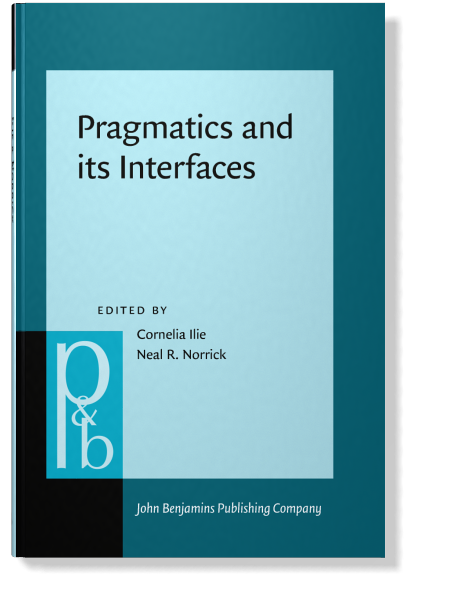
In:Pragmatics and its Interfaces
Edited by Cornelia Ilie and Neal R. Norrick
[Pragmatics & Beyond New Series 294] 2018
► pp. 121–142
Narrative studies versus pragmatics (of narrative)
Published online: 7 September 2018
https://doi.org/10.1075/pbns.294.06nor
https://doi.org/10.1075/pbns.294.06nor
Abstract
This chapter considers the interface between pragmatics and narrative studies, initially with reference to Labovian, conversation analytic (CA) and psycholinguistic approaches to narrative, where common ground is found between these and more properly pragmatic approaches in such topics as tellability and telling rights, along with a shared interest in micro-analytic matters of how tense shifts signal perspective, how discourse markers and repetition mark narrative boundaries and the like. Then it introduces a specifically pragmatic perspective on narrative, considering recurrent functions of stories roughly at the illocutionary level, including both direct and indirect speech acts. This constitutes a top-down, macro-pragmatic perspective on narrative, significantly distinct from CA considerations of epistemic justification for telling or psycholinguistic matters of identity construction.
Keywords: bottom up – top down, discourse marker, formulaicity, macro – micro, narrative, slot, speech act, tellability
Article outline
- 1.Introduction
- 2.Getting the story told: The bottom-up perspective
- 3.What stories do: The top-down perspective
- 4.Stories in story slots
- 5.Direct and indirect force for stories
- 6.Tentative conclusions
Note References

References (75)
Aijmer, Karin. 1987. “
Oh and Ah in English conversation.” In Corpus Linguistics and Beyond, ed. by W. Meijs, 61–86. Amsterdam: Rodopi.
Asher, Nicholas, and Alex Lascarides. 2006. “Indirect Speech Acts.” In.Synthese Indirect Speech Acts – Informatics Homepages Server [URL]
Bamberg, Michael. 2004. “‘I know it may sound mean to say this, but we couldn’t really care less about her anyway’: Form and Functions of ‘Slut-Bashing’ in 15-Year Olds.” Human Development 47: 331–353.
Barthes, Roland. 1966[1975]. “An Introduction to the Analysis of Narrative.” New Literary History 6: 237–272.
Bernaerts, Lars. 2010. “Interactions in Cuckoo’s Nest: Elements of a Narrative Speech-Act Analysis.” Narrative 18: 276–299.
Biber, Douglas, Stig Johansson, Geoffrey Leech, Susan Conrad, and Edward Finegan. 1999. Longman Grammar of Spoken and Written English. Harlow: Pearson Education.
Capone, Alessandro 2005. “Pragmemes (a Study with Reference to English and Italian).” Journal of Pragmatics 37: 1355–1371.
Chafe, Wallace. 1986. “Evidentiality in English Conversation and Academic Writing.” In The Linguistic Coding of Epistemology, ed. by Wallace Chafe, and Johanna Nichols, 261–272. Norwood, NJ: Ablex.
Chatman, Seymour. 1978. Story and Discourse: Narrative Structure in Fiction and Film. Ithaca: Cornell University Press.
Culler, Jonathan. 1975. Structuralist Poetics: Structuralism, Linguistics, and the Study of Literature. Ithaca: Cornell University Press.
Eckert, Penelope. 1989. Jocks and Burnouts: Social Categories and Identity in the High School. New York: Teachers College Press.
Fetzer, Anita 2018 “Discourse Pragmatics: Communicative Action Meets Discourse Analysis.In Pragmatics and Its Interfaces, ed. by Cornelia Ilie, and Neal R. Norrick, 33–57 Amsterdam: John Benjamins.
Fleischman, Suzanne. 1990. Tense and Narrativity: From Medieval Performance to Modern Fiction. Austin: University of Texas Press.
Georgakopoulou, Alexandra. 2007. Small Stories, Interaction and Identities. Amsterdam: Benjamins.
Gordon, Cynthia. 2007. “I just feel horribly embarrassed when she does that’: Constituting a Mother’s Identity.” In Family Talk, ed. by Deborah Tannen, Shari Kendall, and Cynthia Gordon, 49–101. Oxford: Oxford University Press.
Haugh, Michael, and Jonathan Culpeper.2018 “Integrative Pragmatics and (Im)Politeness theory.” In Pragmatics and Its Interfaces, ed. by Cornelia Ilie, and Neal R. Norrick, 213–239 Amsterdam: John Benjamins.
Heath, Shirley Brice. 1982. “Protean Shapes in Literacy Events: Ever-Shifting Oral and Literate Traditions.” In Spoken and Written Language: Advances in Discourse Processes, vol. 9, ed. by Deborah Tannen, 91–118. Norwood: Ablex.
Heritage, John. 1984. “A Change-of-State Token and Aspects of its Sequential Placement.” In Structures of Social Action: Studies in Conversation Analysis, ed. by A. J. Maxwell, and John Heritage, 199–345. Cambridge: Cambridge University Press.
Herman, David (ed). 1999. Narratologies: New Perspectives on Narrative Analysis. Columbus: Ohio StateUniversity Press.
Holmes, Janet. 2018 “Sociolinguistics vs Pragmatics – Where does the Boundary Lie? The Interface between Pragmatics and Conversation Analysis”. In Pragmatics and Its Interfaces, ed. by Cornelia Ilie, and Neal R. Norrick, 11–32 Amsterdam: John Benjamins.
Horn, Lawrence R. 1989. A Natural History of Negation. Chicago: University of Chicago Press. Hymes Dell. 1974. Foundations of Sociolinguistics. Philadelphia: University of Pennsylvania Press [2nd edition. London: Routledge, 2001]
Hymes, Dell. 1974. Foundations in Sociolinguistics: An Ethnographic Approach. Philadelphia: University of Pennsylvania Press.
Ilie, Cornelia. 2018. “Pragmatics vs Rhetoric: Political Discourse at the Pragmatics-Rhetoric Interface. ”In Pragmatics and Its Interfaces, ed. by Cornelia Ilie, and Neal R. Norrick, 85–119. Amsterdam: John Benjamins.
Johnstone, Barbara. 1987. “He says … so I said’: Verb Tense Alternation and Narrative Depictions of Authority in American English.” Linguistics 25: 33–52.Kearns, Michael. 1999. Rhetorical Narratology. Lincoln: University of Nebraska Press.
Labov, William, and Joshua Waletzky. 1967. “Narrative Analysis: Oral Versions of Personal Experience.” In Essays on the Verbal and Visual Arts, ed. by Jean Helm, 12–44. Seattle: University of Washington Press.
Minami, Masahiko. 1998. “Politeness Markers and Psychological Complements: Wrapping-Up Devices in Japanese Oral Personal Narratives.” Narrative Inquiry 8: 351–371.
Mithun, Marianne. 1986. “Evidential Diachrony in Northern Iroquoian.” In Evidentiality: The Linguistic Coding of Epistemology, ed. by Wallace Chafe and Johanna Nichols, 89–112. Norwood, NJ: Ablex.
Norrick, Neal R. 1997. “Twice-Told Tales: Collaborative Narration of Familiar Stories.” Language in Society 26: 199–220.
2000. Conversational Narrative. Amsterdam: Benjamins.
2014. “It just so happened’: Markers of Focus in Narrative and their Translation.” In Caught in the Middle – Language Use and Translation, ed. byKerstin Kunz et al., 349–357. Saarbrücken: Universaar.
2015. “Interjections.” In Corpus Pragmatics, ed. by Karin Aijmer, and Christoph Rühlemann, 249–273. Cambridge: Cambridge University Press.
2016. “Narratives in Conversation as Pragmemes.” In Pragmemes and Theories of Language Use, ed. by K. Allan, A. Capone, and I. Kecskes. 149–166. Berlin: Springer.
Ochs, Elinor, and Lisa Capps. 2001. Living Narrative: Creating Lives in Everyday Storytelling. Cambridge: Harvard University Press.
Ochs, Elinor, Carolyn Taylor, Dina Rudolph, and Ruth Smith. 1992. “Storytelling as a Theory-Building Activity.” Discourse Processes 15: 37–72.
Pike, Kenneth L.1954/1967. Language in Relation to a Unified Theory of the Structure of Human Behavior. The Hague: Mouton.
Pomerantz, Anita. 1984. “Agreeing and Disagreeing with Assessments. Some Features of Preferred/Dispreferred Turn Shapes” In Structures of Social Action, ed. by John M. Atkinson, and John Heritage, 57–101. Cambridge: Cambridge University Press.
Pratt, Marie Louise. 1977. Toward a Speech Act Theory of Literary Discourse. Bloomington: Indiana University Press.
Raymond, Geoffrey, and John Heritage. 2006. “The Epistemics of Social Relations: Owning Grandchildren.” Language in Society 35: 677–705.
Rühlemann, Christopher, and Brian Clancy. 2018. “Corpus Linguistics and Pragmatics.” In Pragmatics and Its Interfaces, ed. by Cornelia Ilie, and Neal R. Norrick, 241–266. Amsterdam: John Benjamins.
Ryave, Alan L. 1978. “On the Achievement of a Series of Stories.” In Studies in the Organization of Conversational Interaction, ed. by Jim Schenkein, 113–132. New York: Academic Press.
Sacks, Harvey. 1984. “On Doing ‘Being Ordinary’.” In Structures of Social Action: Studies in Conversation Analysis, ed. by J. M. Atkinson, and J. Heritage, 413–429. Cambridge: Cambridge University Press.
.1996. “Narrative as Self Portrait: The Sociolinguistic Construction of Identity.” Language in Society 25: 167–203.
1975. “Indirect Speech Acts.” In Syntax and Semantics: Speech Acts, vol. 3, ed. by P. Cole, and J. Morgan, 59–82. New York: Academic Press.
1979. “A Taxonomy of Illocutionary Acts.” In Expression and Meaning, ed. by J. R. Searle, 1–29. Cambridge: Cambridge University Press.
Tannen, Deborah. 1987. “Repetition in Conversation: Toward a Poetics of Talk.” Language 63: 574–605.
. 1989. Talking voices: Repetition, Dialogue, and Imagery in Conversational Discourse. Cambridge: Cambridge University Press.
. 2007. “Power Maneuvers and Connection Maneuvers in Family Interaction.” In Family Talk, ed. by Deborah Tannen, Shari Kendall, and Cynthia Gordon, 27–48. Oxford: Oxford University Press.
Toolan, Michael. 1998. “The Give and Take of Talk, and Caryl Churchill’s Cloud Nine
.” In Exploring the Language of Drama: From Text to Context, 142–160. London: Routledge.
Tsiplakou, Stavroula, and Georgios Floros. 2013. “Never Mind the Text Types, Here’s Textual Force: Towards a Pragmatic Reconceptualization of Text Type.” Journal of Pragmatics 45: 119–130.
Cited by (3)
Cited by three other publications
Haugh, Michael & Jonathan Culpeper
2018. Integrative pragmatics and (im)politeness theory. In Pragmatics and its Interfaces [Pragmatics & Beyond New Series, 294], ► pp. 213 ff.
Ilie, Cornelia
2018. Pragmatics vs rhetoric. In Pragmatics and its Interfaces [Pragmatics & Beyond New Series, 294], ► pp. 85 ff.
Yus, Francisco
2018. The interface between pragmatics and internet-mediated communication. In Pragmatics and its Interfaces [Pragmatics & Beyond New Series, 294], ► pp. 267 ff.
This list is based on CrossRef data as of 28 november 2025. Please note that it may not be complete. Sources presented here have been supplied by the respective publishers. Any errors therein should be reported to them.