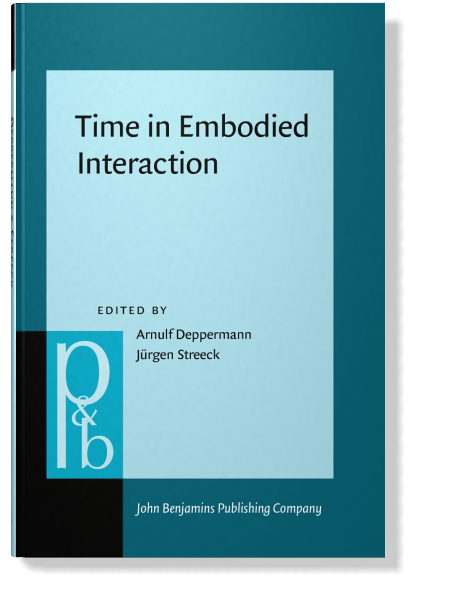
In:Time in Embodied Interaction: Synchronicity and sequentiality of multimodal resources
Edited by Arnulf Deppermann and Jürgen Streeck
[Pragmatics & Beyond New Series 293] 2018
► pp. 1–30
The body in interaction
Its multiple modalities and temporalities
Published online: 13 September 2018
https://doi.org/10.1075/pbns.293.intro
https://doi.org/10.1075/pbns.293.intro
Article outline
- 1.The rising interest in temporalities of bodily interaction
- 2.Temporalities of multimodal conduct
- 3.Indigenous temporal orders of multimodal resources
- 4. The temporal coordination of multimodal resources
- 5.Methodological requirements of studying the temporalities of multimodal interaction
- 6.Consequences of a temporal and multimodal perspective on social interaction for Conversation Analysis (CA)
References

References (181)
Auer, Peter. 1996. “On the Prosody and Syntax of Turn-continuations.” In Prosody in Conversation, ed. by Elizabeth Couper-Kuhlen, and Margret Selting, 57–100. Cambridge: Cambridge University Press.
. 2009. “On-line Syntax: Thoughts on the Temporality of Spoken Language.” Language Sciences 31: 1–13.
. 2010. Zum Segmentierungsproblem in der gesprochenen Sprache. Bayreuth: Universität, InLiSt 49: 1–19.
Auer, Peter, Couper-Kuhlen, Elizabeth, and Frank E. Müller. 1999. Language in Time – The Rhythm and Tempo of Verbal Interaction. Oxford: Oxford University Press.
Auer, Peter, and Stefan Pfänder (eds). 2011. Constructions: Emerging and Emergent. Berlin: de Gruyter.
Baldry, Anthony, and Paul J. Thibault. 2006. Multimodal Transcription and Text Analysis: A Multimedia Toolkit and Coursebook. London: Equinox.
Barth-Weingarten, Dagmar. 2016. Intonation Units Revisited – Cesuras in Talk-in-Interaction. Amsterdam: Benjamins.
Bateman, John, Wildfeuer, Janina, and Tuomo Hiippala. 2017. Multimodality. Foundations, Research and Analysis – A Problem-oriented Introduction. Berlin: de Gruyter.
Bergmann, Werner. 1983. “Das Problem der Zeit in der Soziologie : ein Literaturüberblick zum Stand der “zeitsoziologischen” Theorie und Forschung.“ Kölner Zeitschrift für Soziologie und Sozialpsychologie 35 (3): 462–504.
Bergmann, Pia. 2012. “The Prosodic Design of Parentheses in Spontaneous Speech.” In Prosody and Embodiment in Interactional Grammar, ed. by Bergmann, Pia, Brennig, Jana, Pfeiffer, Martin, and Elisabeth Reber, 103–141. Berlin: de Gruyter.
Birdwhistell, Ray L. 1970. Kinesics and Context: Essays on Body Motion Communication. Philadelphia: University of Pennsylvania Press.
Bohle, Ulrike. 2007. Das Wort ergreifen – Das Wort übergeben. Eine explorative Studie zur Rolle redebegleitender Gesten in der Organisation des Sprecherwechsels. Berlin: Weidler.
Broth, Mathias, and Leelo Keevallik. 2014. “Getting Ready to Move as a Couple: Accomplishing Mobile Formations in a Dance Class.” Space and Culture 17 (2): 107–121.
Broth, Mathias, and Lorenza Mondada. 2013. “Walking Away. The Embodied Achievement of Activity Closings in Mobile Interactions.” Journal of Pragmatics 47: 41–58.
Clark, Herbert H. 2012. “Unspoken Questions, Unspoken Answers.” In Questions: Formal, Functional and Interactional Perspectives, ed. by de Ruiter, Jan–P., 81–102. Cambridge: Cambridge University Press.
Condon, William S. 1980. “The Relation of Interactional Synchrony to Cognitive and Emotional Processes.” In The Relationship of Verbal and Nonverbal Communication, ed. by Mary R. Key, 49–66. The Hague: Mouton.
Cook, Richard, Bird, Geoffrey, Catmur, Caroline, Press, Clare, and Cecilia Heyes. 2014. “Mirror Neurons: From Origin to Function.” Behavioral and Brain Sciences 37 (2): 177–192.
Couper-Kuhlen, Elizabeth. 2002. “Prosody.” In Handbook of Pragmatics, ed. by Jef Verschueren, Jan-Ola Östman, Jan Blommaert, and Chris Bulcaen, 1–19. Amsterdam: Benjamins.
Couper-Kuhlen, Elizabeth, and Margret Selting(eds.). 1996. Prosody in Conversation. Interactional Studies. Cambridge: Cambridge University Press.
Couper-Kuhlen, Elizabeth, and Margret, Selting(eds.). 2001. Studies in Interactional Linguistics. Amsterdam: Benjamins.
Couper-Kuhlen, Elizabeth, and Cecilia E. Ford (eds). 2004. Sound Patterns in Interaction: Cross-linguistic Studies from Conversation. Amsterdam: Benjamins.
Dehé, Nicole, and Yordanka Kavalova (eds). 2007. Parentheticals. Amsterdam: Benjamins.
Deppermann, Arnulf (ed). 2013a. “Conversation Analytic Studies of Multimodal Interaction.” Journal of Pragmatics 46: 1–7.
. 2013b. “Turn-Design at Turn-Beginnings: Multimodal Resources to Deal with Tasks of Turn-Construction in German.” Journal of Pragmatics 46 (1): 91–121.
. 2014. “Multi-modal Participation in Simultaneous Joint Projects: Inter-personal and Intra-personal Coordination of Paramedics in Emergency Drills.” In Multiactivity in Social Interaction: Beyond Multitasking, ed. by Haddington, Pentti, Keisanen, Tiina, Mondada, Lorenza, and Maurice Nevile, 247–281. Amsterdam: Benjamins.
. 2015. “Retrospection and Understanding in Interaction.” In Temporality in Interaction, ed. by Deppermann, Arnulf, and Susanne Günthner, 57–94. Amsterdam: John Benjamins.
. (2018). “Instruction Practices in German Driving Lessons: Differential Uses of Declaratives and Imperatives.” International Journal of Applied Linguistics.
. this volume. Changes in Turn-design over Interactional Histories – the Case of Instructions in Driving School Lessons.
Deppermann, Arnulf, and Reinhold Schmitt. 2007. “Koordination. Zur Begründung eines neuen Forschungsgegenstandes.” In Koordination. Analysen zur multimodalen Interaktion, ed. by Schmitt, Reinhold, 15–54. Tübingen: Narr.
Deppermann, Arnulf, and Susanne Günthner. 2015. “Introduction: Temporality in Interaction.” In Temporality in Interaction, ed. by Deppermann, Arnulf and Susanne Günthner, 1–24. Amsterdam: Benjamins.
Deppermann, Arnulf, Schmitt, Reinhold, and Lorenza Mondada. 2010. “Agenda and Emergence: Contingent and Planned Activities in a Meeting.” Journal of Pragmatics 42 (6): 1700–1718.
Deppermann, Arnulf, Feilke, Helmuth, and Angelika Linke. 2016. ”Sprachliche und kommunikative Praktiken: Eine Annäherung aus linguistischer Sicht.” In Sprachliche und kommunikative Praktiken. Jahrbuch des Instituts für Deutsche Sprache 2015, ed. by Deppermann, Arnulf, Feilke, Helmuth, and Angelika Linke, 1–23. Berlin: de Gruyter.
Egbert, Maria. 1997. “Schisming: The Collaborative Transformation from a Single Conversation to Multiple Conversations.” Research on Language and Social Interaction 30: 1–51.
Ekman, Paul, and Wallace V. Friesen. 1968. “Nonverbal Behavior in Psychotherapy Research.” Research in Psychotherapy 3: 179–216.
. 1969. “The Repertoire of Nonverbal Behavior: Categories, Origins, Usage, and Coding.” Semiotica 1 (1): 49–98.
. 1978. Facial Action Coding System: A Technique for the Measurement of Facial Movement. Palo Alto CA: Consulting Psychologists Press.
Erickson, Frederick, and Jeffrey Shultz. 1982. The Counselor as Gatekeeper: Social Interaction in Interviews. New York: Academic.
Ford, Cecilia E., Thompson, Sandra A., and Veronika Drake. 2012. “Bodily-Visual Practices and Turn Continuation.” Discourse Processes 49 (3–4): 192–212.
Gehlen, A. 1988 (1958). Man. His Nature and Place in the World. New York: Columbia University Press.
Goldin-Meadow, Susan. 2006. “Talking and Thinking with our Hands.” Current Directions in Psychological Science 15: 34–39.
Goodwin, Charles. 1979. “The Interactive Construction of a Sentence in Natural Conversation.” In Everyday Language: Studies in Ethnomethodology, ed. by Psathas, George, 97–121. New York: Irvington.
. 1980. “Restarts, Pauses, and the Achievement of Mutual Gaze at Turn-Beginning.” Sociological Inquiry 50 (3–4): 272–302.
. 2003. “Pointing as Situated Practice.” In Pointing: Where Language, Culture and Cognition Meet, ed. by Kita, Sotaro, 217–241. Mahwah, NJ: Lawrence Erlbaum.
Goodwin, Charles, and Marjorie H. Goodwin. 2004. “Participation.” In A Companion to Linguistic Anthropology, ed. by Duranti, Alessandro, 222–244. Malden, MA: Blackwell.
Goodwin, Marjorie H. 1980. “Processes of Mutual Monitoring Implicated in the Production of Description Sequences.” Sociological Inquiry 50 (3–4): 303–17.
Haddington, Pentti, Keisanen, Tiina, and Maurice Nevile (eds). 2012. “Meaning in Motion: Interaction in Cars.” Semiotica 191 (1–4): 171–198.
Haddington, Pentti, Mondada, Lorenza, and Maurice Nevile (eds). 2013. Interaction and Mobility. Language and the Body in Motion. Berlin: De Gruyter.
Haddington, Pentti, Keisanen, Tiina, Mondada, Lorenza, and Maurice Nevile (eds). 2014. Multiactivity in Social Interaction: Beyond Multitasking. Amsterdam: Benjamins.
Hausendorf, Heiko, Schmitt, Reinhold, and Wolfgang Kesselheim (eds.). 2016. Interaktionsarchitektur, Sozialtopographie und Interaktionsraum. Tübingen: Narr.
Hazel, Spencer, Mortensen, Kristian, and Gitte Rasmussen (eds). 2014. “A Body of Resources – CA Studies of Social Conduct.” Journal of Pragmatics 65: 1–9.
Heath, and Paul Luff. 1996. “Convergent Activities: Line Control and Passenger Information on the London Underground.” In Cognition and Communication at Work, ed. by Engeström, Yngwe, and David Middleton, 96–129. Cambridge: Cambridge University Press.
. 2007. “Gesture and Institutional Interaction: Figuring Bids in Auctions of Fine Art and Antiques.” Gesture 7 (2): 215–240.
. 2013. “Embodied Action and Organizational Activity.” In The Handbook of Conversation Analysis, ed. by Sidnell, Jack, and Tanya Stivers, 283–307. Oxford: Wiley-Blackwell.
Heath, Christian, Sanchez Svensson, Marcus, Hindmarsh, Jon, Luff, Paul, and Dirk vom Lehn. 2002. “Configuring Awareness.” Computer-Supported Cooperative Work 11 (3–4): 317–347.
Heath, Christian. 1986. Body Movement and Speech in Medical Interaction. Cambridge: Cambridge University Press.
. 2010. “Conversation Analysis: Practices and Methods.” In Qualitative Sociology, ed. by Silverman, David, 3rd ed., 208–230. London: Sage.
Heyes, Cecilia. 2009. “Where do Mirror Neurons Come from.” Neuroscience and Biobehavioral Reviews 343 (4): 575–583.
Hoey, Elliott. 2015. “Lapses: How People Arrive at, and Deal with, Discontinuities in Talk.” Research on Language and Social Interaction 48 (4): 430–453.
. 2017. “Sequence Recompletion: A Practice for Managing Lapses in Conversation.” Journal of Pragmatics 109: 47–63.
Husserl, Edmund. 1928. Vorlesungen zur Phänomenologie des inneren Zeitbewusstseins. Halle/Saale: Niemeyer.
Hymes, Dell. 1975. “Breakthrough into Performance.” In Folklore: Performance and Communication, ed. by Ben-Amos, Dan, and Kenneth S. Goldstein, 11–74. Den Haag: Mouton.
Iwasaki, Shimako. this volume. Suspending Talk: Multimodal Organization of Participation and Stance in Japanese.
. 2011. “The Multimodal Mechanics of Collaborative Unit Construction in Japanese Conversation.” In Embodied Interaction. Language and Body in the Material World, ed. by Streeck, Jürgen, Goodwin, Charles, and Curtis LeBaron, 106–120. Cambridge: Cambridge University Press.
Jefferson, Gail 2004. “A Sketch of Some Orderly Aspects of Overlap in Conversation.” In Conversation Analysis. Studies from the First Generation, ed. by Lerner, Gene H., 43–59. Amsterdam: Benjamins.
Kaukomaa, Tiimo, Peräkylä, Anssi, and Johanna Ruusuvuori. 2014. “Foreshadowing a Problem: Turn-Opening Frowns in Conversation.” Journal of Pragmatics 71: 132–147.
Keevallik, Leelo. 2013. “Decomposing Movement: Spatial Deixis in Dance Instruction.” In Interaction and Mobility. Language and the Body in Motion, ed. by Haddington, Pentti, Mondada, Lorenza, and Maurice Nevile, 345–370. Berlin: De Gruyter.
. 2015. “Coordinating the Temporalities of Talk and Dance.” In Temporality in Interaction, ed. by Deppermann, Arnulf, and Susanne Günthner, 309–336. Amsterdam: Benjamins.
. this volume. The Temporal Organization of Conversation while Mucking Out a Sheep Stable.
. 1990. Conducting Interaction. Patterns of Behavior in Focused Encounters. Cambridge: Cambridge University Press.
Kita, Sotaro, van Gijn, Ingeborg, and Harry van der Hulst. 1998. “Movement Phases in Signs and Co-Speech Gestures, and Their Transcription by Human Coders.” In Gesture and Sign Language in Human-Computer Interaction: International Gesture Workshop Bielefeld, Germany, September 17–19, 1997, ed. by Wachsmuth, Ipke, and Martin Fröhlich, 23–35. Berlin: Springer.
Kress, Gunther. 2010. Multimodality: A Social Semiotic Approach to Contemporary Communication. London: Routledge.
Langacker, Ronald. 1987. Foundations of Cognitive Grammar. Vol. 1. Stanford, CA: Stanford University Press.
Leeds-Hurwitz, Wendy (ed). 2010. The Social History of Language and Social Interaction Research: People, Places, Ideas. Cresskill, NJ: Hampton Press.
Levinson, Steven C. 2013. “Action Formation and Ascription.” In The Handbook of Conversation Analysis, ed. by Tanya Stivers, and Jack Sidnell, 103–130. Malden, MA: Wiley-Blackwell.
Levinson, Steven C., and Francisco Torreira. 2015. “Timing in Turn-Taking and its Implications for Processing Models of Language.” Frontiers in Psychology 6: 731.
Li, Xiaoting. 2014. “Leaning and Recipient Intervening Questions in Mandarin Conversation.” Journal of Pragmatics 67: 34–60.
Local, John, and Gareth Walker. 2004. “Abrupt-Joins as a Resource for the Production of Multi-Unit, Multi-Action Turns.” Journal of Pragmatics 36: 1375–1403.
McNeill, David. 1992. Hand and Mind: What Gestures Reveal about Thought. Chicago IL: University of Chicago Press.
Mead, George. H. 1934. Mind, Self, and Society: From the Standpoint of a Social Behaviorist. Chicago: University of Chicago Press.
Meltzoff, Andrew N., and Wolfgang Prinz. 2002. The Imitative Mind: Development, Evolution, and Brain Bases. Cambridge: Cambridge University Press.
Meyer, Christian, Streeck, Jürgen, and Scott Jordan (eds). 2017. Intercorporeality. Emerging Socialities in Interaction. Oxford: Oxford University Press.
Mondada, Lorenza. 2007. “Multimodal Resources for Turn-Taking: Pointing and the Emergence of Possible Next Speakers.” Discourse Studies 9 (2): 195–226.
. 2009. “Emergent Focused Interactions in Public Places: A Systematic Analysis of the Multimodal Achievement of a Common Interactional Space.” Journal of Pragmatics 41: 1977–1997.
. 2013a. “Coordinating Mobile Action in Real Time: The Timely Organization of Directives in Video Games.” In Interaction and Mobility. Language and the Body in Motion, ed. by Haddington, Pentti, Mondada, Lorenza, and Maurice Nevile, 300–341. Berlin: De Gruyter.
. 2013b. “The Conversation Analytic Approach to Data Collection.” In Handbook of Conversation Analysis, ed. by Sidnell, Jack, and Tanya Stivers, 32–56. New York: Blackwell-Wiley.
. 2014a. “The Local Constitution of Multimodal Resources for Social Interaction.” Journal of Pragmatics 65: 137–156.
. 2014b. “The Temporal Orders of Multiactivity: Operating and Demonstrating in the Surgical Theatre”. In Multiactivity in Social Interaction: Beyond Multitasking, ed. by Haddington, Pentti, Keisanen, Tiina, Mondada, Lorenza, and Maurice Nevile, 33–75. Amsterdam: Benjamins.
. 2014c. “Instructions in the Operating Room: How Surgeons Direct Their Assistant’s Hands.” Discourse Studies 16 (2): 131–161.
. 2015. “Multimodal Completions.” In Temporality in Interaction, ed. by Deppermann, Arnulf, and Susanne Günthner, 267–307. Amsterdam: Benjamins.
. 2016. “Challenges of Multimodality: Language and the Body in Social Interaction.” Journal of Sociolinguistics 20 (2): 2–32.
. 2018. “Multiple Temporalities of Language and Body in Interaction: Challenges for Transcribing Multimodality.” Research on Language and Social Interaction 51 (1), 85–106.
. this volume. Questions on the Move: The Ecology of Question/Answer Sequences in Mobile Settings.
Mondada, Lorenza, and Reinhold Schmitt (eds). 2010. Situationseröffnungen. Zur multimodalen Herstellung fokussierter Interaktion. Tübingen: Narr.
Mondada, Lorenza, and Kimmo Svinhufvud. 2016. “Writing-in-Interaction: Studying Writing as a Multimodal Phenomenon in Social Interaction.” Language and Dialogue 6 (1): 1–53.
Morganti, Francesca, Carassa, Antonella, and Giuseppe Riva (eds). 2008. Enacting Intersubjectivity. Amsterdam: IOS.
Mortensen, Kristian. 2009. “Establishing Recipiency in Pre-Beginning Position in the Second Language Classroom.” Discourse Processes 46 (5): 491–515.
Nevile, Maurice. 2015. “The Embodied Turn in Research on Language and Social Interaction.” Research on Language and Social Interaction 48 (2): 121–151.
Nevile, Maurice, Haddington, Pentti, Heinemann, Trine, and Mirka Rauniomaa (eds). 2014. Interacting with Objects: Language, Materiality, and Social Activity. Amsterdam: John Benjamins.
Norris, Sigrid. 2004. Analyzing Multimodal Interaction: A Methodological Framework. London: Routledge.
Oloff, Florence. 2013. “Embodied Withdrawal after Overlap Resolution.” Journal of Pragmatics 46 (1): 139–156.
. this volume. Revisiting Delayed Completions: The Retrospective Management of Co-participant Action.
Oshima, Sae. this volume. Embodiment of Activity Progress: The Temporalities of Service Evaluation.
Pike, Kenneth Lee. 1956. Language in Relation to a Unified Theory of Structure of Human Behavior. The Hague: Mouton.
Pomerantz, Anita. 1984. “Agreeing and Disagreeing with Assessments: Some Features of Preferred/Dispreferred Turn Shapes.” In Structures of Social Action: Studies in Conversation Analysis, ed. by Atkinson, J. Maxwell, and John Heritage, 57–101. Cambridge: Cambridge University Press.
Rasmussen, Gitte. 2014. “Inclined to Better Understanding: The Coordination of Talk and ‘Leaning Forward’ in Doing Repair.” Journal of Pragmatics 65: 30–45.
Rauniomaa, Mirka, and Tiina Keisanen. 2012. “Two Multimodal Formats for Responding to Requests.” Journal of Pragmatics 44 (6–7): 829–842.
Rizzolati, Giacomo, and Laila Craighero. 2004. “The Mirror-Neuron System.” Annual Review of Neuroscience 27: 169–192.
Rossano, Federico 2013. “Gaze in Conversation”. In The Handbook of Conversation Analysis, ed. by Jack Sidnell, and Tanya Stivers, 308–329. Malden, MA: Wiley-Blackwell.
Ruesch, Jürgen, and Kees, Weldon. 1972. Nonverbal Communication. Berkeley: University of California Press.
Sacks, Harvey. 1984. “Notes on Methodology.” In Structures of Social Action, ed. by Atkinson, John Maxwell, and John Heritage, 21–27. Cambridge: Cambridge University Press.
Sacks, Harvey, Schegloff, Emanuel A. and Gail Jefferson. 1974. “A Simplest Systematics for the Organization of Turn-Taking in Conversation.” Language 50 (4): 696–735.
Sacks, Harvey, and Emanuel A. Schegloff. 2002[1975]. “Home Position.” Gesture 2: 133–146.
Scheflen, Albert Edward. 1972. Body Language and Social Order: Communication as Behavioral Control. Englewood Cliffs, NJ: Prentice-Hall.
Schegloff, Emanuel A. 1968. “Sequencing in Conversational Openings.” American Anthropologist 70: 1075–1095.
1984. “On Some Gestures’ Relation to Talk.” In Structures of Social Action, ed. by Atkinson, John Maxwell, and John Heritage, 266–298. Cambridge: Cambridge University Press.
1992. “Repair after Next Turn. The Last Structurally Provided Defence of Intersubjectivity in Conversation.” American Journal of Sociology 97 (5): 1295–1345.
Schegloff, Emmanuel A. 1996. “Turn Organization: One Intersection of Grammar and Interaction.” In Interaction and Grammar, ed. by Ochs, Elinor, Schegloff, Emanuel A. and Sandra A. Thompson, 52–133. Cambridge: Cambridge University Press.
2013. “Ten Operations in Self-initiated, Same-turn Repair.” In Conversational Repair and Human Understanding, ed. by Hayashi, Makoto, Raymond, Geoffrey and Jack Sidnell, 41–70. Cambridge: Cambridge University Press.
Schmidt, Axel. this volume. Prefiguring the Future: Projections and Preparations within Theatrical Rehearsals.
Schmitt, Reinhold. 2003. “Inszenieren: Struktur und Funktion eines gesprächsrhetorischen Verfahrens.” Gesprächsforschung 4: 186–250, [URL] last access June 8,2016.
. 2005. „Zur multimodalen Struktur von turn-taking.” Gesprächsforschung – Online-Zeitschrift zur verbalen Interaktion 6: 17–61. [URL]
last access June 8,2016.
. 2015. “Positionspapier: Multimodale Interaktionsanalyse.” In Ko-Konstruktionen in der Interaktion. Die gemeinsame Arbeit an Äußerungen und anderen sozialen Ereignissen, ed. by Dausendschön-Gay, Ulrich, Gülich, Elisabeth, and Ulrich Krafft, 43–51. Bielefeld: transcript.
Schmitt, Reinhold, and Arnulf Deppermann. 2007. “Monitoring und Koordination als Voraussetzungen der multimodalen Konstitution von Interaktionsräumen.” In Koordination. Analysen zur multimodalen Interaktion, ed. by Schmitt, Reinhold, 95–128. Tübingen: Narr.
. 2010. “Die Transition von Interaktionsräumen als Eröffnung einer neuen Situation.” In Situationseröffnungen. Zur multimodalen Herstellung fokussierter Interaktion., ed. by Mondada, Lorenza, and Reinhold Schmitt, 335–386. Tübingen: Narr.
Schönherr, Beatrix. 1997. Syntax – Prosodie – Nonverbale Kommunikation. Empirische Untersuchungen zur Interaktion sprachlicher und parasprachlicher Ausdrucksmittel im Gespräch. Tübingen: Niemeyer.
Szczepek Reed, Beatrice B. 2006. Prosodic Orientation in English Conversation. Basingstoke: Palgrave Macmillan.
Searle, John R. 1969. Speech Acts. An Essay in the Philosophy of Language. Cambridge: Cambridge University Press.
Sidnell, Jack. 2014. “The Architecture of Intersubjectivity Revisited.” In The Cambridge Handbook of Linguistic Anthropology, ed. by Enfield, Nick J., Kockelman, Paul, and Jack Sidnell, 423–446. Cambridge: Cambridge University Press.
Simmel, Georg. 1916. Das Problem der historischen Zeit. Philosophische Vorträge. Veröffentlicht von der Kantgesellschaft. Nr. 12, ed. by Liebert, Arthur. Berlin: von Reuther und Reichard.
Streeck, Jürgen. 1988. “The Significance of Gestures: How It is Established.” Papers in Pragmatics 2 (1–2): 60–84.
. 1995. “On Projection.” In Interaction and Social Intelligence, ed. by Goody, Edward, 84–110. Cambridge: Cambridge University Press.
. 2007. “Geste und verstreichende Zeit: Stillstand und Bedeutungswandel.” In Gespräch als Prozess, ed. by Hausendorf, Heiko, 157–177. Tübingen: Narr.
. 2009a. Gesturecraft. The Manu-Facture of Meaning. Amsterdam: Benjamins.
. this volume. Times of the Rest. Temporalities of Some Communicative Postures
Streeck, Jürgen, Goodwin, Charles and Curtis LeBaron (eds). 2011. Embodied Interaction. Language and Body in the Material World. Cambridge: Cambridge University Press
Streeck, Jürgen, and Jordan, J. Scott. 2009. “Projection and Anticipation: The Forward-Looking Nature of Embodied Communication.” Discourse Processes 46 (2–3): 93–102.
Stukenbrock, Anja. 2010. “Überlegungen zu einem multimodalen Verständnis der gesprochenen Sprache am Beispiel deiktischer Verwendungsweisen des Ausdrucks „so“.” In Beschreibungen für gesprochenes Deutsch auf dem Prüfstand, ed. by Dittmar, Norbert, and Nils Bahlo, 165–193. Frankfurt/Main: Lang.
. this volume. Forward-Looking: Where do We Go with Multimodal Projections?
Sunakawa, Chiho. this volume. Learning to Be an Orchestral Conductor.
Ursi, Biagio. 2016. Le refus en interaction. Une approche syntaxique et séquentielle de la negation. Lyon: Unpublished PhD-thesis at University Lyon 2.
Cited by (29)
Cited by 29 other publications
Atkinson, Dwight, Elif Burhan-Horasanlı, Anamaría Sagre Barboza, Jorge Andres Mejía-Laguna, Verónica Oguilve & Amable Daiane Custodio Ribeiro
Lilja, Niina, Jan Svennevig, Anna-Kaisa Jokipohja, Arja Piirainen-Marsh, Laura Eilola, Søren Eskildsen, Jenny Gudmundsen, Hanna-Ilona Härmävaara, Joona Poikonen, Nathalie Schümchen, Pawel Urbanik & Johannes Wagner
Schubert, Mojenn
Löfgren, Agnes
Rautiainen, Iira & Tuire Oittinen
Arundale, Robert B.
Bovet, Alain
Choe, Ann Tai & Junichi Yagi
Magnusson, Simon & Melisa Stevanovic
Shor, Leon & Michal Marmorstein
2023. Self-repeat as a multimodal retraction practice. Interactional Linguistics 3:1-2 ► pp. 132 ff.
Ferrara, Lindsay
Gray, Robert James
Krug, Maximilian
Krug, Maximilian
Niediek, Imke, Juliane Gerland & Gudrun Dobslaw
De Stefani, Elwys
Deppermann, Arnulf, Lorenza Mondada & Simona Pekarek Doehler
Deppermann, Arnulf & Axel Schmidt
Ehmer, Oliver
GELHARDT, Anne
Singh, Ajit
Skogmyr Marian, Klara
Stoenica, Ioana-Maria & Sophia Fiedler
Tuncer, Sylvaine, Oskar Lindwall & Barry Brown
Waring, Hansun Zhang
2021. Chapter 3.2. Socializing the emotions of joy and surprise in parent-child interaction. In How Emotions Are Made in Talk [Pragmatics & Beyond New Series, 321], ► pp. 211 ff.
Betz, Emma, Carmen Taleghani-Nikazm & Peter Golato
2020. Mobilizing others. In Mobilizing others [Studies in Language and Social Interaction, 33], ► pp. 1 ff.
Katila, Julia & Johanne S. Philipsen
[no author supplied]
[no author supplied]
This list is based on CrossRef data as of 28 november 2025. Please note that it may not be complete. Sources presented here have been supplied by the respective publishers. Any errors therein should be reported to them.