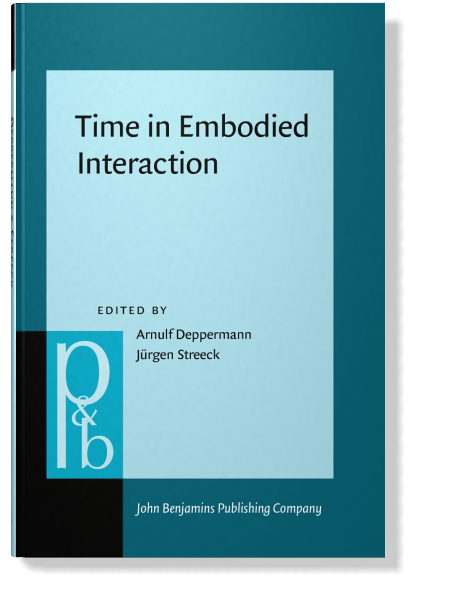
In:Time in Embodied Interaction: Synchronicity and sequentiality of multimodal resources
Edited by Arnulf Deppermann and Jürgen Streeck
[Pragmatics & Beyond New Series 293] 2018
► pp. 203–230
Chapter 6Bodily shadowing
Learning to be an orchestral conductor
Published online: 13 September 2018
https://doi.org/10.1075/pbns.293.06sun
https://doi.org/10.1075/pbns.293.06sun
Abstract
In this chapter, I examine synchronous body movements made by an orchestral conducting teacher and students while engaging one another in an instructional interaction. This behavioral synchrony, which I refer to as bodily shadowing, provides participants with effective ways to learn and teach orchestral conducting skills. It is important for students to move their bodies as the teacher moves his because students learn forms of body movement that are situated in a specific temporal context. By analyzing the elements of the teacher’s behavior that are chosen for shadowing and how shadowing is initiated, I demonstrate the process by which participants communicate the correction. Additionally, I explain how bodily shadowing becomes a means to display understanding and a way of participating in an apprenticeship interaction.
Article outline
- 1.Introduction
- 2.Studies of instructional interactions
- 3. Data and ethnographic background
- 4.Organization of instruction with bodily shadowing
- 4.1Learning a form
- 4.2Learning a tempo
- 4.3Learning to create a relevant space
- 5. Bodily shadowing as a display of understanding
- 6.Bodily shadowing as a display of participation
- 7.Conclusion
Notes Acknowledgement References

References (40)
Arbib, Michael A. 2012. How the Brain Got Language: The Mirror System Hypothesis. Oxford: Oxford University Press.
Arnold, Lynnette. 2012. “Dialogic Embodied Action: Using Gesture to Organize Sequence and Participation in Instructional Interaction.” Research on Language and Social Interaction 45 (3): 269–296.
Cekaite, Asta. 2010. “Shepherding the Child: Embodied Directive Sequences in Parent-Child Interactions.” Text and Talk 30 (1): 1–25.
Gallese, Vittorio, Luciano Fadiga, Leonardo Fogassi and Giacomo Rizzolatti. 1996. “Action Recognition in the Premotor Cortex.” Brain 119: 593–609.
Garfinkel, Harold. 2002. Ethnomethodology’s Program Working Out Durkheim’s Aphorism. MD: Rowman and Littlefield.
. 2000, “Action and embodiment within situated human interaction”, Journal of Pragmatics, 32(10): 1489–1522
Goodwin, Mrjorie H. 1990. He-Said-She-Said: Talk as Social Organization among Black Children. Bloomington and Indianapolis, IN: Indiana University Press.
Goodwin, Marjorie H., and Asta Cekaite. 2013. “Calibration in Directive/Response Sequences in Family Interaction.” Journal of Pragmatics 46: 122–138.
Goodwin, Charles, and Marjorie H. Goodwin. 2004. “Participation.” In A Companion to Linguistic Anthropology, ed. by Duranti, Alessandro, 222–243. Oxford: Basil Blackwell.
Haviland, John B. 2007. “Master Speakers, Master Gesturers: A String Quartet Master Class.” In Gesture and the Dynamic Dimension of Language: Essays in Honor of David McNeill, ed. by Duncan, Susan D., Levy, Elena T., and Justine Cassell, 147–172. Amsterdam: John Benjamins.
Heritage, John, and Tanya Stivers. 1999. “Online Commentary in Acute Medical Visits: A Method of Shaping Patient Expectations.” Social Science and Medicine 49: 1501–1517.
Hindmarsh, Jon, Reynolds, Patricia, and Stephen Dunne. 2011. “Exhibiting Understanding: The Body in Apprenticeship.” Journal of Pragmatics 43 (2): 489–503.
Keevallik, Leelo. 2010. “Bodily Quoting in Dance Correction.” Research on Language and Social Interaction 43 (4): 401–26.
Koschmann, Timothy, LeBaron, Curtis, Goodwin, Charles, and Paul Feltovich. 2011. “’Can You See the Cystic Artery Yet?’ A Simple Matter of Trust.” Journal of Pragmatics 43 (2): 521–541.
Lerner, Gene. 2002. “Turn-Sharing: The Choral Co-Production of Talk-in-Interaction.” In The Language of Turn and Sequence, ed. by Ford, Cecilia E., Fox, Barbara A., and Sandra A. Thompson, 225–256. Oxford: Oxford University Press.
Lindwall, Oskar, and Anna Ekström. 2012. “Instruction-in-Interaction: The Teaching and Learning of a Manual Skill.” Human Studies 35 (1): 27–49.
Majlesi, Ali Reza. 2015. “Matching Gesture-Teahcers’ Repetitions of Students’ Gestures in Second Language Learning Classrooms.” Journal of Pragmatics 76: 30–45.
Macbeth, Douglas. 2011. “Understanding Understanding as an Instructional Matter.” Journal of Pragmatics 43 (2): 438–451.
Marslen-Wilson, William D. 1985. “Speech Shadowing and Speech Comprehension.” Speech Communication 4: 55–51.
Mehan, Hugh. 1979. Learning Lessons: Social Organization in the Classroom. Cambridge, MA: Harvard University Press.
Mondada, Lorenza. 2011. “Understanding as an Embodied, Situated and Sequential Achievement in Interaction.” Journal of Pragmatics 43 (2): 542–552.
. 2013. “Coordinating Mobile Action in Real Time: The Timely Organisation of Directives in Video Games.” In Interaction and Mobility: Language and the Body in Motion, ed. by Haddington, Pentti, Mondada, Lorenza, and Maurice Nevile, 300–342. Berlin: de Gruyter.
Mondada Lorenza, (2014), “Instructions in the Operating Room: How the Surgeon Directs their Assistant’s Hands”, Discourse Studies, 16(2):131–161.
Nicolini, Davide, Gherardi, Silvia, and Dvora Yanow (eds). 2003. Knowing in Organizations: A Practice-Based Approach. Armonk NY: M.E. Sharpe.
Nishizaka, Aug. 2006. “What to Learn : The Embodied Structure of the Environment.” Research on Language and Social Interaction 39 (2): 119–54.
Price, Harry E., and James L. Byo. 2002. “Rehearsing and Conducting.” In The Science and Psychology of Music Performance: Creative Strategies for Teaching and Learning, ed. by Parncutt, Richard, and Gary McPherson, 335–351. Oxford: Oxford University Press.
Sanchez Svensson, Marcus, Luff, Paul, and Christian Heath. 2009. “Embedding Instruction in Practice: Contingency and Collaboration during Surgical Training.” Sociology of Health and Illness 31 (6): 889–906.
Scheflen, Albert. E. 1964. “The Significance of Posture in Communication Systems.” Psychiatry 27 (4): 316–331.
Sinclair, John McHardy, and Malcolm Coulthard. 1975. Towards an Analysis of Discourse: The English Used by Teachers and Pupils. Oxford: Oxford University Press.
Streeck, Jürgen, and J.Scott Jordan. 2009. “Projection and Anticipation : The Forward-Looking Nature of Embodied Communication.” Discourse Processes 46: 93–102.
Suchman, Lucy. 1987. Plans and Situated Actions: The Problem of Human-Machine Communication. New York: Cambridge University Press.
Szczepek-Reed, Beatrice, Reed, Darren, and Elizabeth Haddon. 2013. “Now or Not Now: Coordinating Researts in the Pursuit of Learnables in Vocal Master Classes.” Research on Language and Social Interaction 46 (1): 22–46.
Weeks, Peter. 1990. “Musical Time as a Practical Accomplishment: A Change in Tempo.” Human Studies 13: 323–359.
Cited by (6)
Cited by six other publications
Yasui, Eiko
2025. Vocal resource of effort and force in interaction. Interactional Linguistics 5:1-2 ► pp. 69 ff.
Karvonen, Ulla & Riikka Nissi
Löfgren, Agnes
Ehmer, Oliver
Hata, Kaori
2020. Confronting the EU referendum as
immigrants. In Bonding through context [Pragmatics & Beyond New Series, 314], ► pp. 123 ff.
Sunakawa, Chiho
2020. Familial bonding. In Bonding through context [Pragmatics & Beyond New Series, 314], ► pp. 147 ff.
This list is based on CrossRef data as of 28 november 2025. Please note that it may not be complete. Sources presented here have been supplied by the respective publishers. Any errors therein should be reported to them.