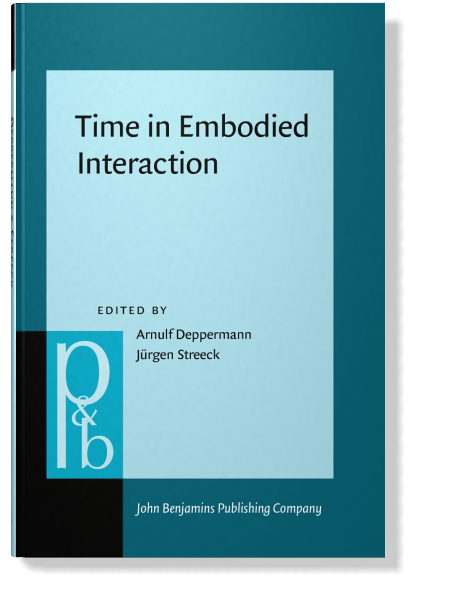
In:Time in Embodied Interaction: Synchronicity and sequentiality of multimodal resources
Edited by Arnulf Deppermann and Jürgen Streeck
[Pragmatics & Beyond New Series 293] 2018
► pp. 123–160
Chapter 4Revisiting delayed completions
The retrospective management of co-participant action
Published online: 13 September 2018
https://doi.org/10.1075/pbns.293.04olo
https://doi.org/10.1075/pbns.293.04olo
Abstract
Since Lerner coined the notion of delayed completion in 1989, this recurrent social practice of continuing one’s speaking turn while disregarding an intermediate co-participant’s utterance has not been investigated with regard to embodied displays and actions. A sequential approach to videotaped mundane conversations in German will explain the occurrence and use of delayed completions. First, especially in multi-party and multi-activity settings, delayed completions can result from reduced monitoring and coordinating activities. Second, recipients can use intra-turn response slots for more extended responsive actions than the current speaker initially projected, leading to delayed completion sequences. Finally, delayed completions are used for blocking possibly misaligned co-participant actions. The investigation of visible action illustrates that delayed completions are a basic practice for retrospectively managing co-participant response slots.
Article outline
- 1.Introduction
- 2.Syntax, action, and embodied conduct as relevant features for understanding the practice of delayed completion
- 2.1Delayed completions as a syntactic phenomenon
- 2.2But what about action?
- 2.3What can video data tell us about delayed completions?
- 2.4Data
- 3.
Analysis
- 3.1Delayed completions emerging in multi-party, multi-activity sequences
- 3.2Delayed completions after minimal displays of understanding
- 3.3Delayed completions after possibly misaligned actions
- 3.3.1Delayed completions for blocking competitive pre-emptive formats
- 3.3.2Delayed completions for blocking disaffiliative responses
- 4. Discussion and conclusion
Notes References

References (54)
Betz, Emma. 2008. Grammar and Interaction: Pivots in German Conversation. Amsterdam: John Benjamins.
Deppermann, Arnulf. 2013. “Multimodal Interaction from a Conversation Analytic Perspective.” Journal of Pragmatics 46: 1–7.
Deppermann, Arnulf, and Reinhold Schmitt. 2007. “Koordination: Zur Begründung eines neuen Forschungsgegenstandes.” In Koordination: Analyse zur multimodalen Interaktion, ed. by Schmitt, Reinhold, 15–54. Tübingen: Narr.
Egbert, Maria M. 1993. Schisming: The Transformation from a Single Conversation to Multiple Conversations, PhD Thesis, UCLA.
Ford, Cecilia E., Fox, Barbara A., and Sandra A. Thompson. 2002. “Constituency and the Grammar of Turn Increments.” In The Language of Turn and Sequence, ed. by Ford, Cecilia E., Fox, Barbara A., and Sandra A. Thompson. Oxford, 14–38. Oxford: Oxford University Press.
Ford, Cecilia E, Thompson, Sandra A., and Veronika Drake. 2012. “Bodily-Visual Practices and Turn Continuation.” Discourse Processes 49 (3–4): 192–212.
Goodwin, Charles. 1981. Conversational Organization: Interaction between Speakers and Hearers. New York: Academic.
Goodwin, Charles, and Marjorie H. Goodwin. 2004. “Participation.” In A Companion to Linguistic Anthropology, ed. by Duranti, Alessandro, 222–244. Oxford: Basil Blackwell.
Goodwin, Marjorie Harness. 1980. “Processes of Mutual Monitoring Implicated in the Production of Description Sequences.” Sociological Inquiry 50: 303–317.
Günthner, Susanne. 2015. “Ko-Konstruktionen im Gespräch: Zwischen Kollaboration und Konfrontation.” In Ko-Konstruktionen in der Interaktion: Die gemeinsame Arbeit an Äußerungen und anderen sozialen Ereignissen, ed. by Dausendschön-Gay, Ulrich, Gülich, Elisabeth, and Ulrich Krafft, 55–74. Bielefeld: Transcript.
Haddington, Pentti, Keisanen, Tiina, Mondada, Lorenza, and Maurice Nevile (eds). 2014. Multiactivity in Social Interaction. Amsterdam: John Benjamins.
Hazel, Spencer, Mortensen, Kristian, and Gitte Rasmussen. 2014. “Introduction: A Body of Resources – CA Studies of Social Conduct.” Journal of Pragmatics 65: 1–9.
Hutchby, Ian. 1992. “Confrontation Talk: Aspects of ‘Interruption’ in Argument Sequences on Talk Radio.” Text 12: 343–371.
Iwasaki, Shimako. 2009. “Initiating Interactive Turn Spaces in Japanese Conversation: Local Projection and Collaborative Action.” Discourse Processes 46 (2–3): 226–246.
. 2011. “The Multimodal Mechanics of Collaborative Unit Construction in Japanese Conversation.” In Embodied Interaction: Language and Body in the Material World, ed. by Streeck, Jürgen, Goodwin, Charles, and Curtis LeBaron, 106–120. Cambridge: Cambridge University Press.
. 2013. “Emerging Units and Emergent Forms of Participation within a Unit in Japanese Interaction: Local Organization at a Finer Level of Granularity.” In Units of Talk – Units of Action, ed. by Szczepek-Reed, Beatrice, and Geoffrey Raymond, 243–276. Philadelphia: John Benjamins.
Jefferson, Gail. 2004. “Glossary of Transcript Symbols with an Introduction.” In Conversation Analysis: Studies from the First Generation, ed. by Lerner, Gene H., 13–31. Philadelphia: John Benjamins.
Keisanen, Tiina, Rauniomaa, Mirka, and Pentti Haddington. 2014. “Suspending Action: From Simultaneous to Consecutive Ordering of Multiple Courses of Action.” In Multiactivity in Social Interaction, ed. by Haddington, Pentti, Keisanen, Tiina, Mondada, Lorenza, and Maurice Nevile, 109–134. Philadelphia: John Benjamins.
Kohonen, Sabine. 2004. “Turn-Taking in Conversation: Overlaps and Interruptions in Intercultural Talk.” Cahiers AFLS 10 (1): 15–32.
Lerner, Gene H. 1989. “Notes on Overlap Management in Conversation: The Case of Delayed Completion.” Western Journal of Speech Communication 53: 167–177.
1996. “On the ‘Semi-Permeable’ Character of Grammatical Units in Conversation: Conditional Entry into the Turn Space of Another Speaker.” In Interaction and Grammar, ed. by Ochs, Elinor, Schegloff, Emanuel A., and Sandra A. Thompson, 238–276. Cambridge: Cambridge University Press.
2004. “Collaborative Turn Sequences: Conversation Analysis.” In Studies from the First Generation, ed. by Gene H. Lerner, 225–256. Amsterdam: John Benjamins.
Licoppe, Christian, and Sylvaine Tuncer. 2014. “Attending to a Summons and Putting Other Activities ‘On Hold’: Multiactivity as a Recognisable Interactional Accomplishment.” In Multiactivity in Social Interaction, ed. by Haddington, Pentti, Keisanen, Tiina, Mondada, Lorenza, and Maurice Nevile, 167–190. Amsterdam: John Benjamins.
Local, John, and Gareth Walker. 2004. “Abrupt-Joins as a Resource for the Production of Multi-Unit, Multi-Action Turns.” Journal of Pragmatics 36 (8): 1375–1403.
Manrique, Elizabeth, and Nick J. Enfield. 2015. “Suspending the Next Turn as a Form of Repair Initiation: Evidence from Argentine Sign Language.” Frontiers in Psychology 15: 1–21. Accessed November 13, 2017.
Mondada, Lorenza. 2007. “Multimodal Resources for Turn-Taking: Pointing and the Emergence of Possible Next Speakers.” Discourse Studies 9 (2): 194–225.
. 2012. “Embodied and Spatial Resources for Turn-Taking in Institutional Multi-party Interactions: The Example of Participatory Democracy Debates.” Journal of Pragmatics 45 (1): 39–68.
. 2014a. “Conventions for Multimodal Transcription.” Basel: Universität. Accessed November 13, 2017. [URL]
. 2014b. “The Temporal Orders of Multiactivity: Operating and Demonstrating in the Surgical Theatre.” In Multiactivity in Social Interaction: Beyond Multitasking, ed. by Haddington, Pentti, Keisanen, Tiina, Mondada, Lorenza, and Maurice Nevile, 33–76. Amsterdam: John Benjamins.
. 2015. “Multimodal Completions.” In Temporality in Interaction, ed. by Deppermann, Arnulf, and Susanne Günthner, 267–307. Amsterdam: John Benjamins.
Mortensen, Kristian. 2012. “Visual Initiations of Repair – Some Preliminary Observations.” In Challenges and New Directions in the Micro-Analysis of Social Interaction, ed. by Brandt, Adam, and Keiko Ikeda, 45–50. Osaka: Kansai University.
Oloff, Florence. 2008. “La complétude négociée des unités de construction de tour: les complétions différées comme ressource en français parlé.” In Congrès Mondial de Linguistique Française (CMLF’08), ed. by Durand, Jacques, Habert, Benoît, and Bernard Laks, 773–788. Paris: Institut de Linguistique Française. Accessed November 13, 2017. [URL]
. 2009. Contribution à l’étude systématique de l’organisation des tours de parole: Les chevauchements en français et en allemand. Mannheim: Universität Mannheim. Accessed November 13, 2017. [URL].
. 2012. “Withdrawal from Turns in Overlap and Participation: Prosody and Embodiment.” In Interactional Grammar, ed. by Bergmann, Pia, Brenning, Jana, Pfeiffer, Martin, and Elisabeth Reber, 207–236. Berlin: De Gruyter.
. 2014. “Analyse multimodale de complétions différées suite à des interventions collaboratives.” In Corps en interaction: participation, spatialité, mobilité, ed. by Mondada, Lorenza, 107–143. Lyon: ENS Editions.
Olsher, David. 2004. “Talk and Gesture: The Embodied Completion of Sequential Actions in Spoken Interaction.” In Second Language Conversations, ed. by Gardner, Rod, and Johannes Wagner, 221–245. London: Continuum.
Papantoniou, Theodoros. 2012. Über die Darstellung von Problemtypen des Sprechens im Deutschen: Eine interaktional-linguistische Untersuchung von Reparaturen. Mannheim: Verlag für Gesprächsforschung.
Sacks, Harvey. 1984. “Notes on Methodology.” In Structures of Social Action: Studies in Conversational Analysis, ed. by Atkinson, J. Maxwell, and John Heritage, 21–27. Cambridge: Cambridge University Press.
Schegloff, Emanuel A. 1995. “Parties and Talking Together: Two Ways in which Numbers Are Significant for Talk-in-Interaction.” In Situated Order: Studies in the Social Organization of Talk and Embodied Activities, ed. by Have, Paul T., and George Psathas, 31–42. Washington: International Institute for Ethnomethodology and Conversation Analysis.
2000. “Overlapping Talk and the Organization of Turn-Taking for Conversation.” Language in Society 29 (1): 1–63.
2001. “Discourse as an Interactional Achievement III: The Omnirelevance of Action.” In The Handbook of Discourse Analysis, ed. by Schiffrin, Deborah, Tannen, Deborah, and Heidi E. Hamilton, 229–249. Oxford: Blackwell.
2002. “Accounts of Conduct in Interaction. Interruption, Overlap, and Turn-Taking.” In Handbook of Sociological Theory, ed. by Turner, Jonathan H., 287–321. New York: Kluwer Academic and Plenum.
Seo, Mi-Suk, and Irene Koshik. 2010. “A Conversation Analytic Study of Gestures that Engender Repair in ESL Conversational Tutoring.” Journal of Pragmatics 42: 2219–2239.
Sidnell, Jack. 2012. “Turn-Continuation by Self and by Other.” Discourse Processes 49 (3–4): 314–337.
Stivers, Tanya. 2008. “Stance, Alignment, and Affiliation During Storytelling: When Nodding Is a Token of Affiliation.” Research on Language and Social Interaction 41 (1): 31–57.
Stivers, Tanya, and Federico Rossano. 2010. “Mobilizing Response.” Research on Language and Social Interaction 43 (1): 3–31.
Thompson, Sandra A., Fox, Barbara A., and Elizabeth Couper-Kuhlen. 2015. Grammar in Everyday Talk: Building Responsive Action. Cambridge: Cambridge University Press.
Vatanen, Anna. 2014. Responding in Overlap: Agency, Epistemicity and Social Action in Conversation. Unpublished PhD thesis. Helsinki: University of Helsinki.
. 2017. “Delayed Completions of Unfinished Turns: On the Phenomenon and its Boundaries.” In Linking Clauses and Actions in Social Interaction, ed. by Laury, Ritva, Etelämäki, Marja, and Elizabeth Couper-Kuhlen, 153–174. Helsinki: Suomalaisen Kirjallisuuden Seura.
Vorreiter, Susanne. 2003. “Turn Continuations: Towards a Cross-Linguistic Classification.” InLiSt – Interaction and Linguistic Structures, 39: 1–25. Accessed November 13, 2017. [URL].
Walker, Gareth. 2004. “On Some Interactional and Phonetic Properties of Increments to Turns in Talk-in-Interaction.” In Sound Patterns in Interaction. Cross-Linguistic Studies from Conversation, ed. by Couper-Kuhlen, Elizabeth, and Cecilia E. Ford, 147–169. Amsterdam: John Benjamins.
Cited by (6)
Cited by six other publications
Greer, Tim
Krug, Maximilian
Scheidt, Carl Eduard, Stefan Pfänder, Arianna Ballati, Stefan Schmidt & Claas Lahmann
Rasmussen, Gitte
Deppermann, Arnulf & Jürgen Streeck
2018. The body in interaction. In Time in Embodied Interaction [Pragmatics & Beyond New Series, 293], ► pp. 1 ff.
This list is based on CrossRef data as of 28 november 2025. Please note that it may not be complete. Sources presented here have been supplied by the respective publishers. Any errors therein should be reported to them.