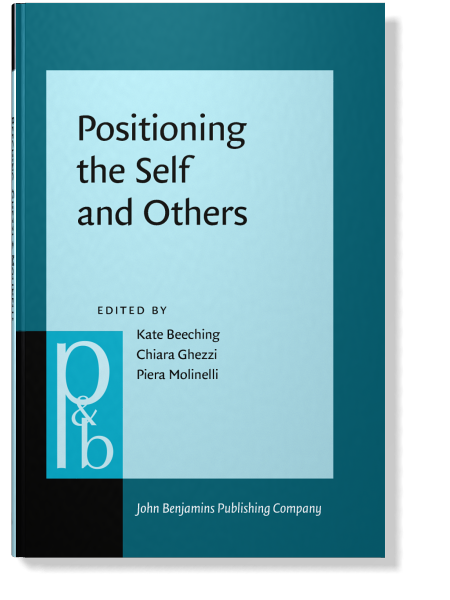
In:Positioning the Self and Others: Linguistic perspectives
Edited by Kate Beeching, Chiara Ghezzi and Piera Molinelli
[Pragmatics & Beyond New Series 292] 2018
► pp. 241–262
Chapter 11Representations of self and other in narratives of return migration
Published online: 17 July 2018
https://doi.org/10.1075/pbns.292.11nik
https://doi.org/10.1075/pbns.292.11nik
Abstract
This paper examines self and other representations in interviews conducted with second-generation Greek return migrants, (in their majority Greek Americans) who relocated to their parents’ homeland as adults within a decade prior to the interviews. Through the analysis of stories of linguistic and cultural assimilation, conflict and transition, authenticity and hybridity, we explore how return migrants construct and negotiate identity positions vis-à-vis other members of their immigrant community, native Greeks, and the interviewer through the employment of indexical devices during the interview. Return migrants constitute an understudied group, especially from a sociolinguistic perspective, and we argue that understanding the complex positioning of identities among this group may provide unique insights into the broader ideologies that mediate hybrid and hyphenated identities in general.
Article outline
- 1.Introduction
- 2.Background
- 3.Data and methods
- 3.1Scope and data collection
- 3.2Analytical focus
- 4.Findings
- 4.1Greek ethnic membership alignment and class membership markers
- 4.2Pronouns others and hierarchies: Greeks, ethnic, Anglos, and Aborigines in Australia
- 4.3Liminal identities
- 4.4Constructed dialogue as a positioning device
- 5.Conclusions
References

References (29)
Bakhtin, Mikhail M. 1981. The Dialogic Imagination: Four Essays by M.M. Bakhtin. Translated by Caryl Emerson and Michael Holquirst. Austin, TX: University of Texas Press.
Bamberg, Michael. 1997. “Positioning between Structure and Performance.” Journal of Narrative and Life History 7 (1–4): 335–342.
Bamberg, Michael, Anna De Fina, and Deborah Shiffrin (eds). 2007. Selves and Identities in Narrative and Discourse. Amsterdam: Benjamins.
Bamberg, Michael, and Alexandra Georgakopoulou. 2008. “Small stories as a new perspective in narrative and identity analysis.” Text and Talk 28 (3): 377–396. doi:.
Barker, Chris, and Dariusz Galasinski. 2001. Cultural Studies and Discourse Analysis. A Dialogue on Language and Identity. London: Sage.
Bucholtz, Mary, and Kira Hall. 2005. “Identity and Interaction: A Sociocultural Linguistic Approach.” Discourse Studies 7 (4–5): 585–614.
Christou, Anastasia. 2006a. “American Dreams and European Nightmares: Experiences and Polemics of Second-Generation Greek-American Returning Migrants.” Journal of Ethnic and Migration Studies 32 (5): 831–845.
Davies, Bronwyn, and Rom Harré. 1990. “Positioning: The Discursive Construction of Selves.” Journal for the Theory of Social Behaviour 20: 43–63.
Eckert, Penelope. 2003. “Language and gender in adolescence.” In The Handbook of Language and Gender, ed. by Janet Holmes, and Miriam Meyerhoff, 381–400. Malden: Blackwell.
De Fina, Anna. 2003. Identity in Narrative: A Study of Immigrant Discourse. Amsterdam: Benjamins.
. 2006. “Group Identity, Narrative and Self-representations. In
Discourse and Identity, ed. by Anna De Fina, Deborah Shiffrin, and Michael Bamberg, 351–375. New York: Cambridge University Press.
De Fina, Anna, Schiffrin, Deborah, and Michael Bamberg (eds). 2006. Discourse and Identity. New York: Cambridge University Press.
De Fina, Anna, and Barbara Johnstone. 2015. ”Discourse Analysis and Narrative.” In The Handbook of Discourse Analysis, ed. by Deborah Tannen, Heidi E. Hamilton, and Deborah Shiffrin (eds), Vol. I, 152–167. Malden, MA: Wiley Blackwells.
De Fina, Anna, and Kendall A. King. 2011. ”Language Problem or Language Conflict? Narratives of Immigrant Women’s Experiences in the US.” Discourse Studies 13 (2): 163–188.
Hollway, Wendy. 1984. “Gender Difference and the Production of Subjectivity.” In Changing the Subject: Psychology, Sodal Regulation and Subjectivity, ed. by Julian Henriques, Cathy Urwin, Wendy Hollway, Couze Venn, and Valerie Walkerdine, 263–261. London: Methuen.
King, Russell, and Anastasia Christou. 2010. “Diaspora, Migration and Transnationalism: Insights from the Study of Second-generation ‘returnees’.” In Diaspora and Transnationalism: Concepts, Theories and Methods, ed. by Rainer Bauböck, and Thomas Faist, 167–184. Amsterdam: Amsterdam University Press.
Langenhove, Luk van, and Rom Harré. 1999. “Introducing Positioning Theory.” In Positioning Theory: Moral Contexts of Intentional Action, ed. by Rom Harré, and Luk van Langenhove, 14–33. Oxford: Blackwell.
Moissinac, Luke. 2007. “Mr. Lanoe hit on my mom”: Reestablishment of Believability in Sequential ‘small stories’ by Adolescent Boys.” In Selves and Identities in Narrative and Discourse, ed. by Michael Bamberg, and Anna De Fina, 229–252. Amsterdam: Benjamins.
Paoletti, Isabella, and Greer Cavallaro Johnson. 2007. “Doing “being ordinary” in an Interview Narrative with a Second Generation Italian-Australian Woman. In Selves and Identities in Narrative and Discourse, ed. by Michael Bamberg, and Anna De Fina, 89–106. Amsterdam: Benjamins.
Pomerantz, Anita. 1986. “Extreme Case Formulations: A Way of Legitimizing Claims.” Human Studies 9: 219–229.
Schegloff, Emanuel A. 1980. “Preliminaries to Preliminaries: “Can I Ask You a Question?”.” Sociological Inquiry 50 (3–4): 104–152.
Sebba, Mark, and Tony Wootton. 1998. “We, They and Identity.” In Code-Switching in Conversation: Language, Interaction and Ethnicity, ed. by Peter Auer, 262–286. London: Routledge.
Stroud, Christopher. 1998. “Perspectives on Cultural Variability of Discourse and Some Implications for Code-Switching.” In Code-Switching in Conversation: Language, Interaction and Ethnicity, ed. by Peter Auer, 321–348. London: Routledge.
Cited by (4)
Cited by four other publications
Molho, Jeremie
Beeching, Kate
Bosworth, Yulia
This list is based on CrossRef data as of 28 november 2025. Please note that it may not be complete. Sources presented here have been supplied by the respective publishers. Any errors therein should be reported to them.