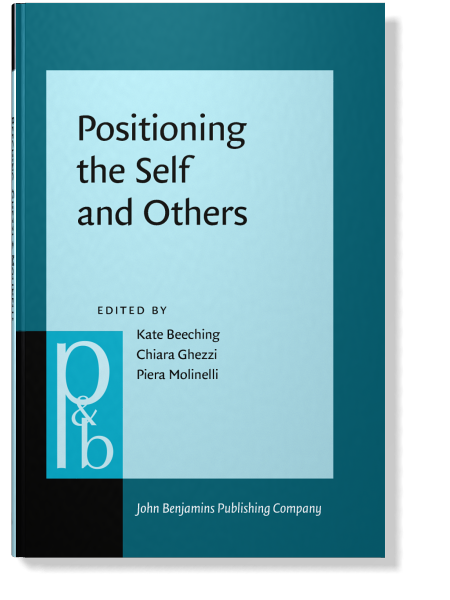
In:Positioning the Self and Others: Linguistic perspectives
Edited by Kate Beeching, Chiara Ghezzi and Piera Molinelli
[Pragmatics & Beyond New Series 292] 2018
► pp. 177–195
Chapter 8Positioning of self in interaction
Adolescents’ use of attention-getters
Published online: 17 July 2018
https://doi.org/10.1075/pbns.292.08aij
https://doi.org/10.1075/pbns.292.08aij
Abstract
Look, listen, come on, excuse me are examples of imperatives of verbs which have developed into discourse markers with an attention-getting function. It is shown that the functional markers are used by adolescents to position themselves in relation to what is said and other participants in the conversation in order to mark their disalignment with the norms of adult society. In the adolescents’ world impoliteness is the norm associated with creating a positive self-image of the speakers. Attention-getters are also an important part of how adolescents perform as tellers of narratives or anecdotes. Adolescents use attention-getters for irony and ‘mock politeness’ and in joking competitive exchanges.
Keywords: attention getters, adolescent speech,
look
,
listen
,
come on
,
excuse me
Article outline
- 1.Introduction
- 2.Background review: Attention-getters in previous work
- 3.Data and methods: Corpus analysis of the attention getters
- 4.Findings
- 4.1
Look
- 4.1.1 Look as a marker of relevance
- 4.1.2 Look and turn-taking
- 4.1.3 Look as argumentation marker
- 4.1.4Patterns with look marking escalation
- 4.1.5Patterns with look as a part of reported speech
- 4.2 Listen
- 4.3 Come on
- 4.4 Excuse me
- 4.1
Look
- 5.Conclusion
Notes References Appendix

References (28)
Aijmer, Karin. 2010. “The Attention-getting Devices look, see and listen
.” In The Prague School and Theories of Structure, edited by Martin Procházka, Markéta Mála, and Pavlína Saldová, 163–176. Göttingen: Vandenhoeck and Ruprecht.
Andersen, Gisle. 2001. Pragmatic Markers and Sociolinguistic Variation. Amsterdam/Philadelphia: Benjamins.
Bousfield, Derek. 2008. Impoliteness in Interaction. Amsterdam/Philadelphia: Benjamins.
Brinton, Laurel J. 2001. “From Matrix Clause to Pragmatic Marker. The History of look-forms.” Journal of Historical Pragmatics 2 (2): 179–199.
Bucholtz, Mary, and Kira Hall. 2005. “Identity and Interaction: a Sociocultural Linguistic Approach.” Discourse Studies 7 (4–5): 585–614.
Company Company, Concepción. 2004. “(¿De)gramaticalización, subjetivización y reanálisis: la flexibilidad categorial del verb en la historia det espanol.” Revista de filología española 84: 29–66.
Cuenca, Maria Josep, and Maria Josep Marín. 2000. “Verbos de Perceptión gramaticalizados como conectores: análisis contrastive espanol-catalán.” Revista española de lingüística aplicada 1: 215–237.
Culpeper, Jonathan. 2011. Impoliteness. Using Language to Cause Offence. Cambridge: Cambridge University Press.
Dostie, Gaétane. 2004. Pragmaticalisation et marqueurs discursifs: analyse sémantique et traitement lexicographique. Brussels: De Boeck/Duculot.
Fagard, Benjamin. 2010. «
É vida. olha … : Imperatives as Discourse Markers and Grammaticalization Paths in Romance Languages. » Languages in Contrast 10 (2): 245–267.
Fedriani, Chiara & Ghezzi, Chiara. 2014. “
The Pragmaticalization of Verbs of Movement and Exchange in Latin and Italian: Paths of Development from Lexicon to Pragmatics.” In Studia linguistica et philologica in honorem Prof. Univ. Dr. Michaela Livescu, ed. by Ilona Badescu, and Mihaela Popescu, 116–139. Craiova: Editura Universitaria.
Ghezzi, Chiara. 2012. “
Guarda, secondo me stai sbagliando! Marcatori interazionali da verbi di percezione in italiano contemporaneo.” In La lingua e la litteratura italiana in Europa: atti del Convegno internazionale di studi di Craiova, ed. by Elena Pirvu, 143–163. Craiova: Editura Universitaria.
Ghezzi, Chiara, and Piera Molinelli. 2014. “Italian guarda, prego, dai. Pragmatic Markers and the Left and Right Periphery.” In Discourse Functions in the Left and Right Periphery: Crosslinguistic Investigations of Language Use and Language Change, ed. by Kate Beeching, and Ulrich Detges, 117–150. Leiden: Brill.
Iliescu, Maria. 2011. “Les marqueurs d’appel en français et en roumain (et en allemand et en anglais).“ In Comparatio delectat, vol.1, ed. by Eva Lavric, Wolfgang Pöckl, and Florian Schallhart, 115–135. Frankfurt am Main: Lang.
Pons Bordería, Salvador. 1998. Conexión y conectores: estudio de su relación en el registro informal de la lengua. Valencia: Departamento de Filología Española, Universitat de Valencia.
Poulsen, Birthe. 1996. “Samtidig tale i unges turtagning. [‘At the same time speaking in the youth’s retreat’].” Unpublished paper. University of Århus.
Romero Trillo, Jesús. 1997. “
Your attention, please: Pragmatic Mechanisms to Obtain the Addressee’s Attention.” Journal of Pragmatics 28: 205–221.
Rossari, Corinne. 2006. « La preuve et regarde. » In Les marqueurs discursifs dans les langues romanes: approaches théoriques et méthodologiques, edited by Martina Drescher, and Barbara Frank-Job, 107–119. Frankfurt am Main: Lang.
Sacks, Harvey, Emanuel A. Schegloff, and Gail Jefferson. 1974. “A Simplest Systematics for Turn-taking in Conversation.” Language 50: 696–735.
Stenström, Anna-Brita, Gisle Andersen, and Kristin Hasund. 2002. Trends in Teenage Talk: Corpus Compilation, Analysis and Findings. Amsterdam/Philadelphia: Benjamins.
Stenström, Anna-Brita. 2013. “Spanish venga and its English Equivalents: A Contrastive Study of Teenage Talk.” In Contrastive Discourse Analysis. Functional and corpus perspectives, ed. by Maite Taboada, Susana Doval Suárez, and Elsa González Álvarez, 53–71. Sheffield/Bristol: Equinox.
Tannen, Deborah. 1989. Talking Voices. Repetition, Dialogue, and Imagery in Conversational Discourse. Cambridge: Cambridge University Press.
Van Olmen, Daniël. 2010. “The Imperative of Intentional Visual Perception as a Pragmatic Marker. A Contrastive Study of Dutch, English and Romance.” Languages in Contrast 10 (2): 223–244.
Cited by (2)
Cited by two other publications
Van Olmen, Daniël & Vittorio Tantucci
Van Olmen, Daniël
2021. Second person parentheticals of unintentional visual perception
in British English. In Pragmatic Markers and Peripheries [Pragmatics & Beyond New Series, 325], ► pp. 251 ff.
This list is based on CrossRef data as of 28 november 2025. Please note that it may not be complete. Sources presented here have been supplied by the respective publishers. Any errors therein should be reported to them.