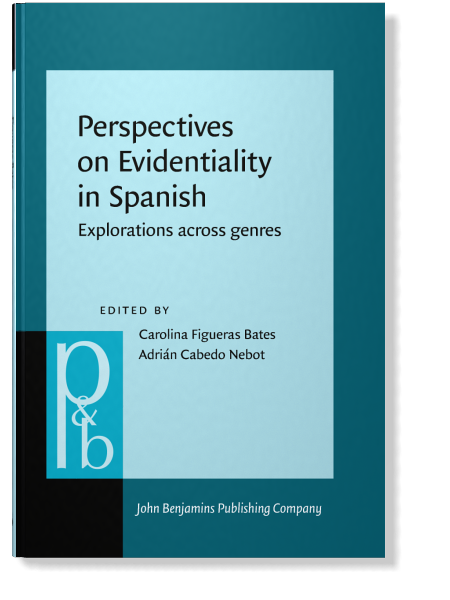
In:Perspectives on Evidentiality in Spanish: Explorations across genres
Edited by Carolina Figueras Bates and Adrián Cabedo
[Pragmatics & Beyond New Series 290] 2018
► pp. 107–124
Chapter 5Evidentiality, deonticity and intensification in Internet forum language
Published online: 24 July 2018
https://doi.org/10.1075/pbns.290.05mic
https://doi.org/10.1075/pbns.290.05mic
Abstract
We analyze the Spanish verbal periphrases tienes que + infinitive and debes + infini-tive [you have to + infinitive and you should + infinitive], with a deontic meaning, in an Internet forum. These verbal forms are used to give advice to other Internet users. After analyzing their functions, we reached the conclusion that such periphrases, with deontic value, function as epistemic modals: on the part of the speaker, they imply an axiological evaluation of his or her advice in terms of it being essential and necessary. Its evidential value (in the sense of information validation rather than as a source) derives from two factors. From a pragmatic inference: when a speaker expresses a high degree of certainty, to the extent of presenting an act as a requirement or obligation, he or she must have compelling evidence in order to believe that. And from an argumentative strategy: in order to justify their exhortations, the speakers draw on their personal experience and present themselves as witnesses who guarantee the validity of their recommendations.
Keywords: evidentiality, deontic modality, intensification, internet genres
Article outline
- 1.Introduction
- 2.Work methodology and preliminary considerations concerning the corpus data
- 3. The theoretical question
- 4.
Tienes que + infinitive [you have to + infinitive] vs. debes + infinitive [you should + infinitive]
- 4.1The source of necessity in tienes que + infinitive [you have to + infinitive] and debes + infinitive [you should + infinitive]
- 4.2 Analysis of the periphrasis debes + infinitive [you should + infinitive]
- 5.Conclusions
Notes References

References (33)
Aikhenvald, Alexandra Y. 2007. “Information Source and Evidentiality: What Can We Conclude?” Rivista di Linguistica 19 (1): 209–227.
Anderson, Lloyd B. 1986. “Evidentials, Path of Change and Mental Maps: Typologically Regular Asymmetries.” In Evidentiality: the Linguistic Coding of Epistemology, ed. by Wallace L. Chafe, and Johanna Nichols, 273–312.
Advances in Discourse Processes v. 20. Norwood, New Jersey: Ablez.
Cabedo Nebot, Adrián, and Carolina Figueras Bates. 2018/this volume. “Evidentiality, Epistemicity and Discourse Genre.” In Perspectives on Evidentiality in Spanish. Explorations across Genres, ed. by Carolina Figueras Bates, and Adrián Cabedo Nebot, 1-24. Amsterdam / Philadelphia: John Benjamins Publishing Company.
Cassany, Daniel, 2002. “La alfabetización digital”. Ponencia plenaria presentada en el XIII Congreso Internacional de la Asociación de Lingüística y Filología de América Latina (ALFAL), Universidad de Costa Rica, San José, Costa Rica, 18–23 de febrero del 2002, con el título ‘La escritura y la enseñanza en el entorno digital’.
Cornillie, Bert. 2007. Evidentiality and Epistemic Modality in Spanish (Semi-)Auxiliaries: A Cognitive-Functional Approach. De Gruyter Mouton.
. 2009. “Evidentiality and Epistemic Modality.” Special Issue of Functions of Language 16:1, 44–62, ed. by Lena Ekberg and Carita Paradis, John Benjamins Publishing Company.
Cornillie, Bert, Marín Arrese, Juana, and Wiemer, Björn. 2015. “Evidentiality and the Semantics-Pragmatics Interface.” Belgian Journal of Linguistics 29: 1–17.
Crystal, David. 2006 [2001]. Lengua y la Internet. Cambridge University Press. [URL]
Fernández de Castro, Félix. 1999. Las perífrasis verbales en el español actual. (Biblioteca románica hispánica 2). Madrid: Gredos.
Fernández López, Justo. 1999. “Perífrasis modales de infinitivo.” [URL]
Fetzer, Anita and Etsuko Oishi (eds.). 2014. Evidentiality in Discourse. Special Issue Intercultural Pragmatics 11.3.
. 1999. “Los verbos auxiliares. Las perífrasis verbales de infinitivo.” In Gramática descriptiva de la lengua española, ed. by Ignacio Bosque, and Violeta, Demonte, 3323–3390. Madrid: Espasa Calpe.
González, Montserrat. 2014. “Evidentiality, Intersubjectivity and Salience in Spanish and Catalan markers claro/clar and la verdad/veritat.” In Intercultural Pragmatics, 11(3), ed. by Anita Fetzer, and Etsuko Oishi, 411–436.
. 2015. “From Truth-Attesting to Intensification: The Grammaticalization of Spanish la verdad and Catalan la veritat.” Discourse Studies, special issue ‘Evidential and Epistemic Strategies in Discourse’ (selected papers from MODEVIG workshop 2014), ed. by Montserrat González, 1-20.
González Vázquez, Mercedes. 2006. Las fuentes de la información. Tipología, semántica y pragmática de la evidencialidad, Universidad de Vigo. Servicio de Publicaciones Universidade de Vigo.
Hennemann, Anja. 2012. A Context-sensitive and Functional Approach to Evidentiality in Spanish or Why Evidentiality needs a Superordinate Category. Peter Lang.
Miche, Elisabeth, and Clara Lorda. 2014. “Probability and Certainty Markers in French and in Spanish (sans doute / sin duda).” Language and Dialogue, 4 (1): 42–57.
Miche, Elisabeth. 2015. “An Analysis of Some Evidential Structures in Essays Written by Students of French as a Foreign Language.” In Discourse Studies, special issue ‘Evidential and Epistemic Strategies in Discourse’ (selected papers from MODEVIG workshop 2014), ed. by Montserrat González, 226–240.
Nuckolls, Janis, and Lev Michael. 2012. “Evidentials and Evidential Strategies in Interactional and Socio-cultural Context.” In Evidentiality in Interaction, ed. by Janis Nuckolls, and Lev Michael, 13–20. Amsterdam: John Benjamins Publishing Company.
Nuyts, Jan. 2001a. “Subjectivity as an Evidential Dimension in Epistemic Modal Expression.” Journal of Pragmatics 33: 383–400.
. 2001b. Epistemic Modality, Language, and Conceptualization: A Cognitive-Pragmatic Perspective. Amsterdam: Benjamins.
. 2010. “On Deontic Modality, Directivity, and Mood: the Case of Dutch Mogen and Moeten.” Journal of Pragmatics 42 (1): 16–34.
. 2012. “Notions of (inter)subjectivity.” English Text Construction 5 (1): 53–76.
Silva-Corvalán, Carmen. 1995. “Contextual Conditions for the Interpretation of ‘poder’ and ‘deber’ in Spanish.” In Modality in grammar and discourse, ed. by Joan Bybee, and Suzanne Fleischman, 67–105. Amsterdam: John Benjamins.
Sirbu-Dumitrescu, Domnita. 1988. “Contribución al studio de la semántica de los verbos modales en español (con ejemplos del habla de Madrid).” Hispania 71 (1): 139–147.
Thegel, Miriam. 2017a. “¿Opiniones, normas o pura necesidad? La modalidad deóntica y la modalidad dináminca a través de deber y tener que.” Studia Romanica Upsaliensia 85: 221.
. 2017b. “Intersubjective Strategies in Deontic Modality: Evidential Functions of Spanish deber ‘must’.” [URL]
Torrent, Aina. 2015. “Evidentiality and Lexicalisation in the Spanish Phraseological System: A Study of the Idiom a fe mía (and its variants).” In Discourse Studies, special issue ‘Evidential and Epistemic Strategies in Discourse’ (selected papers from MODEVIG workshop 2014), ed. by Montserrat González.
Cited by (1)
Cited by one other publication
Cabedo Nebot, Adrián & Carolina Figueras Bates
2018. Evidentiality in discourse. In
Perspectives on Evidentiality in Spanish [Pragmatics & Beyond New Series, 290], ► pp. 1 ff.
This list is based on CrossRef data as of 28 november 2025. Please note that it may not be complete. Sources presented here have been supplied by the respective publishers. Any errors therein should be reported to them.