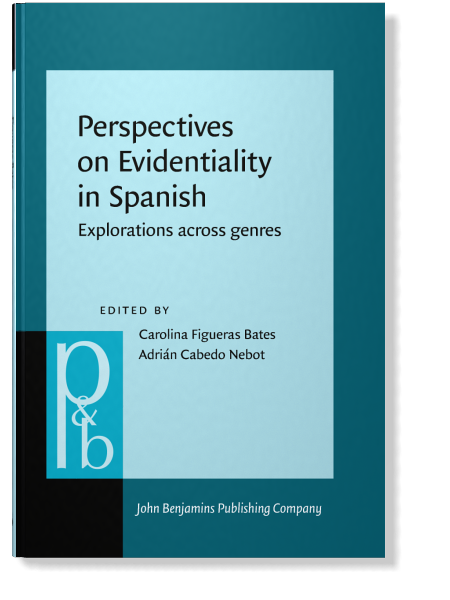
In:Perspectives on Evidentiality in Spanish: Explorations across genres
Edited by Carolina Figueras Bates and Adrián Cabedo
[Pragmatics & Beyond New Series 290] 2018
► pp. 73–106
Chapter 4Performing the self in illness narratives
The role of evidentiality
Published online: 24 July 2018
https://doi.org/10.1075/pbns.290.04bat
https://doi.org/10.1075/pbns.290.04bat
Abstract
Narrating the personal experience of a chronic illness poses the challenge of reflecting on epistemic states and sources of evidence that shape the person´s past, present and future selves. To explore the role of evidentials in different illness stories, 32 unsolicited narratives of eating disorders (ED), 28 accounts of borderline personality disorder (BPD), and 29 testimonies of chronic fatigue syndrome (CFS) were selected from the Internet. The analysis revealed that, in ED narratives, the enactment of the self was realized via visual perception, and the body was construed as self. In BPD narratives, inner emotional states were adopted as the source of evidence, and the mood was defined as self. In CFS narratives, the evidence informing the self came from embodied perception, and sensations were understood as self. Evidentials, therefore, are genre-sensitive and develop particular discursive functions in different illness narratives.
Article outline
- 1.Introduction
- 1.1Evidentiality and construction of self in ED, BPD and CFS narratives
- 2.Methodology
- 2.1Sample
- 2.2Procedure
- 2.3Analysis
- 3.Results
- 3.1Self and evidentiality in ED narratives
- 3.2Self and evidentiality in BPD narratives
- 3.3Self and evidentiality in CFS narratives
- 4.Discussion and concluding remarks
Notes References

References (89)
Adler, Jonathan M., Erica D. Chin, Aiswarya P. Kolisetty, and Thomas F. Oltmanns. 2012. “The Distinguishing Characteristics of Narrative Identity in Adults with Features of Borderline Personality Disorder: An Empirical Investigation.” Journal of Personality Disorders 26(4): 498–512.
American Psychiatric Association. 2013. Diagnostic and Statistical Manual of Mental Disorders: DSMV. Washington, DC: American Psychiatric Association.
Åsbring, Pia. 2001. “Chronic Illness: A Disruption in Life: Identity-Transformation among Women with Chronic Fatigue Syndrome and Fibromyalgia.” Journal of Advanced Nursing 34(3): 312–319.
Åsbring, Pia, and Anna-Liisa Närvänen. 2002. “Women’s Experiences of Stigma in relation to Chronic fatigue Syndrome and Fibromyalgia.” Qualitative Health Research 12: 148–160.
Baldwin, Clive. 2005. “Narrative, Ethics and People with Severe Mental Illness.” Australian and New Zealand Journal of Psychiatry 39, 1022–1029.
Bamberg, Michael. 2004. “‘I Know it may Sound Mean to Say This, but We Couldn’t Really Care Less about Her Anyway.’ Form and Functions of ‘Slut-Bashing’ in Male Identity Constructions in 15-Year-Olds. Human Development 47: 331–353.
. 2005. “Narrative Discourse and Identities.” In Narratology Beyond Literary Criticism: Mediality, Disciplinarity, ed. by Jan Christoph Meister, Tom Kindt, and Wilheim Schernus, 213–237. Berlin: Walter de Gruyter.
Banks, John, and Lindsay Prior. 2001. “Doing Things with Illness: The Micro-Politics of the CFS Clinic.” Social Science and Medicine 52: 11–23.
Bednarek, Monika. 2006. “Epistemological Positioning and Evidentiality in English News Discourse: A Text-Driven Approach.” Text and Talk 26(6): 635–60.
Bermúdez, Fernando. 2005. “Evidencialidad. La codificación lingüística del punto de vista.” Doctoral dissertation. Department of Spanish, Portuguese and Latin American Studies, Stockholm University.
Bradley Rebekah, and Drew Westen. 2005. “The Psychodynamics of Borderline Personality Disorder: A View from Developmental Psychopathology.” Development and Psychopathology 17: 927–957.
Bülow, Pia. 2004. “Sharing Experiences of Contested Illness by Storytelling.” Discourse and Society 15(1): 33–53.
. 2008. “‘You Have to Ask a Little’. Troublesome Storytelling About Contested Illness.” In Health, Illness and Culture. Broken Narratives, ed. by Lars-Christer Hydén, and Jens Brockmeier, 131–153. New York: Routledge.
Bury, Michael. 1982. “Chronic Illness as Biographical Disruption.” Sociology of Health and Illness 4(2). 167–182.
. 1988. “Meanings at Risk: The Experience of Arthritis.” In Living with Chronic Illness, ed. by Robert Anderson, and Michael Bury, 89-116. London: Unwin Hyman.
Butler, Judith. 1990. “Performative Acts and Gender Constitution: An Essay in Phenomenology and Feminist Theory.” In Performing Feminisms: Feminist Critical Theory and Theatre, ed. by Sue-Ellen Case, 270-282. Baltimore, M.D: The Johns Hopkins University Press.
. 1995. “Collected and Fractured: Responses to Identities.” In Identities, ed. by Kwame A. Appiah, and Henry L. Gates, 439–447. Chicago: University of Chicago Press.
Carless, David. 2008. “Narrative, Identity, and Recovery from Serious Mental Illness: A Life History of a Runner.” Qualitative Research in Psychology 5: 233–248.
Cash, Thomas F., and Edwin A. Deagle. 1997. “The Nature and Extent of Body-Image Disburbances in Anorexia Nervosa and Bulimia Nervosa: A Meta-analysis.” International Journal of Eating Disorders 22. 107–125.
Cavanagh, Allison. 2007. Sociology in the Age of the Internet. Berkshire, England: Open University Press.
Charmaz, Kathy. 1983. “Loss of Self: a Fundamental Form of Suffering in the Chronically Ill.” Sociology of Health and Illness 5(2): 168–195.
. 1999. “From ‘Sick Role’ to Stories of Self: Understanding the Self in Illness.” In Self and Identity, Vol. 2: Interdisciplinary Explorations in Physical Health, ed. by Richard D. Ashmore, and Richard A. Contrada, 209–239. New York: Oxford University Press.
. 2010. “Measuring Pursuits, Marking Self: Meaning Construction in Chronic Illness.” International Journal of Qualitative Studies on Health and Well-being 1: 27–37.
Clarke, Juanne, and Susan James. 2003. “The Radicalized Self: The Impact on the Self of the Contested Nature of the Diagnosis of Chronic Fatigue Syndrome.” Social Science and Medicine 57(8): 1387–1395.
Conrad, Peter, and Kristin K. Barker. 2010. “The Social Construction of Illness: Key Insights and Policy Implications.” Journal of Health and Social Behavior 51: 67–79.
Dammann, Gerhard, Claudia Hügli, Joseph Selinger, Daniela Gremaud-Heitz, Daniel Sollberger, Gerhard A Wiesbeck, Joachim Küchenhoff, and Marc Walter. 2011. “The Self-Image in Borderline Personality Disorder: An in-depth Qualitative Research Study.” Journal of Personality Disorders 25(4): 517–527.
Deutsch, Helene. 1965. Neuroses and Character Types: Clinical Psychoanalytic Studies. New York: International Universities.
Didelot, Mary J., and Lisa A. Hollingsworth. 2010. “Illness: The Redefinition of Self and Relationships.” In Illness, Bodies and Contexts, ed. by Isabelle Lange, and Zoë Norridge, 3–14. Oxford: Interdisciplinary Press.
Drachler, Maria de Lourdes, Jose Carlos de Carvalho, Lee Hooper, Chia Swee Hong, Derek Pheby, Luis Nacul, Eliana Lacerda, Peter Campion, Anne Killett, Maggie McArthur, and Fiona Poland. 2009. “The Expressed Needs of People with Chronic Fatigue Syndrome/Myalgic Encephalomyelitis: A systematic review.” BMC Public Health 9 (1): 458.
. 2005. “Discursive Psychology, Mental States and Descriptions.” In Conversation and Cognition, ed. by Hedwig te Molder, and Jonathan Potter, 241–259. Cambridge: Cambridge University Press.
Fernández Jaén, Jorge. 2012. Semántica cognitiva diacrónica de los verbos de percepción física del español. Doctoral Dissertation. Alacant, Spain: Universitat d’Alacant.
Figueras, Carolina. (in press). “Evidentiality in Illness Narratives: Structures with the Spanish Verb ver in Autobiographical Narratives of Eating Disorders.” Pragmatics and Society. Special issue on Discourse Approaches to Evidentiality in Spanish 9(3).
. 1997. “Technologies of the Self.” In Ethics: Subjectivity and Truth, ed. by Paul Rabinow. New York, NY: The New Press.
Frank, Arthur W. 1993. “The Rhetoric of Self-Change: Illness Experience as Narrative.” The Sociological Quarterly 34(1): 39–52.
Fuchs, Thomas. 2007. “Fragmented Selves: Temporality and Identity in Borderline Personality Disorder.” Psychopathology40: 379–387.
Gerhardt, Julie, and Charles Stinson. 1994. “The Nature of Therapeutic Discourse: Accounts of the Self.” Journal of Narrative Life History 4: 151–92.
Giles, David. 2006. “Constructing Identities in Cyberspace: The Case of Eating Disorders.” British Journal of Social Psychology 45: 463–477.
Good, Byron J. 1994. Medicine, Rationality and Experience: An Anthropological Perspective. Cambridge, UK: Cambridge University Press.
Guise, Jennifer, Sue Widdicombe, and Andy McKinlay. 2007. “What Is It Like to Have ME?: The Discursive Construction of ME in Computer-Mediated Communication and Face-to-face Interaction.” Health: An Interdisciplinary Journal for the Social Study of Health, Illness and Medicine 11(1): 87–108.
Gunderson, John G. 2009. “Borderline Personality Disorder: Ontogeny of a Diagnosis.” American Journal of Psychiatry 166: 530–539.
Gunderson, John G., and Paul S. Links. 2008. Borderline Personality Disorder: A Clinical Guide. Second Edition. Washington, DC: American Psychiatry Press, Inc.
Hart, Christopher. 2011. “Legitimizing Assertions and the Logico-Rhetorical Module: Evidence and Epistemic Vigilance in Media Discourse on Immigration.” Discourse Studies 13: 751–769.
Hart, Blossom, and Victoria M. Grace. 2000. “Fatigue in Chronic Fatigue Syndrome: A Discourse Analysis of Women’s Experiential Narratives.” Health Care for Women International 21(3): 187–201.
Horton-Salway, Mary. 2001. “Narrative Identities and the Management of Personal Accountability in Talk about ME: A Discursive Psychology Approach to Illness Narrative.” Journal of Health Psychology 6: 247–59.
Huibers, Marcus, and Simon Wessely. 2006. “The Act of Diagnosis: Pros and Cons of Labelling Chronic Fatigue Syndrome.” Psychological Medicine 36(7): 895–900.
Hydén, Lars Christer. 1995. “In Search of an Ending: Narrative Reconstruction as a Moral Quest.” Journal of Narrative Life History 5: 67–84.
. 2010. “Identity, Self, Narrative.” In Beyond Narrative Coherence, ed. by Matti Hyvärinen, Lars Christer Hydén, Marja Saarenheimo, and Maria Tamboukou, 33–48. Amsterdam: John Benjamins.
Hydén, Lars Christer, and Jen Brockmeier. 2008. “Introduction. The Field of Illness Narratives.” In Health, culture and Illness: Broken Narratives, ed. by Lars Christer Hydén, and Jen Brockmeier, 1–15. London: Routledge.
Jansen, Anita, Chantal Nederkoorn, and Sandra Mulkens. 2005. “Selective Visual Attention for Ugly and Beautiful Body Parts in Eating Disorders.” Behavioral and Research Therapy 43: 183–196.
Jørgensen, Carsten René. 2006. “Disturbed Sense of Identity in Borderline Personality Disorder.” Journal of Personality Disorders 20(6): 618–644.
. 2010. “Invited Essay: Identity and Borderline Personality Disorder.” Journal of Personality Disorders 24(3): 344–364.
Jørgensen, Carsten René, Dorthe Berntsen, Morten Bech, Morten Kjølbye, Birgit E. Bennedsen, and Stine B. Ramsgaard. 2012. “Identity-Related Autobiographical Memories and Cultural Life Scripts in Patients with Borderline Personality Disorder.” Consciousness and Cognition 21: 788–798.
Kleinman, Arthur. 1988. The Illness Narratives: Suffering, Healing and the Human Condition. New York: Basic Books.
Kvaale, Erlend P., William Gottdiener, and Nick Haslam. 2013. “Biogenetic Explanations and Stigma: A Meta-Analytic Review of Associations among Laypeople.” Social Science and Medicine 96: 95–103.
Lieb, Klaus, Mary C. Zanarini, Christian Schmahl, Marsha M. Linehan, and Martin Bohus. 2004. “Borderline Personality Disorder.” The Lancet, 364: 453–461.
Lifton, Robert J. 1993. The Protean Self: Human Resilience in an Age of Fragmentation. New York: Harper and Row.
Marcia, James E. 1980. “Identity in Adolescence.” In Handbook of Adolescent Psychology, ed. by Joseph Adelson, 159–188. New York: Wiley.
Mattingly, Cheryl, Mary Lawlor, and Lanita Jacobs-Huey. 2002. “Narrating September 11: Race, Gender, and the Play of Cultural Identities.” American Anthropologist 104: 743–753.
Morse, J. M. and Johnson, J. L. 1991. “Toward a Theory of Illness: The Illness Constellation Model.” In
The Illness Experience: Dimensions of Suffering, ed. by Janice M. Morse, and Joy L. Johnson, 315–342. Newbury Park, CA: Sage.
Munn, Nancy D. 1992. “The Cultural Anthropology of Time: a Critical Essay.” Annual Review Anthropology 21: 93–123.
Potter, Jonathan. 1996. Representing Reality: Discourse, Rhetoric, and Social Construction. London: Sage.
Potter, Jonathan, and Margaret Wetherell. 1987. Discourse and Social Psychology: Beyond Attitudes and Behaviour. London: Sage.
Radley, Alan, and Michael Billig. 1996. “Accounts of Health and Illness: Dilemmas and Representations.” Sociology of Health and Illness 18(2): 220–240.
Riessman, Catherine K. 2003. “Performing Identities in Illness Narrative: Masculinity and multiple sclerosis.” Qualitative Research 3: 5–33.
Rodríguez Espiñeira, María José. 2000. “Percepción directa e indirecta en español. Diferencias semánticas y formales.” Verba 27: 33–85.
Semerari, Antonio, Antonio Carcione et al. 2007. “Understanding Minds: Different Functions and Different Disorders? The Contribution of Psychotherapy Research.” Psychotherapy Research 17: 106–119.
Shaw, Claire, and Gillian Proctor. 2005. “Women at the Margins: A Critique of the Diagnosis of Borderline Personality Disorder.” Feminism and Psychology 15(4): 483–490.
Shohet, Merav. 2007. “Narrating Anorexia: ‘Full’ and ‘Struggling’ Genres of Recovery.” Ethos 35: 344–382.
Shotter, John. 1981. “Telling and Reporting: Prospective and Retrospective Uses of Self-Ascriptions.” In The Psychology of Ordinary Explanations of Behaviour, ed. by Charles Antaki, 157–181. London: Academic Press.
Travers, Michele K., and Jocalyn Lawler. 2008. “Self within a Climate of Contention: Experiences of Chronic Fatigue Syndrome.” Social Science and Medicine 66: 315–326.
Treat, Teresa A., Richard J. Viken et al. 2010. “Role of Attention, Memory, and Covariation-Detection Processes in Clinically Significant Eating-Disorder Symptoms.” Journal of Mathematical Psychology 54: 184–195.
Tuschen-Caffier, Brunna, Caroline Bender, Detlef Caffier, and Jennifer Svaldi. 2015. “Selective Visual Attention during Mirror Exposure in Anorexia and Bulimia Nervosa.” PLoS ONE 10(12).
Vindrola-Padros, Cecilia, and Ginger A. Johnson. 2014. “The Narrated, Nonnarrated, and the Disnarrated: Conceptual Tools for Analyzing Narratives in Health Services Research.” Qualitative Health Research 24(11): 1603–1611.
Vitousek, Kelly Bemis, and Steven D. Hollon. 1990. “The Investigation of Schematic Content and Processing in Eating Disorders.” Cognitive Therapy and Research 14: 191–214.
Walker, Jacob. 2012. “Researching Contested Illnesses: The Case of Chronic Fatigue Syndrome (CFS). In-Training.” Retrieved in 04-12-2016 from [URL].
Whitehead, Lisa Claire. 2006a. “Quest, Chaos and Restitution: Living with Chronic Fatigue Syndrome/myalgic Encephalomyelitis.” Social Science and Medicine 62: 2236–2245.
. 2006b. “Toward a Trajectory of Identity Reconstruction in Chronic Fatigue Syndrome/myalgic Encephalomyelitis: A Longitudinal Qualitative Study.” International Journal of Nursing Studies 43(8): 1023–1031.
Wiggins, Sally, and Jonathan Potter. 2008. “Discursive Psychology.” In The Sage Handbook of Qualitative Research in Psychology, ed. by Carla Willig, and Wendy Stainton Rogers, 73–90. London: Sage.
Wilkinson-Ryan, Tess, and Drew Westen. 2000. “Identity Disturbance in Borderline Personality Disorder: An Empirical Investigation.” American Journal of Psychiatry 157(4): 528–541.
Williamson, Donald A., Stephanie L. Muller et al. 1999. “Cognitive Bias in Eating Disorders: Implications of Theory and Treatment.” Behavior Modification 23: 556–577.
Cited by (6)
Cited by six other publications
Shortland, Diane, Qulsom Fazil, Anna Lavis & Nutmeg Hallett
Albelda Marco, Marta
Figueras Bates, Carolina & Dorota Kotwica
Cabedo Nebot, Adrián & Carolina Figueras Bates
2018. Evidentiality in discourse. In
Perspectives on Evidentiality in Spanish [Pragmatics & Beyond New Series, 290], ► pp. 1 ff.
Figueras Bates, Carolina
This list is based on CrossRef data as of 28 november 2025. Please note that it may not be complete. Sources presented here have been supplied by the respective publishers. Any errors therein should be reported to them.