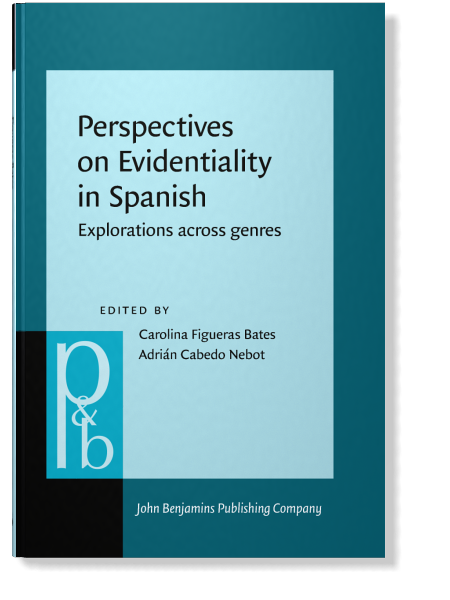
In:Perspectives on Evidentiality in Spanish: Explorations across genres
Edited by Carolina Figueras Bates and Adrián Cabedo
[Pragmatics & Beyond New Series 290] 2018
► pp. 1–24
Chapter 1Evidentiality in discourse
Published online: 24 July 2018
https://doi.org/10.1075/pbns.290.01cab
https://doi.org/10.1075/pbns.290.01cab
Article outline
- 1.Introduction
- 2.The domain of evidentiality
- 2.1Evidentials in discourse
- 3.Evidentiality and discourse genre: Pragmatic overtones
- 4.Presenting the chapters
Notes References

References (109)
Aksu-Koç, Ayhan, and Dan Slobin. 1986. “A Psychological Account of the Development and Use of Evidentials in Turkish.” In Evidentiality: The linguistic coding of epistemology, ed. by Wallace Chafe, and Johanna Nichols, 159–167. Hillsdale, N J: Ablex.
Albelda, Marta. 2015. “Evidentiality in Non-evidential Languages: Are There Evidentials in Spanish?” Journal of Pragmatics 85: 135–137.
. 2016. “La expresión de la evidencialidad en la construcción se ve (que).” Spanish in Context 13(2): 237–262.
Anderson, Lloyd B. 1986. “Evidentials, Paths of Change, and Mental Maps: Typologically Regular Asymmetries.” Advances in Discourse Processes 20: 273–312.
Atkinson, Paul. 1999. Medical Discourse, Evidentiality and the Construction of Professional Responsibility. In Talk, Work, and Institutional Order, ed. by Srikant Sarangi, and Celia Roberts, 75–107. Berlin: Mouton de Gruyter.
Babel, Anna M. 2009. “Dizque, Evidentiality, and Stance in Valley Spanish.” Language in Society 39: 487–511.
Bazerman, Charles. 1997. “The Life of Genre, the Life in the Classroom.” In Genre and writing: Issues, arguments, alternatives, ed. by Wendy Bishop, and Hans A. Ostrom, 19–26. Portsmouth, NH: Boynton/Cook Publishers, Inc.
Bednarek, Monika. 2006. “Epistemological Positioning and Evidentiality in English News Siscourse: A Text-driven Approach.” Text & Talk 26.6: 635–660.
Bello, Andrés [1847] 1970. Gramática de la lengua castellana destinada al uso de los americanos. Buenos Aires: Sopena.
Berkenkotter, Carol, and Thomas N. Huckin. 1995. Genre Knowledge in Disciplinary Communication. Hillsdale, NJ: Lawrence Erlbaum.
Bermúdez, Fernando W. 2002. “La estructura evidencial del castellano: elevación de sujeto y gramaticalización.” Romansk Forum 16: 19–29.
2004. “La categoría evidencial del castellano: metonimia y elevación de sujeto.” Boletín de Lingüística 22. 3–31.
2005a. “Los tiempos verbales como marcadores evidenciales. El caso del pretérito perfecto compuesto.” Estudios Filológicos 40: 165–188.
2005b. Evidencialidad. La codificación lingüística del punto de vista. Doctoral dissertation. Department of Spanish, Portuguese and Latin American Studies: Stockholm University.
Biber, Douglas, and Susan Conrad. 2009. Register, Genre, and Style. New York: Cambridge University Press.
Boye, Kasper. 2010. “Evidence for what? Evidentiality and Scope.” STUF-Lang. Typol. Univers. 63.4: 290–307.
. 2012. Epistemic Meaning. A Crosslinguistic and Functional-Cognitive Study. Berlin-New York: Mouton de Gruyter.
Bury, Michael. 1988. “Meanings at Risk: The Experience of Arthritis.” In Living with Chronic Illness, ed. by Robert Anderson, and Michael Bury, 89–116. London: Unwin Hyman.
Cabedo Nebot, Adrián 2018/this volume. “Prosody, Genres and Evidentiality in Spanish: The Case of Por lo visto.” In Perspectives on Evidentiality in Spanish. Explorations across genres, ed. by Carolina Figueras Bates, and Adrián Cabedo Nebot, 125–146. Amsterdam / Philadelphia: John Benjamins Publishing Company.
Calvi, Maria Vittoria. 2010. “Los géneros discursivos en la lengua del turismo: una propuesta de clasificación.” Ibérica 19: 9–32.
Cargill, Margaret, and Patrick O’Connor. 2009. Writing Scientific Research Articles. Strategy and Steps. Oxford: Blackwell.
Chafe, Wallace. 1986. “Evidentiality in English Conversation and Academic Writing.” In Evidentiality: The linguistic coding of epistemology, ed. by Wallace Chafe, and Johanna Nichols, 261–272. Hillsdale, MJ: Ablex Publishers.
Chafe, Wallace, and Johanna Nichols. 1986. Evidentiality: The linguistic coding of epistemology. Hillsdale, N.J.: Ablex,
Charmaz, Kathy. 1999. “From ‘Sick Role’ to Stories of Self: Understanding the Self in Illness.” In Self and Identity, Vol. 2: Interdisciplinary Explorations in Physical Health, ed. by Richard D. Ashmore, and Richard A. Contrada, 209–239. New York: Oxford University Press.
Clift, Rebecca. 2006. “Indexing Stance: Reported Speech as an Interactional Evidential.” Journal of Sociolinguistics 10(5): 569–595.
Cornillie, Bert. 2007. Epistemic Modality and Evidentiality in Spanish (semi-) auxiliaries. A cognitive-functional Approach. Berlin-New-York: Mouton de Gruyter.
. 2009. “Evidentiality and Epistemic Modality: On the Close Relationship between Two Different Categories.” Functions of Language 16.1: 44–62.
Cornillie, Bert, Juana Marín Arrese, and Wiemer, Björn. 2015. “Evidentiality and the Semantics-Pragmatics Interface.” Belgian Journal of Linguistics 29: 1–17.
Cuenca, Maria-Josep, and Maria-Josep Marín. 2012. “Discourse Markers and Modality in Spoken Catalan: The Case of (És) Clar.” Journal of Pragmatics 44.15: 2211–2225.
De Haan, Ferdinand. 1999. “Evidentiality and Epistemic Modality: Setting Boundaries.” Southwest Journal of Linguistics 18: 83–10.
De la Mora, Juliana, and Ricardo Maldonado. 2015. “Dizque: Epistemics Blurring Evidentials in Mexican Spanish.” Journal of Pragmatics 85: 168–180.
Demonte, Violeta, and Olga Fernández. 2005. “Features in COMP and Syntactic Variation. The Case of ‘Dequeísmo’ in Spanish.” Lingua 115: 1063–1082.
Dendale, Patrick, and Liliane Tasmowski. 2001. “Introduction: Evidentiality and Related Notions.” Journal of Pragmatics 33: 339–348.
Diewald, Gabriele, and Elena Smirnova. 2010. Linguistic Realization of Evidentiality in European Languages. Berlin-New York: Mouton de Gruyter.
Dijk, Teun Van. 1980a. Macrostructures: an Interdisciplinary Study of Global Structures in Discourse, Interaction, and Cognition. Hillsdale, New Jersey: Lawrence Erlbaum Associates.
Du Bois, John W. 1986. “Self-Evidence and Ritual Speech.” In Evidentiality: 7e linguistic coding of epistemology, ed. by Wallace Chafe, and Johanna Nichols, 313–336. Hillsdale, N.J.: Ablex.
2007. “The Stance Triangle.” In Stancetaking in Discourse:Subjectivity, Evaluation,Interaction, ed. by Robert Englebretson, 139–82. Amsterdam: John Benjamins.
Escandell, María Victoria. 2010. “Futuro y evidencialidad.” Anuario de Lingüística Hispánica 26. 9–34.
. 2014. “Evidential Futures: the Case of Spanish.” In Future Tense vs. Future Time: an Introduction, ed. by Philippe De Brabanter, Mihael Kissine, and Saghie Sharifzadeh, 219–246. Oxford: Oxford University Press.
Estellés, María, and Marta Albelda. 2014. “Evidentials, Politeness and Prosody in Spanish: A Corpus Analysis.” Journal of Politeness Research 10.1: 29–62.
Estellés, María, & Albelda, Marta 2018/this volume. “On the Dynamicity of Evidential Scales: Pragmatic Indirectness in Evidentiality as a Rhetorical Strategy in Academic and Political Discourse.” In Perspectives on Evidentiality in Spanish. Explorations across genres, ed. by Carolina Figueras Bates, and Adrián Cabedo Nebot, 25–48. Amsterdam / Philadelphia: John Benjamins Publishing Company.
Faller, Martina T. 2002. Semantics and Pragmatics of Evidentials in Cuzco Quechua. Stanford University doctoral dissertation. [URL]
Fernández Jaén, Jorge. 2012. Semántica cognitiva diacrónica de los verbos de percepción física del español. Doctoral Dissertation. Universitat d’Alacant: Alacant, Spain.
Fetzer, Anita. 2014. “Foregrounding Evidentiality in (English) Academic Discourse: Patterned Co-occurrences of the Sensory Perception Verbs Seem and Appear.” Intercultural Pragmatics 11:3. 333–355.
Fetzer, Anita, and Etsuko Oishi (eds.). 2014. Evidentiality in discourse. Special Issue Intercultural Pragmatics 11.3.
Figueras Bates, Carolina 2018/this volume. “Performing the Self in Illness Narratives: The Role of Evidentiality.” In Perspectives on Evidentiality in Spanish. Explorations across genres, ed. by Carolina Figueras Bates, and Adrián Cabedo Nebot, 73–106. Amsterdam / Philadelphia: John Benjamins Publishing Company.
(In press). “Evidentiality in Illness Narratives: Structures with Spanish Verb Ver in Autobiographical Narratives of Eating Disorders.” Pragmatics & Society.
Fox, Barbara. 2001. “Evidentiality: Authority, Responsibility, and Entitlement in English Conversation.” Journal of Linguistic Anthropology 11.2: 167–192.
Giltrow, Janet, and Dieter Stein. 2009. Genres in the Internet: Issues in the Theory of Genre. Amsterdam: John Benjamins Publishing Company.
Givón, Talmy. 1982. “Evidentiality and Epistemic Space.” Studies in Language 6.1: 23–49.
González, Monserrat (ed.). 2015. “Evidential and Epistemic Strategies in Discourse.” Special Issue of Discourse Studies 17.2.
González, Carlos, and Pablo Lima. 2009. “Estrategias de expresión de la evidencialidad en la argumentación oral en sala de clases.” Signos 42.71: 295–315.
González, Montserrat. 2018/this volume. “‘No sé’: Epistemic Stance, Evidential Grounding and Scope in Unplanned Oral Genres.” In Perspectives on Evidentiality in Spanish. Explorations across genres, ed. by Carolina Figueras Bates, and Adrián Cabedo Nebot, 147–172. Amsterdam / Philadelphia: John Benjamins Publishing Company.
Hanks, William F. 2012. “Evidentiality in Social Interaction.” Pragmatics and Society 3.2: 169–180.
Hassler, Gerda. 2010. “Epistemic Modality and Evidentiality and their Determination on a Deictic Basis. The Case of Romance Languages.” In Empirical Approaches to Language Typology: Linguistic Realization of Evidentiality in European Languages, ed. by Gabrielle Diewald, and Elena Smirnova, 223–247. Berlin: Mouton de Gruyter.
Hill, Jane, and Judith Irvine (eds.). 1993. Responsibility and Evidence in Oral Discourse. Cambridge: Cambridge University Press.
Hoye, Leo Francis. 2008. “Evidentiality in Discourse: A pragmatic and Empirical Account.” In Pragmatics and Corpus Linguistics, ed. by Jesús Romero-Trillo, 151–174. Berlin/New York: Mouton de Gruyter.
Hugo, Evelyn. 2011. “Las formas de segunda persona singular como estrategias evidenciales.” Revista de Lingüística Teórica y Aplicada 49(1): 143–167.
Hyland, Ken. 2004. Disciplinary Discourses: Social Interactions in Academic Writing. Ann Arbor, MI: University of Michigan Press.
Ifantidou, Elly. 2001. Evidentials and relevance. Amsterdam: John Benjamins Publishing Company.
Kamio, Akio. 1994. “The Theory of Territory of Information: The Case of Japanese.” Journal of Pragmatics 21: 67–100.
. 1997. Territory of Information. Amsterdam: John Benjamins Publishing Company.
Kärkkäinen, Elise. 2003. Epistemic Stance in English Conversation. Amsterdam: John Benjamins Publishing Company.
Kärkkäinen Elise. 2006. “Stance Talking in Conversation: From Subjectivity to Intersubjectivity.” Text & Talk 266: 699–731.
Kärkkäinen Elise. 2007. “The Role of I guess in Conversational Stancetaking.” In Discourse: Subjetivity, Evaluation, Interaction, ed. by Robert Englebretson, 183–219. Amsterdam: John Benjamins Publishing Company.
Kotwica, D. 2018/this volume.. “Exploring evidentiality in Spanish Biology articles (1850–1920): Intersubjectivity and accessibility of evidences.” In Perspectives on Evidentiality in Spanish. Explorations across genres, ed. by Carolina Figueras Bates, and Adrián Cabedo Nebot, 49–72. Amsterdam / Philadelphia: John Benjamins Publishing Company.
Leonetti, Manuel, and M. Victoria Escandell. 2003. “On the Quotative Readings of Spanish ‘Imperfecto’.” Cuadernos de Lingüística X: 135–154.
Lempert, Michael. 2008. “The Poetics of Stance: Text-metricality, Epistemicity, Interaction.” Language in Society 37(4): 569–592.
Levinson, Stephen C., and Francisco Torreira. 2015. “Timing in Turn-taking and its Implications for Processing Models of Language.” Frontiers in Psychology 6: 731.
Llopis Cardona, A. 2018/this volume. “The Spanish Quotative Según Across Written Genres.” In Perspectives on Evidentiality in Spanish. Explorations across genres, ed. by Carolina Figueras Bates, and Adrián Cabedo Nebot,173–204. Amsterdam / Philadelphia: John Benjamins Publishing Company.
Marín Arrese Juana. 2011. “Epistemic Legitimizing Strategies, Commitment and Accountability in Discourse.” Discourse Studies 13(6): 789–797.
Marín Arrese, Juana. 2015. “Epistemicity and Stance: A Cross-linguistic Study of Epistemic Stance Strategies in Journalistic Discourse in English and Spanish.” Discourse Studies 17(2): 210–225.
Marín Arrese, Juana, Gerda Haβler, and Marta Carretero. (eds.) 2017. Evidentiality revisited. Amsterdam: John Benjamins Publishing Company.
Maldonado, R., and de la Mora Gutiérrez, J. 2018/this volume. “Según Along Time: Following an Epistemic Path.” In Perspectives on Evidentiality in Spanish. Explorations across genres, ed. by Carolina Figueras Bates, and Adrián Cabedo Nebot, 205–222. Amsterdam / Philadelphia: John Benjamins Publishing Company.
Miche, Elisabeth. 2018/this volume. “Evidentiality, Deonticity and Intensification in Internet Forum Language.” In Perspectives on Evidentiality in Spanish. Explorations across genres, ed. by Carolina Figueras Bates, and Adrián Cabedo Nebot, 107–124. Amsterdam / hiladelphia: John Benjamins Publishing Company.
Mushin, Ilana. 2000. “Evidentiality and Deixis in Narrative Retelling.” Journal of Pragmatics 32: 927–957.
. 2001. Evidentiality and Epistemological Stance. Narrative Retelling. Amsterdam: John Benjamins Publishing Company.
Nuckolls, Janis, and Lev Michael. 2012. “Evidentials and Evidential Strategies in Interactional and Socio-cultural Context.” In Evidentiality in Interaction, ed. by Janis Nuckolls, and Lev Michael, 13–20. Amsterdam: John Benjamins Publishing Company.
Nuyts, Jan. 2012. “Notions of (inter)subjectivity.” English Text Construction 5: 53–76.
Papafragou, Anna. 2000. Modality: Issues in the Semantics-Pragmatics Interface. Oxford, England: Elsevier.
Pomerantz, Anita. 1984. “Giving a source or basis: The Practice in Conversation of Telling ‘How I know’.” Journal of Pragmatics 8: 607–625.
Rodríguez, Ramalle. 2007. “El complementante que como marca enfática en el texto periodístico.” Revista Electrónica de Lingüística Aplicada 5: 41–53.
Rodríguez Ramalle, M. Teresa. 2008. “Marcas enunciativas y evidenciales en el discurso periodístico.” In Actas del XXXVII Simposio Internacional de la Sociedad Española de Lingüística (SEL), ed. by Inés Olza Moreno, Manuel Casado Velarde, and Ramón González Ruiz, 735–744. Pamplona: Servicio de Publicaciones de la Universidad de Navarra.
Rodríguez Rosique, Susana. 2008. “Las ventanas de la gramática: discurso y futuro distanciador.” Círculo de Lingüística Aplicada a la Comunicación 55: 111–132.
. 2015. “Distance, Evidentiality and Counter-argumentation: Concessive Future in Spanish.” Journal of Pragmatics 85: 181–199.
Rodríguez, Rosique, Susana 2018/this volume. “Tenses in Interaction: Beyond Evidentiality.” In Perspectives on Evidentiality in Spanish. Explorations across genres, ed. by Carolina Figueras Bates, and Adrián Cabedo Nebot, 223–250. Amsterdam / Philadelphia: John Benjamins Publishing Company.
Sacks, Harvey, Emanuel Schegloff, and Gail Jefferson. 1974. “A Simplest Systematics for the Organization of Turn Taking for Conversation.” Language 50(4): 696–735.
Schwenter, Scott A. 1999. “Evidentiality in Spanish Morphosyntax. A Reanalysis of (de)queísmo.” In Estudios de variación sintáctica, ed. by María José Serrano Montesinos, 65–87. Madrid: Iberoamericana.
Speas, Peggy. 2008. “On the Syntax and Semantics of Evidentials.” Language and Linguistics Compass 2: 940–965.
Squartini, Mario. 2001. “The Internal Structure of Evidentiality in Romance.” Studies in Language 25: 297–334.
Swales, John M. 1990. Genre Analysis: English in Academic and Research Settings. Cambridge: Cambridge University Press.
Tardy, Christine, and John Swales. 2014. “Genre analysis”. In Pragmatics of discourse, ed. by Klaus P. Schneider and Anne Barron, 165-198. Berlin: Mouton De Gruyter.
van der Auwera, Johan, and Vladimir A. Plungian. 1998. “Modality’s Semantic Map.” Linguistic Typology 2.1: 125–139.
Wierzbicka, Anna. 1994.” Semantics and Epistemology: The Meaning of ‘Evidentials’ in a Cross-Linguistic Perspective” Language Sciences 16: 81–137.
Willett, Thomas. 1988. “A Cross-linguistic Survey of the Grammaticalization of Evidentiality.” Studies in Language 12: 51–97.
Cited by (3)
Cited by three other publications
Kapranov, Oleksandr
Cestero Mancera, Ana María & Dorota Kotwica
Miche, Elisabeth
2018. Evidentiality, deonticity and intensification in Internet forum language. In
Perspectives on Evidentiality in Spanish [Pragmatics & Beyond New Series, 290], ► pp. 107 ff.
This list is based on CrossRef data as of 28 november 2025. Please note that it may not be complete. Sources presented here have been supplied by the respective publishers. Any errors therein should be reported to them.