In:Implicitness: From lexis to discourse
Edited by Piotr Cap and Marta Dynel
[Pragmatics & Beyond New Series 276] 2017
► pp. 201–216
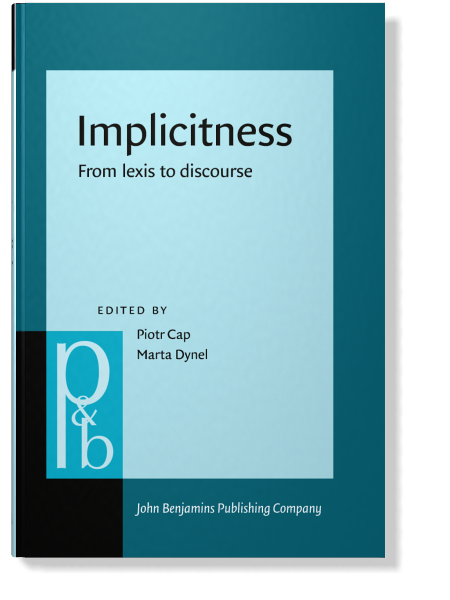
Chapter 9Implicitness in the use of situation-bound utterances
Published online: 30 June 2017
https://doi.org/10.1075/pbns.276.09kec
https://doi.org/10.1075/pbns.276.09kec
This chapter discusses the nature of implicit knowledge encoded in situation-bound utterances (SBUs) that are defined as highly conventionalized, prefabricated pragmatic units whose occurrences are tied to standardized communicative situations because they serve as interactional patterns and rituals that usually mean the same to all speakers of a particular speech community. It will be argued that there is a strong connection between implicitness and conventions of usage in language use. Conventional routine expressions like SBUs encode information that is equally available for all members of the given speech community. This information is usually implicit because the functional meaning of expressions is rarely reflected in their compositional meaning. The paradox of the use of SBUs is that although most of them are characterized by a high level of implicitness, they may still represent the most direct way to express some social function.
Article outline
- 1.Introduction
- 2.Characteristics of situation-bound utterances
- 3.Tacit knowledge
- 4.Context-dependence of implicitly conveyed information
- 4.1Understanding context
- 4.2SBUs are context sensitive in different degrees
- 5.Can SBUs be underspecified?
- 6.Conclusion
Notes References

References (28)
Aijmer, Karin. 1996. Conversational Routines in English: Convention and Creativity. London: Longman.
Altenberg, Bengt. 1998. “On the Phraseology of Spoken English: The Evidence of Recurrent Word-Combinations.” In Phraseology: Theory, Analysis, and Applications, ed. by Paul Cowie Anthony, 101–122. Oxford: Clarendon Press.
Ariel, Mira. 2016. “Revisiting the Typology of Pragmatic Interpretations.” Intercultural Pragmatics 13: 1–35.
Carston, Robyn. 2002. Thoughts and Utterances: The Pragmatics of Explicit Communication. Oxford: Blackwell.
Coulmas, Florian. 1981. Conversational Routine: Explorations in Standardized Communicative Situations and Prepatterned Speech. The Hague: Mouton de Gruyter.
Eemeren, van Frans H., and Rob Grootendorst, 1984. Speech Acts in Argumentative Discussions. A Theoretical Model for the Analysis of Discussions Directed Towards Solving Conflicts of Opinion. Dordrecht: Foris Publications.
Fillmore, Charles J. 1976. “The Need for a Frame Semantics within Linguistics.” Statistical Methods in Linguistics 12: 5–29.
Frege, Gottlob. 1884/1980. The Foundations of Arithmetic. Trans. by John L. Austin (2nd ed.). Evanston, IL: Northwestern University Press.
Gairns, Ruth, and Stuart Redman. 1986. Working with Words: A Guide to Teaching and Learning Vocabulary. Cambridge: Cambridge University Press.
Giora, Rachel. 1997. “Understanding Figurative and Literal Language: The Graded Salience Hypothesis.” Cognitive Linguistics 8: 183–206.
. 2007. “Formulaic Language in English Lingua Franca.” In Explorations in Pragmatics: Linguistic, Cognitive and Intercultural Aspects, ed. by István Kecskés, and Laurence R. Horn, 191–219. Berlin: Mouton de Gruyter.
Leibniz, Gottfried Wilhelm. 1976/1679. Philosophical Papers and Letters. Trans. and ed. by Leroy E. Loemker. Dordrecht/Boston: D. Reidel.
Levinson, Stephen C. 2003. “Language and Mind: Let’s Get the Issues Straight!” In Language in Mind: Advances in the Study of Language and Cognition, ed. by Gentner Dedre, and Susan Goldin-Meadow, 25–46. Cambridge, MA: MIT Press.
Millikan, Ruth. 2008. “A Difference of Some Consequence between Conventions and Rules.” Topoi 27:87–99.
Morgan, Jerry L. 1978. “Two Types of Convention in Indirect Speech Acts.” In Pragmatics (Syntax and Semantics 9), ed. by Peter Cole, 261–280. New York: Academic Press.
Nattinger, James R., and Jeanette S. DeCarrico. 1992. Lexical Phrases and Language Teaching. New York: Oxford University Press.
Searle, John. 1979. Expression and Meaning: Studies in the Theory of Speech Acts. Cambridge: Cambridge University Press.
Violi, Patrizia. 2000. “Prototypicality, Typicality, and Context.” In Meaning and Cognition: A Multidisciplinary Approach, ed. by Liliana Albertazzi, 103–123. Amsterdam: John Benjamins.
Wittgenstein, Ludwig. 1921/1922. Tractatus Logico-Philosophicus. Trans. by Charles Ogden. London: Routledge and Kegan Paul.
Yus, Francisco. 1999. “Misunderstandings and Explicit/Implicit Communication.” Pragmatics 9: 487–517.
Cited by (5)
Cited by five other publications
Lewandowska-Tomaszczyk, Barbara, Anna Bączkowska, Chaya Liebeskind, Giedre Valunaite Oleskeviciene & Slavko Žitnik
Bączkowska, Anna
Bączkowska, Anna
Mustajoki, Arto & Alla Baikulova
This list is based on CrossRef data as of 28 november 2025. Please note that it may not be complete. Sources presented here have been supplied by the respective publishers. Any errors therein should be reported to them.