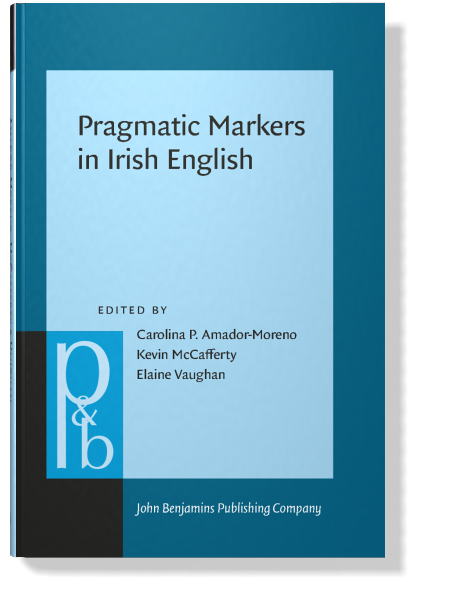
In:Pragmatic Markers in Irish English
Edited by Carolina P. Amador-Moreno, Kevin McCafferty and Elaine Vaughan
[Pragmatics & Beyond New Series 258] 2015
► pp. 292–317
Blathering Beauties
The use of pragmatic markers on an Irish beauty blog
Published online: 15 July 2015
https://doi.org/10.1075/pbns.258.13mil
https://doi.org/10.1075/pbns.258.13mil
Investigations of Irish English have not ventured into cyberspace to any great
degree so this chapter represents a preliminary exploration into the virtual
universe of Irish English. A case-study approach is adopted, trawling data from
an Irish beauty website, www.beaut.ie, and specifically the beaut.ie/blather
feature of this website. Here participants respond to items on the website, but
also interact with each other about a wide variety of topics. All comments are
archived with time of contribution and user name for each day’s ‘blather’, and
so a database spanning several months of contributions was constructed. The
aim of the study is to first identify what types of pragmatic markers are used
in this conversational written genre and then to consider the function of such
markers, with particular focus on issues of stance and ‘conversational’ structure.

References (67)
Aijmer, Karin. 2002. English Discourse Particles: Evidence from a Corpus. Amsterdam: John Benjamins.
Aijmer, Karin, and Anne-Marie Simon-Vandenbergen. 2011. “Pragmatic Markers.” In Discursive Pragmatics, ed. by Jan Zienkowski, Jan-Ola Östman and Jef Verschueren, 223–247. Amsterdam: John Benjamins.
Amador-Moreno, Carolina P. 2005. “Discourse Markers in Irish English: An Example from Literature.” In The Pragmatics of Irish English, ed. by Anne Barron and Klaus Schneider, 73–100. Berlin: Mouton de Gruyter.
Amaghlobeli, Natia. 2012. “Linguistic Features of Typographic Emoticons in SMS Discourse.” Theory and Practice in Language Studies 2 (2): 348–354.
Amárach Research and Studies. 2008. Life Online Report 2008. Available at [URL]. Accessed 22nd March 2013.
Andersen, Gisle. 1998. “The Pragmatic Marker Like from a Relevance-Theoretic Perspective.” In Discourse Markers. Description and Theory, ed. by Andreas Jucker and Yael Ziv, 147–170. Amsterdam: John Benjamins.
. 2001. Pragmatic Markers and Sociolinguistic Variation. A Relevance-Theoretic Approach to the Language of Adolescents. Amsterdam: John Benjamins.
Azuma, Junichi, and Martin Ebner. 2008. “A Stylistic Analysis of Graphic Emoticons: Can They Be Candidates for a Universal Visual Language of the Future?”
Proceedings of ED-Media 2008: World Conference on Educational Media, Hypermedia and Telecommunications
. AACE Cheasapeake, CA, 972–977. Available at [URL]. Accessed 22nd March 2013.
Baron, Naomi. 2008. Always On: Language in an Online and Mobile World. Oxford: Oxford University Press.
Barron, Anne, and Klaus Schneider. 2005. “Irish English: A Focus on Language in Action.” In The Pragmatics of Irish English, ed. by Anne Barron and Klaus Schneider, 3–16. Berlin: Mouton de Gruyter.
Beißwenger, Michael and Angelika Storrer. 2008. “Corpora of Computer-Mediated Communication.” In Corpus Linguistics: An International Handbook Volume 1, ed. by Anke Lüdeling and Merja Kytö, 292–308. Berlin: Mouton de Gruyter.
Bieswanger, Markus. 2013. “Micro-linguistic Structural Features of Computer-Mediated Communication.” In Pragmatics of Computer-Mediated Communication, ed. by Susan Herring, Dieter Stein and Tuija Virtanen, 463–485. Berlin: De Gruyter.
Blakemore, Diane. 2004. “Discourse Markers.” In The Handbook of Pragmatics, ed. by Laurence R. Horn and Gregory Ward, 221–240. Oxford: Blackwell.
Boxer, Diane, and Florencia Cortés-Conde. 1997. “From Bonding to Biting: Conversational Joking and Identity Display.” Journal of Pragmatics 27 (3): 275–294.
Brinton, Laurel. 1996. Pragmatic Markers in English.Grammaticalization and Discourse Functions. Berlin: Mouton de Gruyter.
. 2006. “Pathways in the Development of Pragmatic Markers in English.” In The Handbook of the History of English, ed. by Ans van Kemenade and Bettelou Los, 307–334. Oxford: Blackwell.
. 2010. “Discourse Markers.” In Historical Pragmatics. Vol. 8 of Handbooks of Pragmatics, ed. by Andreas Jucker and Irma Taavitsainen, 285–314. Berlin/New York: Mouton de Gruyter.
Brown, Penelope, and Stephen Levinson. 1987. Politeness. Some Universals in Language Usage. Cambridge: Cambridge University Press.
Clancy, Brian, and Elaine Vaughan. 2012. “
It’s lunacy now: A Corpus-Based Pragmatic Analysis of the Use of Now in Contemporary Irish English.” In New Perspectives on Irish English, ed. by Bettina Migge and Máire Ní Chiosáin, 225–246. Amsterdam: John Benjamins.
Claridge, Claudia. 2007. “Constructing a Corpus from the Web: Message Boards.” In Corpus Linguistics and the Web, ed. by Marianne Hundt, Nadja Nesselhauf and Carolin Biewer, 87–108. Amsterdam: Rodopi.
Columbus, Georgie. 2009. “Irish Like as an Invariant Tag: Evidence From ICE-Ireland.” Paper presented at AACL 2009, Edmonton, Canada. Available at [URL]. Accessed 22nd March 2013.
Crystal, David. 2006. Language and the Internet. Second edition. Cambridge: Cambridge University Press.
Dailey-O’Cain, Jennifer. 2000. “The Sociolinguistic Distribution of and Subjective Attitudes toward Focuser Like and Quotative Like.” Journal of Sociolinguistics 4 (1): 60–80.
Dresner, Eli, and Susan C. Herring. 2010. “Functions of the Non-Verbal in CMC: Emoticons and Illocutionary Force.” Communication Theory 20 (3): 249–268.
Eisenstein, Jacob, Brendan O’Connor, Noah Smith, and Eric Xing. 2010. “A Latent Variable Model for Geographic Lexical Variation.” Available at [URL]. Accessed 22 March 2013.
Farr, Fiona, and Anne O’Keeffe. 2002. “
Would as a Hedging Device in an Irish Context: An Intra-Varietal Comparison of Institutionalised Spoken Interaction.” In Using Corpora to Explore Linguistic Variation, ed. by Randi Reppen, Susan Fitzmaurice and Douglas Biber, 25–48. Amsterdam: John Benjamins.
Fox Tree, Jean E. 2010. “Discourse Markers Across Speakers and Settings.” Language and Linguistics Compass 4 (5): 269–281.
Gehweiler, Elke. 2010. “Interjections and Expletives.” In Historical Pragmatics, ed. by Andreas Jucker and Irma Taavitsainan, 315–350. Berlin: Mouton de Gruyter.
Graham, Sage L. 2007. “Disagreeing to Agree: Conflict, (Im)Politeness and Identity in a Computer-Mediated Community.” Journal of Pragmatics 39 (4): 742–759.
Hasselgård, Hilde. 2006. “ ‘Not Now’ – On Non-correspondence between the Cognate Adverbs Now and Nå.” In Pragmatic Markers in Contrast, ed. by Karin Aijmer and Anne Marie Simon-Vandenbergen, 93–113. Amsterdam: Elsevier.
Herring, Susan C. 2004. “Computer-Mediated Discourse Analysis: An Approach to Researching Online Behavior.” In Designing for Virtual Communities in the Service of Learning, ed. by Sasha A. Barab, Rob Kling and James H. Gray, 338–376. New York: Cambridge University Press.
. 2007. “A faceted classification scheme for computer-mediated discourse.” Language@Internet 4 [URL]. Accessed March 22nd 2013
. 2011. “Computer-Mediated Conversation: Introduction and Overview.” Language@Internet 8. [URL]. Accessed March 22nd 2013
. 2013. “Discourse in Web 2.0: Familiar, Reconfigured, and Emergent.” In Georgetown University Round Table on Languages and Linguistics 2011: Discourse 2.0: Language and new media, ed. by Deborah Tannen and Anna Marie Trester, 1–25. Washington, DC: Georgetown University Press.
Herring, Susan C., Dieter Stein, and Tuija Virtanen. 2013. “Introduction to the Pragmatics of Computer-Mediated Communication.” In Pragmatics of Computer-Mediated Communication, ed. by Susan Herring, Dieter Stein and Tuija Virtanen, 3–32. Berlin: De Gruyter.
Hickey, Raymond. 2007. Irish English. History and Present-Day Forms. Cambridge: Cambridge University Press.
Huffaker, David, and Sandra Calvert. 2005. “Gender, Identity, and Language Use in Teenager Blogs.” Journal of Computer-Mediated Communication 10 (2). Available at [URL]. Accessed March 22nd 2013
Huls, Erica. 2006. The Communicative Functions of Emoticons in Computer-Mediated Communication. Unpublished manuscript. Available at [URL]. Accessed March 22nd 2013
Jucker, Andreas. 2002. “Discourse Markers in Early Modern English.” In Alternative Histories of English, ed. by Richard Watts and Peter Trudgill, 210–230. London: Routledge.
Jucker, Andreas, and Sara Smith. 1998. “
And People Just You Know Like ‘Wow’. Discourse Markers as Negotiating Strategies.” In Discourse Markers. Description and Theory, ed. by Andreas Jucker and Ziv Yael, 171–202. Amsterdam: John Benjamins.
Kallen, Jeffrey L. 2004. “Politeness in Modern Ireland: “You Know The Way In Ireland, It’s Done Without Being Said.”” In Politeness in Europe, ed. by Leo Hickey and Miranda Stewart, 130–144. Clevedon: Multilingual Matters.
Kallen, Jeffrey, and John Kirk. 2012. SPICE-Ireland: A User’s Guide. Belfast: Cló Ollscoil na Banríona.
Kleinke, Sonja. 2010. “Interactive Aspects of Computer-Mediated Communication.” In Discourses in Interaction, ed. by Sanna-Kaisa Tanskanen, Marja-Liisa Helasvuo, Marjut Johansson and Mia Raitaniemi, 195–222. Amsterdam: John Benjamins.
Kotthoff, Helga. 1996. “Impoliteness and Conversational Joking: On Relational Politics.” Folia Linguistica 30 (3/4): 299–327.
Locher, Miriam A. 2010. “Introduction: Politeness and Impoliteness in Computer-Mediated Communication.” Journal of Politeness Research 6 (1): 1–5.
Locher, Miriam A., and Richard J. Watts. 2005. “Politeness Theory and Relational Work.” Journal of Politeness Research 1 (1): 9–33.
Martin, Gillian. 2005. “Indirectness in Irish–English Business Negotiation: A Legacy of Colonialism.” In The Pragmatics of Irish English, ed. by Anne Barron and Klaus Schneider, 235–268. Berlin: Mouton de Gruyter.
Provine, Robert, Robert Spencer, and Darcy Mandell. 2007. “Emotional Expression Online: Emoticons Punctuate Website Text Messages.” Journal of Language and Social Psychology 26 (3): 299–307.
Puschmann, Cornelius. 2013. “Blogging.” In Pragmatics of Computer-Mediated Communication, ed. by Susan Herring, Dieter Stein and Tuija Virtanen, 83–108. Berlin: De Gruyter.
Schweinberger, Martin. 2012. “The Discourse Marker LIKE in Irish English.” In New Perspectives on Irish English, ed. by Bettina Migge and Máire Ní Chiosáin, 179–202. Amsterdam: John Benjamins.
Spencer-Oatey, Helen. 2000. “Rapport Management: A Framework for Analysis.” In Culturally Speaking. Managing Rapport Through Talk Across Cultures, ed. by Helen Spencer-Oatey, 11–46. London: Continuum.
Stenström, Anna-Brita. 1990. “Lexical Items Peculiar to Spoken Discourse.” In The London-Lund Corpus of Spoken English Description and Research, ed. by Jan Svartvik, 137–175. Lund: Lund University Press.
Thurlow, Crispin, and Kristine Mroczek. 2011. “Introduction: Fresh Perspectives on New Media Sociolinguistics.” In Digital Discourse. Language in the New Media, ed. by Crispin Thurlow and Kristine Mroczek, xix–xxxviii, New York: Oxford University Press.
Thurlow, Crispin, and Michele Poff. 2013. “Text Messaging.” In Pragmatics of Computer-Mediated Communication, ed. by Susan Herring, Dieter Stein and Tuija Virtanen, 163–190. Berlin/New York: De Gruyter.
Wallis, Sean. 2007. “Annotation, Retrieval, Experimentation. Or: You Only Get What You Put In.” Varieng Volume 1 Annotating Variation and Change. Available at [URL]. Accessed 22nd March 2013.
Walther, Joseph. 1996. “Computer-Mediated Communication: Impersonal, Interpersonal, and Hyperpersonal Interaction.” Communication Research 23 (1): 3–43.
Cited by (8)
Cited by eight other publications
Westphal, Michael
O’Keeffe, Anne
P. Amador-Moreno, Carolina
Vaughan, Elaine
Walshe, Shane
McCafferty, Kevin & Carolina P. Amador-Moreno
2019. ‘but a[h] Hellen d[ea]r sure you have it more in your power in every respect than I have’
– Discourse marker sure in Irish English. In Processes of Change [Studies in Language Variation, 21], ► pp. 73 ff.
Ní Mhurchú, Aoife
Rühlemann, Christoph & Brian Clancy
2018. Corpus linguistics and pragmatics. In Pragmatics and its Interfaces [Pragmatics & Beyond New Series, 294], ► pp. 241 ff.
This list is based on CrossRef data as of 28 november 2025. Please note that it may not be complete. Sources presented here have been supplied by the respective publishers. Any errors therein should be reported to them.