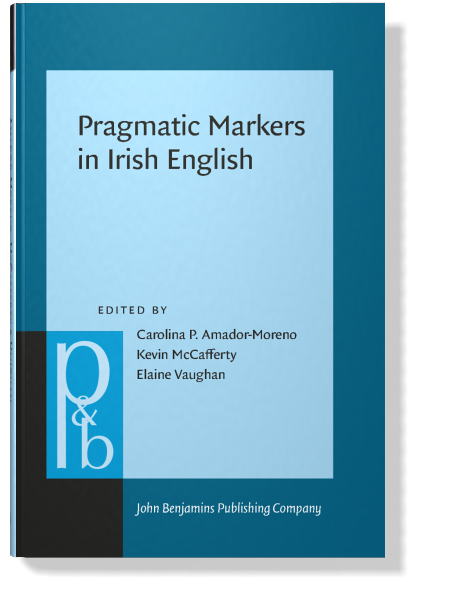
In:Pragmatic Markers in Irish English
Edited by Carolina P. Amador-Moreno, Kevin McCafferty and Elaine Vaughan
[Pragmatics & Beyond New Series 258] 2015
► pp. 270–291
“Sure this is a great country for drink and rowing at elections”
Pragmatic markers in the Corpus of Irish English Correspondence, 1750�1940
Published online: 15 July 2015
https://doi.org/10.1075/pbns.258.12ama
https://doi.org/10.1075/pbns.258.12ama
Few features of Irish English have been studied diachronically and the area of
pragmatic markers is likewise largely neglected even as regards present-day
Irish English (Corrigan 2010). This study uses data from the Corpus of Irish
English Correspondence (CORIECOR) to survey the history of some of the
pragmatic markers regarded as most typical of Irish English, particularly like
and sure. Besides addressing issues like the historical provenance of these
pragmatic markers in varieties of British English, Scots, in contact with Irish,
or as innovations in Irish English itself, we trace changes in the functions for
which the markers are used throughout the timespans covered by CORIECOR
(1750–1940). Also examined are usage patterns in the light of previous empirical
findings that many of the distinctive features of Irish English tend to emerge
in the written record only at relatively late stages in the process of language
shift, and the hypothesis that this may be related to increasing colloquialisation
or vernacularisation.

References (80)
Aijmer, Karin. 2009. “The Pragmatics of Adverbs.” In One Language, Two Grammars? Differences between British and American English, ed. by Günter Rohdenburg and Julia Schlüter, 324–340. Cambridge: Cambridge University Press.
Andersen, Gisle. 2001. Pragmatic Markers and Sociolinguistic Variation. A Relevance-theoretic Approach to the Language of Adolescents. Amsterdam: John Benjamins.
Amador-Moreno, Carolina P. 2005. “Discourse Markers in Irish English: An Example from Literature.” In The Pragmatics of Irish English, ed. by Anne Barron and Klaus P. Schneider, 73–100. Berlin: Mouton de Gruyter.
. 2006. An Analysis of Hiberno-English in the Early Novels of Patrick MacGill. Bilingualism and language Shift from Irish to English in County Donegal. Lewiston NY: Edwin Mellen Press.
Amador-Moreno, Carolina P., and Anne O’Keeffe. 2009. “From Arrah to Like: Irish English Discourse Markers in Fictional and Non-fictional Corpora.” Paper given at IVACS Annual Symposium, University of Edinburgh, January 2009.
Barron, Anne, and Klaus P. Schneider. 2005. The Pragmatics of Irish English. Berlin: Mouton de Gruyter.
Beal, Joan C. 2008. “English Dialects in the North of England: Morphology and Syntax.” In Varieties of English 1. The British Isles, ed. by Bernd Kortmann and Clive Upton, 373–403. Berlin: Mouton de Gruyter.
. 1995. Dimensions of Register Variation: A Cross-linguistic Comparison. Cambridge: Cambridge University Press.
Brinton, Laurel J. 1996. Pragmatic Markers in English. Grammaticalization and Discourse Functions. Berlin: Mouton de Gruyter.
Canny, Nicholas. 1994. “English Migration into and across the Atlantic during the Seventeenth and Eighteenth Centuries.” In Europeans on the Move. Studies on European Migration, 1500–1800, ed. by Nicholas Canny, 39–75. Cambridge: Cambridge University Press.
Carter, Ronald A., and Michael J. McCarthy. 2006. Cambridge Grammar of English. Cambridge: Cambridge University Press.
Clancy, Brian. 2000. A Case Study of the Linguistic Features of a Limerick Family. Unpublished MA thesis, Mary Immaculate College, University of Limerick.
Claudi, Ulrike, and Bernd Heine. 1986. “On the Metaphorical Base of Grammar.” Studies in Language 10 (2): 297–335.
Corrigan, Karen P. 2010. Irish English, Volume 1 – Northern Ireland. Edinburgh: Edinburgh University Press.
Dolan, Terence P. 2004. A Dictionary of Hiberno-English. Second edition. Dublin: Gill and Macmillan.
Elliott, Bruce S., David A. Gerber, and Suzanne M. Sinke. 2006. “Introduction.” In Letters across Borders. The Epistolary Practices of International Migrants, ed. by Briuce S. Elliott, David A. Gerber, and Suzanne M. Sinke, 1–25. New York: Palgrave Macmillan.
Farr, Fiona, and Anne O’Keeffe. 2002. “
Would as a Hedging Device in an Irish Context: An Intra-varietal Comparison of Institutionalised Spoken Interaction.” In Using Corpora to Explore Linguistic Variation, ed. by Randi Reppen, Susan Fitzmaurice, and Douglas Biber, 25–48. Amsterdam: John Benjamins.
Fenton, James. 2006 [2001, 1995]. The Hamely Tongue. A Personal Record of Ulster-Scots in County Antrim. Third edition. Newtownards: Ulster-Scots Academic Press.
Filppula, Markku. 2008. “Irish English: Morphology and Syntax”. In Varieties of English 1. The British Isles, ed. by Bernd Kortmann and Clive Upton, 328–359. Berlin: Mouton de Gruyter.
Fitzgerald, Garret. 1984. “Estimates for Baronies of Minimum Level of Irish-speaking among Successive Decennial Cohorts: 1771–1781 to 1861–1871.” Proceedings of the Royal Irish Academy, Section C, 84: 117–155.
. 2003. “Irish-speaking in the Pre-famine Period: A Study Based on the 1911 Census Data for People Born before 1851 and Still Alive in 1911.” Proceedings of the Royal Irish Academy, Section C, 103: 5, 191–283.
Fitzgerald, Patrick, and Brian Lambkin. 2008. Migration in Irish History, 1607–2007. London: Palgrave Macmillan.
Fitzmaurice, Susan M. 2002. The Familiar Letter in Early Modern English. Amsterdam: John Benjamins
Fitzpatrick, David. 1994. Oceans of Consolation. Personal Accounts of Irish Migration to Australia. Ithaca: Cornell University Press.
. 2006. “Irish Emigration and the Art of Letter-writing.” In Letters across Borders. The Epistolary Practices of International Migrants, ed. by Bruce S. Elliott, David A. Gerber, and Suzanne M. Sinke, 97–106. New York: Palgrave Macmillan.
Hayden, Mary, and Marcus Hartog. 1909. “The Irish Dialect of English.” Fortnightly Review NS 85: 775–785, 933–947.
Hickey, Raymond. 2003. Corpus Presenter. Software for Language Analysis. With a Manual and A Corpus of Irish English as Sample Data. Amsterdam: John Benjamins.
. 2005. Dublin English. Evolution and Change. Amsterdam: John Benjamins.
Jespersen, Otto. 1961. A Modern English Grammar on Historical Principles, Part VI: Morphology. London: Bradford and Dickens.
Joyce, Patrick Weston. 1988 [1910]. English as We Speak It in Ireland. Ed. and introduction Terence P. Dolan. Dublin: Wolfhound Press.
Kallen, Jeffrey L. 2004. “Politeness in Modern Ireland: ‘You Know the Way in Ireland, It’s Done without Being Said’”. In Politeness in Europe, ed. by Leo Hickey and Miranda Stewart, 130–144. Clevedon: Multilingual Matters.
. 2006. “
Arrah, Like, You Know: The Dynamics of Discourse Marking in ICE-Ireland.” Plenary paper presented at the Sociolinguistics Symposium 16, University of Limerick, July 2006.
Kallen, Jeffrey L., and John M. Kirk. 2008. SPICE-Ireland: A User’s Guide. Belfast: Cló Ollscoil na Banríona.
Kortmann, Bernd. 2008. “Synopsis: Morphological and Syntactic Variation in the British Isles.” In Varieties of English 1. The British Isles, ed. by Bernd Kortmann and Clive Upton, 478–495. Berlin: Mouton de Gruyter.
Kytö, Merja. 1991. Variation and Diachrony, with Early American English in Focus. Studies on CAN/MAY and SHALL/WILL. Frankfurt am Main: Peter Lang.
Levey, Stephen. 2006. “The Sociolinguistic Distribution of Discourse Marker Like in Preadolescent Speech.” Multilingua 25: 413–44.
McCafferty, Kevin. 2011. “English Grammar, Celtic Revenge? The Progressive and Future Will in Irish English.” In Researching the Languages of Ireland. A Festschrift for Hildegard L.C. Tristram, ed. by Raymond Hickey, 223–242. Uppsala: Uppsala University Press.
McCafferty, Kevin, and Carolina P. Amador-Moreno. 2012a. “‘I Will Be Expecting a Letter from You before This Reaches You’. Studying the Evolution of a New-dialect Using a Corpus of Irish English Correspondence (CORIECOR).” In Letter Writing in Late Modern Europe, ed. by Marina Dossena and Gabriella Del Lungo Camiciotti, 179–204. Amsterdam: John Benjamins.
. 2012b. “CORIECOR: A Corpus of Irish English Correspondence. Compiling and Using a Diachronic Corpus to Study the Evolution of Irish English.” In New Perspectives on Irish English, ed. by Bettina Migge and Máire Ní Chiosáin, 265–287. Amsterdam: John Benjamins.
. In preparation. CORIECOR. The Corpus of Irish English Correspondence. Bergen and Cáceres: University of Bergen and University of Extremadura.
Macaulay, Ronald. 2001. “You’re Like ‘Why Not?’ The Quotative Expressions of Glasgow Adolescents.” Journal of Sociolinguistics 5: 3–21.
Meehan, Teresa. 1991. “It’s Like, ‘What’s Happening in the Evolution of Like’?” Kansas Working Papers in Linguistics 16: 37–51.
Meurman-Solin, Anneli. 2002. “The Progressive in Early Scots.” In English Historical Syntax and Morphology. Selected Papers from 11ICEHL, ed. by Teresa Fanego, Javier Pérez-Guerra, and María José López-Couzo, 203–229. Amsterdam: John Benjamins.
Miller, Jim. 2008. “Scottish English: Morphology and Syntax.” In Varieties of English 1. The British Isles, ed. by Bernd Kortmann and Clive Upton, 299–327. Berlin: Mouton de Gruyter.
Miller, Kerby A. 1985. Emigrants and Exiles. Ireland and the Irish Exodus to North America. Oxford: Oxford University Press.
Montgomery, Michael B. 1995. “The Linguistic Value of Ulster Emigrant Letters.” Ulster Folklife 41: 26–41.
Murphy, Bróna. 2010. Corpus and Sociolinguistics. Investigating Age and Gender in Female Talk. Amsterdam: John Benjamins.
. 2004. “
Well, You Know, Shur: The Influence of Age on the Use of Pragmatic Markers in Spoken Discourse.” Paper presented at the CALS Conference, University of Limerick.
Nestor, Niamh, Catríona Ní Chasaide, and Vera Regan. 2012. “The Polish Community in Ireland: Language and Identity.” In New Perspectives on Irish English, ed. by Bettina Migge and Máire Ní Chiosáin, 327–353. Amsterdam: John Benjamins.
Nevalainen, Terttu, and Helena Raumolin-Brunberg. 2003. Historical Sociolinguistics. Language Change in Tudor and Stuart England. London: Longman.
O’Keeffe, Anne. 2005. “‘You’ve a Daughter Yourself?’ A Corpus-based Look at Question Forms in an Irish Radio Phone-in.” In The Pragmatics of Irish English, ed. by Anne Barron and Klaus P. Schneider, 339–366. Berlin: Mouton de Gruyter.
Palander-Collin, Minna. 2010. “Correspondence.” In Historical Pragmatics, ed. by Andreas H. Jucker and Irma Taavitsainen, 651–677. Berlin: Mouton de Gruyter.
Robinson, Philip. 2007 [1997]. Ulster-Scots. A Grammar of the Traditional Written and Spoken Language. Second edition. Belfast: The Ullans Press.
Romaine, Suzanne, and Deborah Lange. 1991. “The Use of Like as a Marker of Reported Speech and Thought: A Case of Grammaticalization in Progress.” American Speech 66: 227–279.
Schneider, Edgar W. 2002. “Investigating Variation and Change in Written Documents.” In The Handbook of Language Variation and Change, ed. by J.K. Chambers, Peter Trudgill, and Natalie Schilling-Estes, 67–96. Oxford: Basil Blackwell.
Schweinberger, Martin. 2012. “A Variational Approach towards Discourse Marker LIKE in Irish-English.” In New Perspectives on Irish English, ed. by Bettina Migge and Máire Ní Chiosáin, 179–202. Amsterdam: John Benjamins.
Smitterberg, Erik. 2005. The Progressive in 19th-Century English. A Process of Integration. Amsterdam: Rodopi.
Smout, T.C., N.C. Landsman, and T.M. Devine. 1994. “Scottish Emigration in the Seventeenth and Eighteenth Centuries.” In Europeans on the Move. Studies on European Migration, 1500–1800, ed. by Nicholas Canny, 76–112. Cambridge: Cambridge University Press.
Stoney, F.S. [Pseud. Colonel O’Critical] 1885. Don’t Pat. A Manual of Irishisms. Dublin: McGee William.
Tagliamonte, Sali A. 2012. Roots of English. Exploring the History of Dialects. Cambridge: Cambridge University Press.
Taniguchi, Jiro. 1972 [1956]. A Grammatical Analysis of Artistic Representation of Irish English, with a Brief Discussion of Sounds and Spelling. Tokyo: Shinozaki Shorin.
Tieken-Boon van Ostade, Ingrid. 2009. An Introduction to Late Modern English. Edinburgh: Edinburgh University Press.
Traugott, Elizabeth C. 1995. “The Role of the Development of Discourse Markers in a Theory of Grammaticalization.” Paper presented at the 12th International Conference on Historical Linguistics, University of Manchester, UK, version of 11/97.
. 1996. “Constructions in Grammaticalization.” In The Handbook of Historical Linguistics, ed. by Brian Joseph and Richard Janda, 624–647. Oxford: Oxford University Press.
Cited by (15)
Cited by 15 other publications
Hickey, Raymond
Jucker, Andreas H.
Sotoca-Fernández, David
Strange, Louis
Avila-Ledesma, Nancy E.
McCafferty, Kevin & Carolina P. Amador-Moreno
2019. ‘but a[h] Hellen d[ea]r sure you have it more in your power in every respect than I have’
– Discourse marker sure in Irish English. In Processes of Change [Studies in Language Variation, 21], ► pp. 73 ff.
Ní Mhurchú, Aoife
Rühlemann, Christoph & Brian Clancy
2018. Corpus linguistics and pragmatics. In Pragmatics and its Interfaces [Pragmatics & Beyond New Series, 294], ► pp. 241 ff.
Amador-Moreno, Carolina P.
P. Amador-Moreno, Carolina
Amador-Moreno, Carolina P., Karen P. Corrigan, Kevin McCafferty & Emma Moreton
Avila-Ledesma, Nancy E. & Carolina P. Amador-Moreno
Amador-Moreno, Carolina P. & Kevin McCafferty
2015. ‘[B]ut sure its only a penny after all’. In Transatlantic Perspectives on Late Modern English [Advances in Historical Sociolinguistics, 4], ► pp. 179 ff.
[no author supplied]
[no author supplied]
This list is based on CrossRef data as of 28 november 2025. Please note that it may not be complete. Sources presented here have been supplied by the respective publishers. Any errors therein should be reported to them.