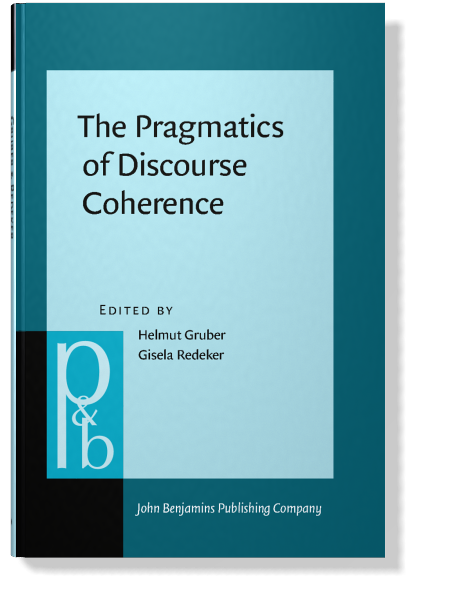
In:The Pragmatics of Discourse Coherence: Theories and applications
Edited by Helmut Gruber and Gisela Redeker
[Pragmatics & Beyond New Series 254] 2014
► pp. 87–119
The coding of discourse relations in English and German argumentative discourse
Published online: 26 November 2014
https://doi.org/10.1075/pbns.254.04spe
https://doi.org/10.1075/pbns.254.04spe
This chapter examines contrastively the overt and non-overt coding of discourse
relations in British English and German editorials. Particular attention is given
to the linguistic coding of discourse relations between adjacently and non-adjacently
positioned discourse units, and to the question of granularity. In the
data, the discourse relation of Contrast is coded overtly in adjacent and nonadjacent
positioning in the two languages, while Continuation, Elaboration,
Explanation and Comment are coded differently. In the British data, there is a
clear preference for coding discourse relations between adjacently positioned
subordinating discourse relations overtly on the level of clause, and in the
German data, discourse relations holding between non-adjacently positioned
sentences are preferably marked overtly.

References (51)
Asher, Nicholas, and Alex Lascarides. 2003. Logics of Conversation. Cambridge: Cambridge University Press.
Asher, Nicholas, and Laure Vieu. 2005. “Subordinating and Coordinating Discourse Relations.” Lingua 115: 591–610.
Benz, Anton, and Peter Kühnlein. 2008. “Constraints in Discourse. An Introduction.” In Constraints in Discourse, ed. by Anton Benz, and Peter Kühnlein, 1–26. Amsterdam: John Benjamins.
Bloor, Thomas, and Meriel Bloor. 1995. The Functional Analysis of English: A Hallidayan Approach. London: Arnold.
Brinton, Laurel. 1996. Pragmatic Markers in English: Grammaticalization and Discourse Functions. Berlin: Mouton de Gruyter.
Bublitz, Wolfram, Uta Lenk, and Eija Ventola (eds). 1999. Coherence in Spoken and Written Discourse. Amsterdam: John Benjamins.
Chesterman, Andrew. 1998. Contrastive Functional Analysis. Amsterdam: John Benjamins.
Clyne, Michael. 1987. “Cultural Differences in the Organization of Academic Texts.” Journal of Pragmatics 11: 211–247.
Degand, Liesbeth, Nathalie Lefèvre, and Yves Bestgen. 1999. “The Impact of Connectives and Anaphoric Expression on Expository Discourse Comprehension.” Document Design 1: 39–51.
Doherty, Monika. 2003. “Discourse Relators and the Beginnings of Sentences in English and German.” Languages in Contrast 3: 223–251.
Esser, Jürgen. 2006. Presentation in Language. Rethinking Speech and Writing. Tübingen: Gunter Narr.
Fetzer, Anita. 2005. “Negative Theme Zones in Political Interviews: A Contrastive Analysis of German and English Turn-initial Positions.” In Pressetextsorten im Vergleich. Contrasting Text Types in the Press, ed. by Andrew Chesterman, and Hartmut Lenk, 283–301. Hildesheim: Olms.
. 2008. “Theme Zones in English Media Discourse. Forms and Functions.” Journal of Pragmatics 40 (9): 1543–1568.
Gernsbacher, Morton-Ann, and Talmy Givón (eds). 1995. Coherence in Spontaneous Text. Amsterdam: John Benjamins.
. 2005. Context as Other Minds. Amsterdam: John Benjamins.
Gómez-González, Maria. 2001. The Theme–Topic Interface. Evidence from English. Amsterdam: John Benjamins.
Grosz, Barbara, Ararvind Joshi, and Scott Weinstein. 1995. “Centering: A Framework for Modelling the Local Coherence of Discourse.” Computational Linguistics 21: 203–225.
Grosz, Barbara, and Candace Sidner. 1986. “Attention, Intentions and the Structure of Discourse.” Computational Linguistics 12: 175–204.
Gumperz, John. 1992. “Contextualization and Understanding.” In Rethinking Context: Language as an Interactive Phenomenon, ed. by Alessandro Duranti, and Charles Goodwin, 229–252. Cambridge: Cambridge University Press.
Hannay, Mike. 1994. “The Theme Zone.” In Nauwe Betrekkingen, ed. by Ronney Boogart, and Jan Noordegraaf, 107–117. Amsterdam: Neerlandistiek and Münster: Nodus Publikationen.
House, Juliane. 1996. “Contrastive Discourse Analysis and Misunderstanding: The Case of German and English.” In Contrastive Sociolinguistics, ed. by Marlies Hellinger, and Ulrich Ammon, 345–361. Berlin/New York: Mouton de Gruyter.
Kamp, Hans, and Uwe Reyle. 1993. From Discourse to Logic. Introduction to Modeltheoretic Semantics of Natural Language, Formal Logic and Discourse Representation Theory. Dordrecht: Kluwer.
Karagjosova, Elena. 2003. “Modal Particles and the Common Ground.” In Perspectives on Dialogue in the New Millennium, ed. by Peter Kühnlein, Hannes Rieser, and Henk Zeevat, 335–349. Amsterdam: John Benjamins.
König, Ekkehard. 1997. “Zur Bedeutung von Modalpartikeln im Deutschen: Ein Neuansatz im Rahmen der Relevanztheorie.” Germanistische Linguistik 136: 57–75.
Krifka, Manfred, and Caroline Féry. 2008. “Information Structure. Notional Distinctions, Ways of Expression.” In Unity and Diversity of Languages, ed. by Piet van Sterkenburg, 123–136. Amsterdam: John Benjamins.
Krzeszowski, Tomas. 1989. “Towards a Typology of Contrastive Studies.” In Contrastive Pragmatics, ed. by Wieslaw Oleksy, 55–72. Amsterdam: John Benjamins.
Lenker, Ursual. 2010. Argument and Rhetoric – Adverbial Connectors in the History of English. Berlin: Mouton de Gruyter.
Liedtke, Frank. 1997. “Gesagt? getan: Über illokutionäre Indikatoren.” Linguistische Berichte 8: 189–213.
Mann, William C., and Sandra A. Thompson. 1987. “Rhetorical Structure Theory: Description and Construction of Text Structures.” In Natural Language Generation, ed. by Gerard Kempen, 85–95. Den Haag: Martinus Nijhoff.
. 1988. “Rhetorical Structure Theory: Toward a Functional Theory of Text Organization.” Text 8: 243–281.
Pomerantz, Anita. 1984. “Agreeing and Disagreeing with Assessments: Some Features of Preferred/Dispreferred Turn Shapes.” In Structures of Social Action, ed. by John Atkinson, and John M. Heritage, 57–101. Cambridge: Cambridge University Press.
Quirk, Randolph, Sidney Greenbaum, Geoffrey Leech, and Jan Svartvik. 1985. A Grammar of Contemporary English. London: Longman.
Reinhart, Tanya. 1982. “Pragmatics and Linguistics: An Analysis of Sentence Topics.” Philosophica 27: 53–94.
Reis, Marga. 1997. “Zum syntaktischen Status unselbständiger Verbzweit-Sätze.” In Sprache im Fokus. Festschrift für Heinz Vater zum 65. Geburtstag, ed. by Christa Dürscheid, Karl-Heinz Ramers, and Monika Schwarz, 121–144. Tübingen: Niemeyer.
Schegloff, Emanuel. 1995. “Discourse as an Interactional Achievement III: The Omnirelevance of Action.” Research on Language and Social Interaction 28 (3): 185–211.
Soria, Claudia, and Giacomo Ferrari. 1998. “Lexical Marking of Discourse Relations – Some Experimental Findings.”
Proceedings of COLING-ACL Workshop on Discourse Relations and Discourse Markers
, 36–42. Montréal.
Speyer, Augustin. 2010. “Die Markierung von Diskursrelationen im Frühneuhochdeutschen.” Sprachwissenschaft 35: 409–442.
Thibault, Paul. 2003. “Contextualization and Social Meaning-making Practices.” In Language and Interaction. Discussions with John J. Gumperz, ed. by Susan Eerdmans, et al., 41–62. Amsterdam: John Benjamins.
Cited by (6)
Cited by six other publications
Biryukova, E. V., E. G. Borisova & I. S. Kalyatin
Speyer, Augustin
2022. Discourse relations and the German prefield. In Language Change at the Interfaces [Linguistik Aktuell/Linguistics Today, 275], ► pp. 215 ff.
Fetzer, Anita
2018. The encoding and signalling of discourse relations in argumentative discourse. In The Construction of Discourse as Verbal Interaction [Pragmatics & Beyond New Series, 296], ► pp. 13 ff.
Speyer, Augustin & Anita Fetzer
2018. “Well would you believe it, I have failed the exam again”. Pragmatics and Society 9:1 ► pp. 26 ff.
Zaliznjak, Anna A. & Irina Mikaelian
This list is based on CrossRef data as of 28 november 2025. Please note that it may not be complete. Sources presented here have been supplied by the respective publishers. Any errors therein should be reported to them.