In:Evaluation in Context
Edited by Geoff Thompson † and Laura Alba-Juez
[Pragmatics & Beyond New Series 242] 2014
► pp. 197–220
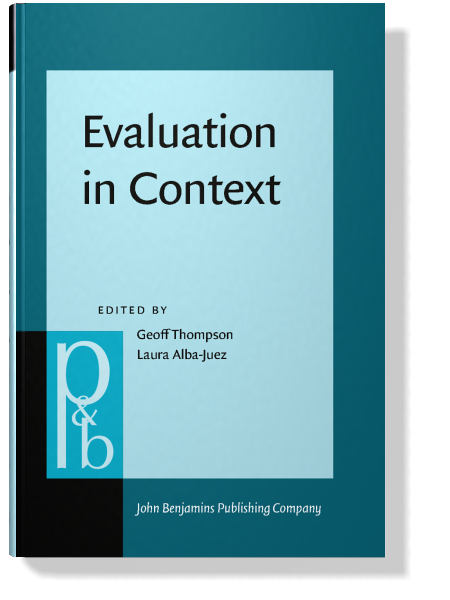
“An astonishing season of destiny!” Evaluation in blurbs used for advertising TV series
Published online: 4 February 2014
https://doi.org/10.1075/pbns.242.10bed
https://doi.org/10.1075/pbns.242.10bed
In this chapter I explore evaluation in DVD blurbs (the text on the back of DVD box sets for TV series), which promote television series to potential buyers. The approach taken to the analysis of evaluation is corpus linguistics, and this chapter reports on findings from a pilot study examining the blurbs for 50 contemporary American television series. A combination of frequency analysis and concordancing is used to examine the use of evaluation in these discourse types in terms of frequency, dispersion and functionality. The findings suggest that the discourse type of the DVD blurb is linguistically restricted – although not in terms of specific lexico-grammatical items, but rather in terms of pragmatic functions, and that it has much in common with both traditional advertising and book blurbs.

References (44)
Anthony, Laurence. 2003. AntMover (Version 1.0). Okayama, Japan: Okayama University of Science. <[URL]>
2008. AntConc (Version 3.2.2). Tokyo, Japan: Waseda University. <[URL]>
Bateman, John A. 2008. Multimodality and Genre. A Foundation for the Systematic Analysis of Multimodal Documents. Basingstoke/New York: Palgrave Macmillan.
Beasley, Ron and Danesi, Marcel. 2002. Persuasive Signs. The Semiotics of Advertising. Berlin/New York: Mouton de Gruyter.
Bednarek, Monika. 2006a “Evaluating Europe - Parameters of evaluation in the British press.” In Reconfiguring Europe - the Contribution of Applied Linguistics (British Studies in Applied Linguistics 20), Constant Leung and Jennifer Jenkins (eds), 137–156. London: BAAL/Equinox.
2009. “Language patterns and Attitude”. Functions of Language 16 (2): 165–192.
2012. “‘Get us the hell out of here’: Key words and trigrams in fictional television series.” International Journal of Corpus Linguistics 17 (1): 35–63.
Biber, Douglas, Johansson, Stig, Leech, Geoffrey, Conrad, Susan and Finegan, Edward. 1999. Longman Grammar of Spoken and Written English. London: Longman.
Dunn, Anne. 2005. “The genres of television.” Narrative and Media, Helen Fulton, Rosemary Huisman, Julian Murphet and Anne Dunn (eds), 125–139. Cambridge: Cambridge University Press.
Gea-Valor, Ma. Lluïsa. 2005. “Advertising books: a linguistic analysis of blurbs.” Ibérica 10: 41–41.
Genette, Gerard. 1997. Paratexts. Thresholds of Interpretation. Cambridge: Cambridge University Press.
Gries, Stefan Th. 2006. “Some proposals towards a more rigorous corpus linguistics.” ZAA 54 (2): 191–202.
Halliday, Michael A.K. and Matthiessen, Christian M.I.M. 2004. An Introduction to Functional Grammar (3rd edition). London: Arnold.
Hunston, Susan. 2004. “Counting the uncountable: problems of identifying evaluation in a text and in a corpus.” In Corpora and Discourse, Alan Partington, John Morley and Louann Haarman (eds), 157–188. Bern: Peter Lang.
2011. Corpus Approaches to Evaluation. Phraseology and Evaluative Language. London/New York: Routledge.
Hunston, Susan and Sinclair, John. 2000. “A local grammar of evaluation.” In Evaluation in Text: Authorial Stance and the Construction of Discourse, Susan Hunston and Geoff Thompson (eds), 74–101. Oxford: Oxford University Press.
Hyland, Ken. 2000. Disciplinary Discourses: Social Interactions in Academic Writing. Harlow, UK: Longman.
Kaltenbacher, Martin. 2006. “Culture related linguistic differences in tourist websites: the emotive and the factual. A corpus analysis within the framework of Appraisal.” In System and Corpus. Exploring Connections, Geoff Thompson and Susan Hunston (eds), 269–292. London: Equinox.
Koester, Almut. 2010. “Building a small specialised corpus.” In The Routledge Handbook of Corpus Linguistics, Anne O’Keeffe and Michael McCarthy (eds), 66–79. New York: Routledge.
Lee, David Y.W. 2007. “Corpora and discourse analysis. New ways of doing old things.” In Advances in Discourse Studies, Vijay Bhatia, John Flowerdew and Rodney Jones (eds), 86–99. London: Routledge.
Martin, James and White, Peter. 2005. The Language of Evaluation. Appraisal in English. Basingstoke/New York: Palgrave Macmillan.
McEnery, Tony, Xiao, Richard and Tono, Yukio. 2006. Corpus-Based Language Studies. An Advanced Resource Book. London/New York: Routledge.
Mason, Oliver. n.d. QTag. <[URL]>
Miller, Donna R. 1999. “Meaning up for grabs: value-orientation patterns in British parliamentary debate on Europe.” In Language and Ideology: Selected papers from the 6th International Pragmatics Conference,Vol. I, Jef Verschueren (ed.), 386–404. Antwerp: International Pragmatics Association.
2002. “Ways of meaning ‘yea’ and ‘nay’ in parliamentary debate as register: a cost-benefit analysis.” In The Economy Principle in English: Linguistic, Literary, and Cultural Perspectives. Proceedings of the 19th Conference of the Associazione Italiana di Anglistica, Marialuisa Bignami, Giovanni Iamartino and Carlo Pagetti (eds), 220–233. Milano: Edizioni Unicopli.
Partington, Alan. 2010. “Modern Diachronic Corpus-Assisted Discourse Studies (MD-CADS) on UK newspapers: an overview of the project.” Corpora 5 (2): 83–108.
Pounds, Gabrina. 2011. “‘This property’ offers much character and charm’: evaluation in the discourse of online property advertising.” Text & Talk 31 (2): 195–220.
Römer, Ute. 2008. “Identification impossible? A corpus approach to realisations of evaluative meaning in academic writing.” Functions of Language 15 (1): 115–130.
Shaw, Philip. 2006. “Evaluative language in evaluative and promotional genres.” In Variation in Business and Economics Discourse: Diachronic and Genre Perspectives, Gabriella Del Lungo Camiciotti, Marina Dossena and Belinda Crawford Camiciottoli (eds), 152–165. Rome: Officina Edizioni.
Taboada, Maite and Grieve, Jack. 2004. “Analyzing appraisal automatically.” Exploring Attitude and Affect in Text: Theories and Applications. Papers from 2004 AAAI Spring Symposium, 158–161. Stanford: Stanford AAAI (American Association for Artificial Intelligence) Technical Reports.
Cited by (11)
Cited by 11 other publications
Ortega-Robles, Carmen & Encarnación Hidalgo-Tenorio
Hidalgo-Downing, Laura & Paula Pérez-Sobrino
Peldová, Petra
Siromaa, Maarit & Mirka Rauniomaa
Bednarek, Monika
Cruz García, Laura
Bednarek, Monika & Helen Caple
Su, Hang
2015. Review of Yan & Webster (2014): Developing Systemic Functional Linguistics: Theory and Application. Functions of Language 22:1 ► pp. 150 ff.
[no author supplied]
[no author supplied]
This list is based on CrossRef data as of 28 november 2025. Please note that it may not be complete. Sources presented here have been supplied by the respective publishers. Any errors therein should be reported to them.