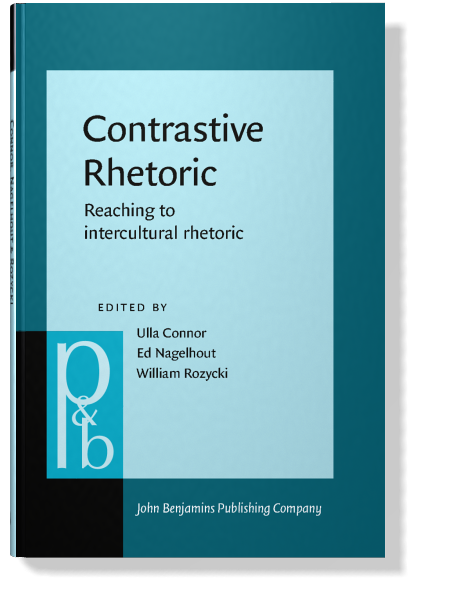
In:Contrastive Rhetoric: Reaching to intercultural rhetoric
Edited by Ulla Connor, Ed Nagelhout and William Rozycki
[Pragmatics & Beyond New Series 169] 2008
► pp. vii–viii
Get fulltext
This article is available free of charge.
Published online: 9 January 2008
https://doi.org/10.1075/pbns.169.toc
https://doi.org/10.1075/pbns.169.toc
Table of contents
Introduction
Section I. Current state of contrastive rhetoric9
From contrastive rhetoric to intercultural rhetoric: A search for collective identity
The importance of comparable corpora in cross-cultural studies
Section II. Contrastive corpus studies in specific genres43
Metadiscourse across three varieties of English: American, British, and advanced learner English
A genre-based study of research grant proposals in China
Different cultures – different discourses? Rhetorical patterns of business letters by English and Russian speakers
Spanish language newspaper editorials from Mexico, Spain, and the U.S.
The rhetorical structure of academic book reviews of literature: An English-Spanish cross-linguistic approach
Newspaper commentaries on terrorism in China and Australia: A contrastive genre study
Section III. Contrastive rhetoric and the teaching of ESL/EFL writing193
"Long sentences and floating commas": Mexican students' rhetorical practices and the sociocultural context
English web page use in an EFL setting: A contrastive rhetoric view of the development of information literacy
From Confucianism to Marxism: A century of theme treatment in Chinese writing instruction
Plagiarism in an intercultural rhetoric context: What we can learn about one from the other
Section IV. Future directions275
A conversation on contrastive rhetoric: Dwight Atkinson and Paul Kei Matsuda talk about issues, conceptualizations, and the future of contrastive rhetoric
Mapping multidimensional aspects of research: Reaching to intercultural rhetoric
Notes on contributors
Index
