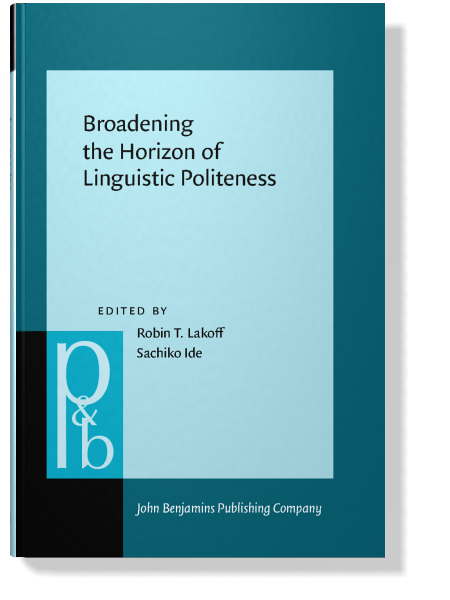
In:Broadening the Horizon of Linguistic Politeness
Edited by Robin T. Lakoff and Sachiko Ide
[Pragmatics & Beyond New Series 139] 2005
► pp. v–viii
Get fulltext
This article is available free of charge.
Published online: 27 October 2005
https://doi.org/10.1075/pbns.139.toc
https://doi.org/10.1075/pbns.139.toc
Table of contents
Acknowledgmentsix
Foreword
Introduction: Broadening the horizon of linguistic politeness
Part I. General overviews: The plenary papers
Civility and its discontents: Or, getting in your face
How and why honorifics can signify dignity and elegance: The indexicality and reflexivity of linguistic rituals
Whither politeness
Part II. The theoretical perspective
Yoroshiku onegaishimasu: Routine practice of the routine formula in Japanese
An argument for a frame-based approach to politeness: Evidence from the use of the imperative in Cypriot Greek
The significance of ‘face’ and politeness in social interaction as revealed through Thai ‘face’ idioms
Part III. The descriptive perspective
Face threatening acts, primary face threatening acts, and the management of discourse: Australian English and speakers of Asian Englishes
Politeness in Thai computer-mediated communication
Polite diminutives in Spanish: A matter of size?
Indirectness as a politeness strategy of Thai speakers
Part IV. The comparative perspective
Japanese honorifics as a marker of sociocultural identity: A view from non-western perspectives
Directness as a source of misunderstanding: The case of requests and suggestions
Forms of address in Irish and Swedish
Women, men and polite requests: English and Greek
Privacy: An intercultural perspective
Selection of linguistic forms for requests and offers: Comparison between English and Chinese
Part V. The historical perspective
Japanese pronouns of address: Their behavior and maintenance over time
An aspect of the origins and development of linguistic politeness in Thai
Index
