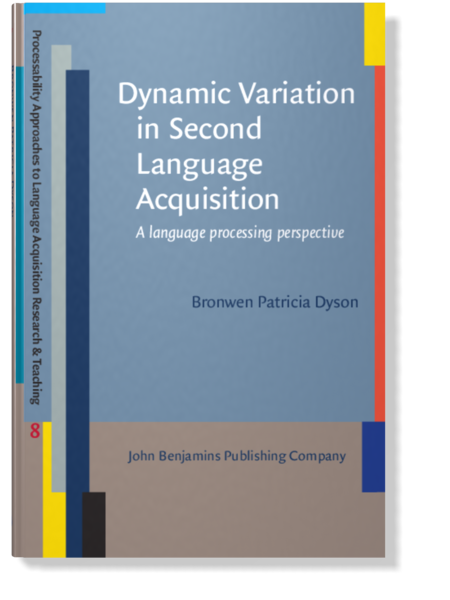
In:Dynamic Variation in Second Language Acquisition: A language processing perspective
Bronwen Patricia Dyson
[Processability Approaches to Language Acquisition Research & Teaching 8] 2021
► pp. vii–xi
Get fulltext
This article is available free of charge.
Published online: 16 August 2021
https://doi.org/10.1075/palart.8.toc
https://doi.org/10.1075/palart.8.toc
Table of contents
Abbreviations
xiii
Chapter 1.The challenge of dynamic variation in language processing
1
1.1Introduction
1
1.2Why a language processing approach to second language
variation?
2
1.3PT’s dynamic variational dimension: The variational options
hypothesis
6
1.3.1Developmental problems
7
1.3.2Developmental trailers and scouts
8
1.3.3Accuracy differences: Variational options
9
1.3.4Learner orientation
10
1.4Research gap
11
1.5Aim of the book
13
1.6PT’s dynamic developmental dimension: The fixed trajectory
16
1.6.1Levelt’s model and processing procedures
16
1.6.2LFG and feature unification
18
1.6.3L2 English morphological stages
21
1.6.4L2 English syntactic stages
24
1.7A snapshot of PT’s dynamic methodologies
26
1.8The significance of this book for debate on L2 variation
29
1.8.1Variation is inherent, systematic and change-making
29
1.8.2Systematic variation is related to change
30
1.8.3Unsystematic variation is transformative
31
1.9Defining L2 variation: variation and difference
32
1.10Outline of the book
33
Chapter 2.Contemporary lenses on variation in SLA
35
2.1Introduction
35
2.2Sociolinguistics and variationism
36
2.2.1Defining learner versus target language choices
37
2.2.2Systematic (and free) variation
39
2.2.3Variation due to contextual variables
41
2.2.4Conclusion
44
2.3Usage based linguistics
44
2.3.1Learner variation as the focus
44
2.3.2Regularities in variation
46
2.3.3Variation due to socio-cognitive factors
47
2.3.4Conclusion
49
2.4Dynamic Systems Theory and Complexity Theory
49
2.4.1Defining variability versus variation
49
2.4.2Free variation as the driver of change
50
2.4.3Variation due to multiple socio-cognitive factors
52
2.4.4Conclusion
53
2.5Discussion and conclusion
53
Chapter 3.Origins of L2 variation as a dynamic linguistic system
55
3.1Introduction
55
3.2The dynamics of the Multidimensional Model
56
3.2.1Overview
56
3.2.2The dynamics of psycholinguistic development
57
3.2.3The dynamics of psycholinguistic variation
58
3.2.4Conclusion
60
3.3The dynamics of the Predictive Framework
60
3.3.1Psycholinguistic development
61
3.3.2Psycholinguistic variation
61
3.4Conclusion
63
Chapter 4.Dynamic variation as a dimension of processability
65
4.1Introduction
65
4.2The dynamics of the variational options hypothesis
66
4.2.1Developmental problems
67
4.2.2Developmental trailers and scouts
70
4.2.3Variational options
72
4.2.4Learner orientation: Simplifying (Type A), standardizing (Type
B)
76
4.2.5Empirical support
77
4.2.6Recapping the hypothesis
78
4.2.7Variation in PT’s developmental features
78
4.3The dynamics of the developmental style hypothesis
82
4.3.1Lexical and grammatical morphemes
83
4.3.2Previous studies of developmental style: A critical
self-review
85
4.3.3Timing of PT’s developmental features
86
4.3.4Timing of Stage 3 syntax and related Stage 4 morphosyntax
90
4.3.5Timing of verb and noun morphology
95
4.4The dynamics of developmental change
101
4.4.1Variation, change, and fossilization
101
4.4.2Variation, emergence, and change
102
4.5Conclusion
104
Chapter 5.A methodology for studying dynamic variation
107
5.1Introduction
107
5.2A context of L2 acquisition
107
5.3Participants as variable L2 processers
180
5.4Spoken, task-based communication over time
110
5.4.1Longitudinal data
110
5.4.2Task-based data
112
5.4.3Spoken data
114
5.5Measuring dynamic variation in development
114
5.5.1Measuring developmental stages
115
5.5.2Measuring trailers, scouts, and variational options
116
5.5.3Measuring developmental style
120
5.5.4Measuring free variation
122
5.6Conclusion
123
Chapter 6.Dynamic variation in simplifying developmental problems
125
6.1Introduction
125
6.2Syntactic results: From simplifying to standardizing
126
6.2.1Philomena: Simplifying scout and omission
126
6.2.2Ellen: Simplifying scout and omission
131
6.2.3Mary: Simplifying scout and omission
133
6.2.4Andre: Simplifying with intra-learner variation
136
6.2.5Samia: Simplifying scout and omission
139
6.2.6Yan: Simplifying (delayed) scout and omission
141
6.2.7Amir: Standardizing trailer and avoidance
144
6.2.8Daniel: Standardizing trailer and avoidance?
145
6.2.9Summary
148
6.3Morphological results: From simplifying to standardizing
149
6.3.1Philomena: Simplifying scout and violation
149
6.3.2Mary: Simplifying scout and violation
152
6.3.3Daniel: Simplifying scout and violation
153
6.3.4Ellen: Simplifying scout and violation
155
6.3.5Yan: Simplifying but sensitivity to the context
157
6.3.6Andre: Simplifying scout and balanced options
159
6.3.7Amir: Simplifying scout and avoidance
161
6.3.8Samia: Standardizing trailer and balanced options?
163
6.4Overall summary
164
6.5Discussion and conclusion
165
Chapter 7.Dynamic variation in developmental style
169
7.1Introduction
169
7.2Overview of the learners’ style
170
7.3Timing of information questions
171
7.3.1Philomena: Reliance on Stage 3 syntax
172
7.3.2Ellen: Reliance on Stage 3 syntax
176
7.3.3Mary: Reliance on Stage 3 syntax
179
7.3.4Samia style: Reliance on Stage 3 syntax
181
7.3.5Andre: Reliance on Stage 3 syntax, with elaboration
183
7.3.6Yan: Reliance on canonical order, no Stage 4 co-timing
185
7.3.7Amir: Stage 4 morphosyntax, formulae
186
7.3.8Daniel: Reliance on canonical order, Stage 4
morphosyntax,
187
7.3.9Summary
190
7.4Timing of noun and verb morphology
190
7.4.1Ellen: Dependence on words
192
7.4.2Mary: Morphological lag
195
7.4.3Philomena: Dependence on words
197
7.4.4Yan: Morphological lag
200
7.4.5Amir’s style: Morphological lag
202
7.4.6Andre: Morphological lag
204
7.4.7Samia: Co-timing of morphology and syntax
205
7.4.8Daniel: Co-timing of morphology and syntax
206
7.4.9Summary
208
7.5From syntax-first to morphology and syntax
209
7.5.1Ellen: Syntax-first (Stages 2 to 4)
210
7.5.2Yan: Syntax-first (Stages 2 to 4)
211
7.5.3Mary: Syntax-first (Stages 3 to 4)
212
7.5.4Philomena: Syntax-first (Stages 3 to 4)
212
7.5.5Andre: Syntax-first (Stages 3 to 4)
212
7.5.6Amir: Syntax-first (Stage 4)
213
7.5.7Samia: Mixed morphosyntactic (Stages 3 to 4)
214
7.5.8Daniel: Mixed morphosyntactic (Stages 2 to 4)
214
7.6Discussion and conclusion
215
Chapter 8.Processability and developmental change
219
8.1Introduction
219
8.2Ellen: No free variation
221
8.3Philomena: Emergence as driver
226
8.4Yan: Emergence as driver
230
8.5Daniel: Free variation?
233
8.6Overall results
236
8.7Discussion and conclusion
238
Chapter 9.The contribution of dynamic variation to SLA
241
9.1Introduction
241
9.2Dynamic variation in L2 processing
242
9.2.1Variational options results
242
9.2.2Developmental style results
243
9.2.3Implications of variational options and developmental
style
244
9.2.4Developmental change results
246
9.2.5Implications of developmental change
246
References
249
Appendix
257
Name index
265
Subject index
267
