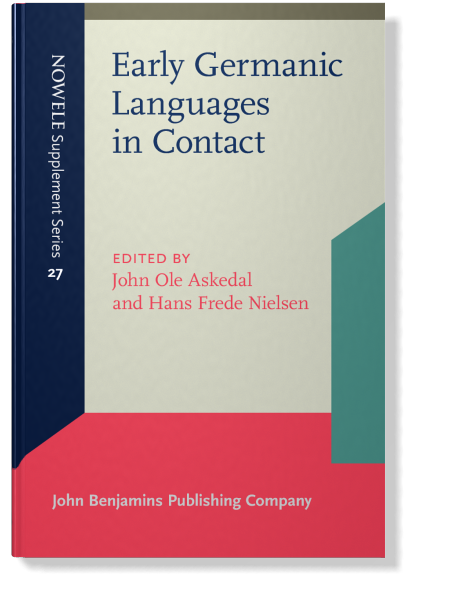
In:Early Germanic Languages in Contact
Edited by John Ole Askedal and Hans Frede Nielsen †
[NOWELE Supplement Series 27] 2015
► pp. 203–221
Identifying and Dating Norse-Derived Terms in Medieval English: Approaches and Problems
Published online: 11 June 2015
https://doi.org/10.1075/nss.27.11pon
https://doi.org/10.1075/nss.27.11pon

References (70)
Anderson, J. & Britton, D. 1999. The Orthography and Phonology of the Ormulum
. English Language and Linguistics 3.299-334.
Bates, D. (ed.). 1998. Regesta Regum Anglo-Normannorum: The Acta of William I (1066-1087). Oxford: Clarendon Press.
Bennett, J.A.W. & Smithers, G.V. 1968. Early Middle English Verse and Prose (2nd ed.). Oxford: Clarendon Press.
Björkman, E. 1900-02. Scandinavian Loanwords in Middle English, 2 vols. Studien zur englischen Philologie, 7 and 11. Halle: Niemeyer.
Brate, E. 1885. Nordische Lehnwörter im Orrmulum. Beiträge zur Geschichte der deutschen Sprache und Literatur 10.1-80 and 580-586.
Dance, R. 2000. Is the Verb die Derived from Old Norse? A Review of the Evidence. English Studies 81.368-383.
. 2003a. The AB Language: The Recluse, the Gossip and the Language Historian. In Y. Wada (ed.), A Companion to Ancrene Wisse, 57-82. Cambridge: Brewer.
. 2003b. Words Derived from Old Norse in Early Middle English: Studies in the Vocabulary of the South-West Midland Texts. Medieval and Renaissance Texts and Studies, 246. Tempe, AZ: Arizona Center for Medieval and Renaissance Studies.
. 2011. “Tomorȝan hit is awane”: Words Derived from Old Norse in Four Lambeth Homilies. In J. Fisiak & M. Bator (eds.), Foreign Influences on Medieval English, 77-127. Studies in English Medieval Language and Literature, 28. Frankfurt am Main: Peter Lang.
. 2012 (for 2011).
Ealde æ, niwæ laȝe: Two Words for “Law” in the Twelfth Century. New Medieval Literatures 13.149-182.
. 2013. “Tor for to telle”: Words Derived from Old Norse in Sir Gawain and the Green Knight
. In J. Jefferson & A. Putter (eds.), Multilingualism in Medieval Britain (c. 1066-1520): Sources and Analysis, 41-58. Medieval Texts and Cultures of Northern Europe, 15. Turnhout: Brepols.
. Forthcoming. Words Derived from Old Norse in Sir Gawain and the Green Knight: An Etymological Survey.
Denison, D. & Hogg, R. 2006. Overview. In R. Hogg & D. Denison (eds.), A History of the English Language, 1-42. Cambridge: Cambridge University Press.
Dictionary of Medieval Latin from British Sources. 1975-. Ed. by R.E. Latham, et al. Oxford: Oxford University Press.
[DOE =] Dictionary of Old English. 1986-. Ed. by A.C. Amos, et al. Toronto: Pontifical Institute of Mediaeval Studies, University of Toronto.
Durkin, P. 2014. Borrowed Words: A History of Loanwords in English. Oxford: Oxford University Press.
The Electronic Sawyer: Online Catalogue of Anglo-Saxon Charters. Available at <[URL]>, accessed on 04/02/2014.
Falk, H. & Torp, A. 1903-06. Etymologisk ordbog over det norske og det danske sprog. Kristiania: H. Aschehoug & Co.
Flom, G.T. 1900. Scandinavian Influence on Southern Lowland Scotch: A Contribution to the Linguistic Relations of English and Scandinavian. Columbia University Germanic Studies, 1. New York: n.p.
Förster, M.T.W. (ed.). 1932. Die Vercelli-Homilien. Bibliothek der angelsächsischen Prosa, 12. Hamburg: H. Grand.
Gneuss, H. 1972. The Origin of Standard Old English and Æthelwold’s School at Winchester. Anglo-Saxon England 1.63-83.
Harmer, F.E. (ed.). 1989. Anglo-Saxon Writs. Paul Watkins Medieval Studies, 2 (2nd ed.). Stamford: Watkins.
Hofmann, D. 1955. Nordisch-englische Lehnbeziehungen der Wikingerzeit. Bibliotheca Arnamagnæana, 14. Copenhagen: Munksgaard.
Hogg, R. & Fulk, R.D. 2011. A Grammar of Old English. Vol. 2: Morphology. Chichester: Wiley-Blackwell.
Hug, S. 1987. Scandinavian Loanwords and Their Equivalents in Middle English. European University Studies Series, 21: Linguistics, 62. Berlin: Peter Lang.
Irvine, S. 2000. The Compilation and Use of Manuscripts Containing Old English in the Twelfth Century. In M. Swan & E.M. Treharne (eds.), Rewriting Old English in the Twelfth Century, 41-61. Cambridge Studies in Anglo-Saxon England, 30. Cambridge: Cambridge University Press.
Johannesson, N.L. 2006. Bread, Crumbs and Related Matters in the Ormulum. In R.W. McConchie, et al. (eds.), Selected Proceedings of the 2005 Symposium on New Approaches in English Historical Lexis (HEL-LEX), 69-82. Somerville, MA: Cascadilla Proceedings Project.
Ker, N.R. 1990. Catalogue of Manuscripts Containing Anglo-Saxon(Oxford: Clarendon Press, 1957). Rpt. with a Supplement from Anglo-Saxon England, 5 (1977): 121-131. Oxford: Clarendon Press.
Kries, S. 2003. Skandinavisch-schottische Sprachbeziehungen im Mittelalter. Der altnordische Lehneinfluss. North-Western European Language Evolution Supplement, 20. Odense: University Press of Southern Denmark.
Kroonen, G. 2013. Etymological Dictionary of Proto-Germanic. Leiden Indo-European Etymological Dictionary Series, 11. Leiden: Brill.
Laing, M. 1993. Catalogue of Sources for a Linguistic Atlas of Early Medieval English. Cambridge: Brewer.
Lowe, K.A. 1990. The Anglo-Saxon Vernacular Will: Studies in Texts and Their Transmission. Unpublished doctoral dissertation, University of Cambridge.
. 1992. Two Thirteenth Century Cartularies from Bury St Edmunds: A Study in Textual Transmission. Neuphilologische Mitteilungen 93.293-301.
. 2001. Elders and Betters: Hinderclay in Suffolk. Journal of the English Place-Name Society 33.15-20.
. 2010. Linguistic Geography, Demography, and Monastic Community: Scribal Language at Bury St Edmunds. In A. Hall, O. Timofeeva, Á. Kiricsi & B. Fox (eds.), Interfaces between Language and Culture in Medieval England: A Festschrift for Matti Kilpiö, 147-178. The Northern World, 48. Leiden: Brill.
[MED =] Middle English Dictionary. 1952-2001. Ed. by H. Kurath, et al. Ann Arbor: University of Michigan Press.
Minkova, D. & Stockwell, R.P. 1994. Syllable Weight, Prosody, and Meter in Old English. Diachronica 11.35-64.
Nielsen, H.F. 1985. Old English and the Continental Germanic Languages: A Survey of Morphological and Phonological Interrelations. Innsbrucker Beiträge zur Sprachwissenschaft, 33 (2nd ed.). Innsbruck: Institut für Sprachwissenschaft der Universität Innsbruck.
. 1998. The Continental Backgrounds of English and Its Insular Development until 1154. A Journey through the History of the English Language in England and America, 1. Odense: Odense University Press.
Nightingale, P. 1983. The Ora, the Mark and the Mancus: Weight Standards and the Coinage in Eleventh-Century England. Part I. Numismatic Chronicle 143.248-257.
. 1984. The Ora, the Mark and the Mancus: Weight Standards and the Coinage in Eleventh-Century England. Part II. Numismatic Chronicle 144.234-248.
Noreen, A. 1913. Geschichte der nordischen Sprachen: besonders in altnordischer Zeit. Grundriss der germanischen Philologie, 4 (3rd ed.). Strasbourg: Karl J. Trübner.
[OED 1989 =] Oxford English Dictionary. 1989. Ed. by John A. Simpson and Edmund Weiner (2nd ed.). Oxford: Oxford University Press.
[OED 2000- =] Oxford English Dictionary. 2000-. Ed. by John A. Simpson (3rd ed.). Oxford: Oxford University Press. Available at <[URL]>, accessed from 18/12/2013 to 14/02/2014.
Olszewska, E.S. 1962. Alliterative Phrases in the Ormulum: Some Norse Parallels. In N. Davis & C.L. Wrenn (eds.), English and Medieval Studies Presented to J. R. R. Tolkien on the Occasion of His Seventieth Birthday, 112-127. London: Allen & Unwin.
Parsons, D. 2001. How Long Did the Scandinavian Language Survive in England? Again. In J. Graham-Campbell, et al. (eds.), Vikings and the Danelaw: Select Papers from the Proceedings of the Thirteenth Viking Congress, Nottingham and York, 21-30 August 1997, 299-312. Oxford: Oxbow Books.
Pelteret, D.A.E. 1995. Slavery in Early Medieval England: From the Reign of Alfred until the Twelfth Century. Studies in Anglo-Saxon History, 7. Woodbridge: Boydell.
Pons-Sanz, S.M. 2000. Analysis of the Scandinavian Loanwords in the Aldredian Glosses to the Lindisfarne Gospels. Studies in English Language and Linguistics: Monographs, 9. Valencia: Department of English and German Philology, University of Valencia.
. 2007a. Norse-Derived Vocabulary in Late Old English Texts: Wulfstan’s Works, a Case Study. North-Western European Language Evolution Supplement, 22. Odense: University Press of Southern Denmark.
. 2007b. A Paw in Every Pie: Wulfstan and the Anglo-Saxon Chronicle Again. Leeds Studies in English, n.s. 38.31-52.
. 2013. The Lexical Effects of Anglo-Scandinavian Linguistic Contact on Old English. Studies in the Early Middle Ages, 1. Turnhout: Brepols.
. 2014. The Language of Early English Literature: From Cædmon to Milton. Perspectives on the English Language. Houndmills: Palgrave Macmillan.
Skeat, W.W. 1924. An Etymological Dictionary of the English Language (2nd ed.). Oxford: Clarendon Press.
Swan, M. 2010. London, Lambeth Palace 487. In O. Da Rold, T. Kato, M. Swan & E. Treharne (eds.), The Production and Use of English Manuscripts 1060 to 1220. Leicester: University of Leicester. Available at <[URL]>, accessed on 04/02/2014.
Stark, D. 1982. The Old English Weak Verbs: A Diachronic and Synchronic Analysis. Tübingen: Max Niemeyer.
Townend, M. 2002. Language and History in Viking Age England: Linguistic Relations between Speakers of Old Norse and Old English. Studies in the Early Middle Ages, 6. Turnhout: Brepols.
Thompson, P.J. 2012. Morphologization and Rule Death in Old English: A Stratal Optimality Theoretic Account of High Vowel Deletion. Doctoral dissertation, University of Edinburgh.
Thorson, P. 1936. Anglo-Norse Studies: An Enquiry into the Scandinavian Elements in the Modern English Dialects. Amsterdam: Swets and Zeitlinger.
Wełna, J. 2010.
Good : Ill and Healthy : Ill: The Fates of a Scandinavian Loanword in Medieval English. In P.P. Chruszczewski & Z. Wąsik (eds.), Language in Contact 2010, 187-200. Philologica Wratislaviensia: Acta et Studia, 4. Wrocław: Philological School of Higher Education in Wrocław Publishing.
Cited by (3)
Cited by three other publications
Dance, Richard, Philip Durkin, Carole Hough & Heather Pagan
Dance, Richard
This list is based on CrossRef data as of 28 november 2025. Please note that it may not be complete. Sources presented here have been supplied by the respective publishers. Any errors therein should be reported to them.