In:Eyes on Text: Eye movements in reading and language processing
Cengiz Acartürk
[Natural Language Processing 16] 2025
► pp. vii–x
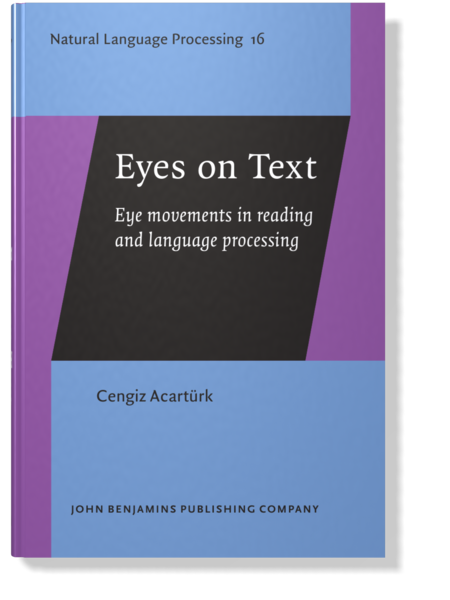
Table of contents
Preface
Part I.Basics
Chapter 1.Introduction
Texts, models, readers
A closer look at the movements of the eyeball
Eye movement events: Saccades and fixations
Areas of Interest (AOIs)
A historical perspective to reading
Scientific context of research on eyes on text
The cognitive revolution
A bibliometric overview
Concluding remarks
Summary
Chapter 2.Eye movements in reading
Anatomical and physiological aspects
Eye-monitoring systems
Precision and accuracy
Eye movement event detection algorithms
Wearable eye trackers
Fixation and saccade measures
Basic measures
Early and late measures
Inner speech and eye voice span measures
Concluding remarks
Summary
Part I: Suggested readings
Part I: Early books
Part II.Methodology
Chapter 3.Designing experiments
The task
The text
Explicit design of text stimuli
Analytical approaches
Word frequency, length, predictability
Target-word approaches in stimuli design
Licenses for text reuse
The reader
Individual differences
Number of participants
Glasses and lenses
Experiment paradigms
Gaze contingent moving window
Boundary paradigm
Rapid serial visual presentation paradigm
Disappearing text paradigm
Complementary methods
Brain imaging
Pupillometry
Concluding remarks
Summary
Chapter 4.Data and analysis
Data quality and cleansing
Word length effects
Linear regression
Linear mixed models
Random intercepts and random slopes
Word frequency effects
Predictability effects
Concluding remarks
Summary
Part II: Suggested readings
Part III.Perspectives on eyes on text
Chapter 5.Modeling perspectives
Models of human text processing
Early models
Word context effects
Later models
Models of eye movement control in reading
Early models
E-Z reader model
Swift model
Glenmore model
OB1-reader model
Alternative modeling approaches
Modeling pillars
Perception and motor control
Interaction and recognition
Construction and integration
Concluding remarks
Summary
Chapter 6.Empirical perspectives
Topics in research on eyes on text
Text font
Spacing between words
Word skipping
Phonological activation
Landing site and launch site
Parafoveal information intake
Orthographic neighborhood
Eyes on complex words, phrases, and sentences
Eyes on complex words
Eyes on pseudowords
Eyes on emotion words
Eyes on complex sentences
Eyes on ambiguities in sentences
Eyes on speech quotations and literary narratives
Eyes on translated text
Eyes on rhymes and poetry
Eyes on paragraphs
Eyes on discourse connectives
Eyes on referential expressions
Eyes on text in multimodal context
Eyes on digital text
Eyes on subtitles
Eyes on source codes
Eyes on text while writing
Concluding remarks
Summary
Chapter 7.Reader-oriented perspectives
Children’s eyes on text
Dyslexia
ADHD and ASD
Elderly eyes on text
Other impaired reading conditions
Eyes on text in memory tasks
Eyes on L2 text
Concluding remarks
Summary
Part III: Suggested readings
Part IV.Bridging the gaps
Chapter 8.The Joseph’s coat
The two camps: Psychology and linguistics
The third camp: Individual reading skills
Concluding remarks
Summary
Chapter 9.NLP applications: Humans in the loop
Personalized interfaces
Reverse engineering reading
Reading speed and speed reading
Concluding remarks
Summary
Bibliography
