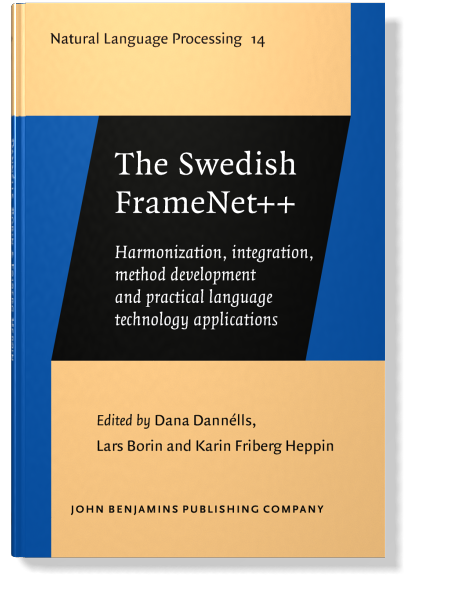
In:The Swedish FrameNet++: Harmonization, integration, method development and practical language technology applications
Edited by Dana Dannélls, Lars Borin and Karin Friberg Heppin
[Natural Language Processing 14] 2021
► pp. 281–302
Get fulltext
Chapter 11Computational representation of FrameNet for multilingual natural
language generation
Available under the Creative Commons Attribution-NonCommercial-NoDerivatives (CC BY-NC-ND) 4.0 license.
For any use beyond this license, please contact the publisher at rights@benjamins.nl.
Published online: 26 November 2021
https://doi.org/10.1075/nlp.14.11dan
https://doi.org/10.1075/nlp.14.11dan
Abstract
Multilingual natural language generation, the
process of producing written or spoken utterances in parallel
languages from either structured or unstructured representations
requires large amounts of syntactic and semantic information to
generate an expression that is tailored to the target audience. This
information is offered by FrameNet-like resources, which have been
developed for a number of languages. In this chapter, we present a
computational FrameNet grammar resource for multilingual natural
language generation. We compare between English and Swedish
framenets to illustrate how these can be unified under a shared
computational representation using Grammatical Framework. We
demonstrate how the grammar was exploited in two practical
multilingual natural language generation applications to facilitate
tourist communication and empower museum users with coherent artwork
descriptions.
Article outline
- 1.Introduction
- 2.Comparison of selected framenets
- 2.1Berkeley FrameNet
- 2.2Swedish FrameNet
- 2.3Summary of the comparison
- 3.Computational framenets in Grammatical Framework
- 3.1Grammatical Framework
- 3.2FrameNet grammar library in GF
- 3.3Status of the FrameNet grammar library
- 4.FrameNet-based multilingual NLG
- 4.1Accurate generation of tourist phrases
- 4.2Coherent text generation of museum objects
- 5.Final words
Notes References Appendix

References (53)
Bäckström, Linnéa, Benjamin Lyngfelt & Emma Sköldberg. 2014. Towards interlingual constructicography: On
correspondence between constructicon resources for English
and Swedish. Constructions and Frames 6(1): 9–32.
Baker, Collin. 2014. FrameNet: A knowledge base for natural language
processing. In Proceedings of Frame Semantics in NLP: A workshop in
honor of Chuck Fillmore (1929–2014), 1–5. Baltimore: ACL.
Baker, Collin, Michael Ellsworth, Miriam R. L. Petruck & Swabha Swayamdipta. 2018. Frame semantics across languages: Towards a
multilingual framenet. In Proceedings of Coling 2018: Tutorial abstracts, 9–12. Santa Fe: ACL.
Borin, Lars, Dana Dannélls, Markus Forsberg, Maria Toporowska Gronostaj & Dimitrios Kokkinakis. 2010. The past meets the present in Swedish
FrameNet++. In Proceedings of EURALEX 2010, 269–281. Ljouwert/ Leeuwarden: Fryske Akademy.
Borin, Lars, Dana Dannélls & Normunds Grūzıtis. 2018. Linguistics vs. language technology in
constructicon building and use. In Benjamin Lyngfelt, Lars Borin, Kyoko Ohara & Tiago Timponi Torrent (eds.), Constructicography: Constructicon development across
languages, 229–253. Amsterdam: John Benjamins.
Borin, Lars, Markus Forsberg & Lennart Lönngren. 2013. SALDO: A touch of yin to WordNet’s
yang. Language Resources and Evaluation 47(4): 1191–1211.
Borin, Lars, Markus Forsberg & Johan Roxendal. 2012. Korp – the corpus infrastructure of
Språkbanken. In Proceedings of LREC 2012, 474–478. Istanbul: ELRA.
Brickley, Dan & R. V. Guha. 2004. RDF vocabulary description language 1.0: RDF
Schema. Research report. Online: W3C.
Burchardt, Aljoscha, Katrin Erk, Anette Frank, Andrea Kowalski, Sebastian Padó & Manfred Pinkal. 2009. FrameNet for the semantic analysis of German:
Annotation, representation and automation. In Hans C. Boas (ed.), Multilingual FrameNets in computational lexicography:
Methods and applications, 209–244. Berlin: Mouton de Gruyter.
Candito, Marie, Pascal Amsili, Lucie Barque, Farah Benamara, Gaël de Chalendar, Marianne Djemaa, Pauline Haas, Richard Huyghe, Yvette Yannick Mathieu, Philippe Muller, Benoı̂t Sagot & Laure Vieu. 2014. Developing a French framenet: Methodology and
first results. In Proceedings of LREC 2014, 1372–1379. Reykjavik: ELRA.
Dannélls, Dana. 2010. Applying semantic frame theory to automate
natural language templates generation from ontology
statements. In Proceedings of INLG 2010, 179–184. Dublin: ACL.
. 2012. Multilingual text generation from structured
formal representations. Gothenburg: University of Gothenburg. (PhD thesis).
. 2012. On generating coherent multilingual descriptions
of museum objects from Semantic Web
ontologies. In Proceedings of INLG 2012, 76–84. Utica: ACL.
Dannélls, Dana & Lars Borin. 2012. Toward language independent methodology for
generating artwork descriptions – exploring FrameNet
information. In Proceedings of LaTeCH 2012, 18–23. Avignon: ACL.
Dannélls, Dana, Mariana Damova, Ramona Enache & Milen Chechev. 2012. Multilingual online generation from Semantic Web
ontologies. In Proceedings of WWW 2012, 239–242. Lyon: ACM.
Dannélls, Dana & Normunds Grūzıtis. 2014a. Controlled natural language generation from a
multilingual FrameNet-based grammar. In Proceedings of CNL 2014, 155–166. Berlin: Springer.
. 2014b. Extracting a bilingual semantic grammar from
FrameNet-annotated corpora. In Proceedings of LREC 2014, 466–2473. Reykjavik: ELRA.
Dannélls, Dana, Aarne Ranta, Ramona Enache, Mariana Damova & Maria Mateva. 2013. D8.3 multilingual grammar for museum object descriptions
(deliverable of eu project molto multilingual online
translation). Research report. Gothenburg: University of Gothenburg.
Duma, Daniel & Ewan Klein. 2013. Generating natural language from linked data:
Unsupervised template extraction. In Proceedings of IWCS 2013, 83–94. Potsdam: ACL.
Ell, Basil & Andreas Harth. 2014. A language-independent method for the extraction
of RDF verbalization templates. In Proceedings of INLG 2014, 26–34. Philadelphia: ACL.
Ferrández, Óscar, Michael Ellsworth, Rafael Muñoz & Collin F. Baker. 2010. Aligning FrameNet and WordNet based on semantic
neighborhoods. In Proceedings of LREC 2010, 310–314. Valletta: ELRA.
Fillmore, Charles J. 1982. Frame semantics. In Linguistic Society of Korea (ed.), Linguistics in the morning calm, 111–137. Seoul: Hanshin Publishing Co.
Fillmore, Charles J. & B. T. Sue Atkins. 1992. Toward a frame-based lexicon: The semantics of
RISK and its neighbors. In Adrienne Lehrer & Eva F. Kittay (eds.), Frames, fields and contrasts: New essays in semantic and
lexical organization, 75–102. Hillsdale: Lawrence Erlbaum Associates.
Fillmore, Charles J. & Collin Baker. 2009. A frames approach to semantic
analysis. In Bernd Heine & Heiko Narrog (eds.), The Oxford handbook of linguistic analysis, 313–339. Oxford: Oxford University Press.
Fillmore, Charles J., Christopher R. Johnson & Miriam R. L. Petruck. 2003. Background to FrameNet. International Journal of Lexicography 16(3): 235–250.
Fillmore, Charles J., Miriam R. L. Petruck, Josef Ruppenhofer & Abby Wright. 2003. FrameNet in action: The case of
attaching. International Journal of Lexicography 16(3): 297–332.
Friberg Heppin, Karin & Maria Toporowska Gronostaj. 2012. The rocky road towards a Swedish FrameNet –
creating SweFN. In Proceedings of LREC 2012, 256–261. Istanbul: ELRA.
Fuchs, Norbert E., Kaarel Kaljurand & Tobias Kuhn. 2008. Attempto Controlled English for knowledge
representation. In Cristina Baroglio, Piero A. Bonatti, Jan Małuszyński, Massimo Marchiori, Axel Polleres & Sebastian Schaffert (eds.), Reasoning web, 104–124. Berlin: Springer.
Garlik, Steve Harris & Andy Seaborne. 2013. SPARQL 1.1 query language. Research report. Online: W3C.
Gatt, Albert & Emiel Krahmer. 2018. Survey of the state of the art in natural
language generation: Core tasks, applications and
evaluation. Journal of Artificial Intelligence Research 61(1): 65–170.
Gilardi, Luca & Collin F. Baker. 2018. Learning to align across languages: Toward
Multilingual FrameNet. In Proceedings of the International FrameNet workshop at
LREC 2018: Multilingual framenets and
constructicons, 13–22. Miyazaki: ELRA.
Grūzītis, Normunds & Dana Dannélls. 2017. A multilingual FrameNet-based grammar and lexicon
for controlled natural language. Language Resources and Evaluation 51(1): 37–66.
Grūzītis, Normunds, Peteris Paikens & Guntis Barzdins. 2012. FrameNet Resource Grammar Library for
GF. In Proceedings of CNL 2012, 121–137. Berlin: Springer.
Hayoun, Avi & Michael Elhadad. 2016. The Hebrew FrameNet project. In Proceedings of LREC 2016, 4341–4347. Portorož: ELRA.
Kim, Jeong-uk, Younggyun Hahm & Key-Sun Choi. 2016. Korean FrameNet expansion based on projection of
Japanese FrameNet. In Proceedings of Coling 2016: System
demonstrations, 175–179. Osaka: ACL.
Lassila, Ora & Ralph Swick. 1999. Resource Description Framework (RDF): Model and syntax
specification. Research report. Online: W3C.
Nivre, Joakim, Johan Hall, Jens Nilsson, Atanas Chanev, Gülşen Eryığıt, Sandra Kübler, Svetoslav Marinov & Erwin Marsi. 2007. MaltParser: A languageindependent system for
data-driven dependency parsing. Natural Language Engineering 13(2): 95–135.
Ohara, Kyoko Hirose. 2013. Toward constructicon building for Japanese in
Japanese FrameNet. Veredas 17(1): 11–28.
Pedersen, Bolette S., Sanni Nimb, Anders Søgaard, Mareike Hartmann & Sussi Olsen. 2018. A Danish FrameNet lexicon and an annotated corpus
used for training and evaluating a semantic frame
classifier. In Proceedings of LREC 2018, 2382–2386. Miyazaki: ELRA.
Petruck, Miriam R. L. & Michael J. Ellsworth. 2018. Representing spatial relations in
FrameNet. In Proceedings of the First international workshop on
spatial language understanding, 41–45. New Orleans: ACL.
Ranta, Aarne. 2004. Grammatical Framework, a type-theoretical grammar
formalism. Journal of Functional Programming 14(2).
Ranta, Aarne, Krasimir Angelov, Normunds Grūzītis & Prasanth Kolachina. 2020. Abstract syntax as interlingua: Scaling up the
Grammatical Framework from controlled languages to robust
pipelines. Computational Linguistics 46(2): 425–486.
Ranta, Aarne, Ramona Enache & Grégoire Détrez. 2010. Controlled language for everyday use: The MOLTO
phrasebook. In Michael Rosner & Norbert E. Fuchs (eds.), Proceedings of CNL 2010, 115–136. Cham: Springer.
Reiter, Ehud & Robert Dale. 1997. Building applied natural language generation
systems. Journal of Natural Language Engineering 3(1): 57–87.
Roberts, Kirk, Yuqi Si, Anshul Gandhi & Elmer V. Bernstam. 2018. A FrameNet for cancer information in clinical
narratives: Schema and annotation. In Proceedings of LREC 2018, 272–279. Miyazaki: ELRA.
Ruppenhofer, Josef, Michael Ellsworth, Miriam R. L. Petruck, Christopher R. Johnson, Collin F. Baker & Jan Scheffczyk. 2016. FrameNet II: Extended theory and practice. Research report. Berkeley: ICSI.
Subirats, Carlos. 2009. Spanish Framenet: A frame-semantic analysis of
the Spanish lexicon. In Hans C. Boas (ed.), Multilingual FrameNets in computational lexicography.
methods and applications, 135–162. Berlin: Mouton de Gruyter.
Torrent, Tiago T., Maria Margarida M. Salomão, Fernanda C. A. Campos, Regina M. M. Braga, Ely E. S. Matos, Maucha A. Gamonal, Julia A. Gonçalves, Bruno C. P. Souza, Daniela S. Gomes & Simone R. Peron. 2014. Copa 2014 FrameNet Brasil: A frame-based
trilingual electronic dictionary for the football world
cup. In Proceedings of Coling 2014: System
demonstrations, 10–14. Dublin: ACL.