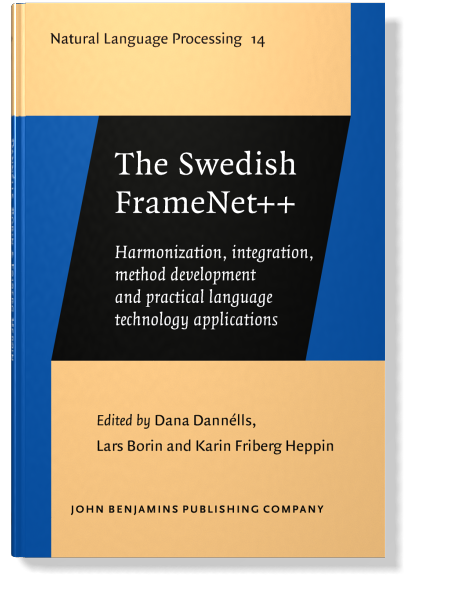
In:The Swedish FrameNet++: Harmonization, integration, method development and practical language technology applications
Edited by Dana Dannélls, Lars Borin and Karin Friberg Heppin
[Natural Language Processing 14] 2021
► pp. 37–66
Get fulltext
Chapter 2Swedish FrameNet
Available under the Creative Commons Attribution-NonCommercial-NoDerivatives (CC BY-NC-ND) 4.0 license.
For any use beyond this license, please contact the publisher at rights@benjamins.nl.
Published online: 26 November 2021
https://doi.org/10.1075/nlp.14.02dan
https://doi.org/10.1075/nlp.14.02dan
Abstract
This chapter describes the development of Swedish
FrameNet. A new framenet project often follows one of two
methodological approaches: (1) extension, through
translation of a different-language – often English – framenet into
the target language, and (2) merging, where the
resource is built from scratch in the target language. Both
approaches have their pros and cons, which have been extensively
discussed in the literature. Swedish FrameNet is mainly developed
through the extension approach, although balanced with the merging
approach. Drawing on the two approaches simultaneously, we describe
how integrated language resources and tools have been exploited to
create and develop Swedish FrameNet: how it was constructed, what it
contains, and the basic assumptions underlying the annotation of its
contents.
Article outline
- 1.Introduction
- 1.1Berkeley FrameNet
- 1.2International framenets
- 2.Framenet development methodologies
- 2.1The extension approach
- 2.2Merging approach
- 2.3Modified and new frames
- 3.Language resources and tools for building SweFN
- 4.The SweFN database
- 4.1Database fields
- Name
- BFN ID
- SweCxn ID*
- Definition
- Semantic type*
- Inheritance
- Domain*
- Core elements
- Peripheral elements
- Examples
- Compound patterns*
- Compound examples*
- Lexical units
- Suggestions for LUs*
- Regular polysemy*
- Berkeley-LUs
- Created by
- Comment and hidden comment*
- Status
- Modified
- 4.2Annotation and encoding of the data
- 4.2.1Encoding of lexical units
- Indexing
- Nesting
- Discontinuity
- Elliptical constructions
- 4.2.2Encoding of nouns as targets
- 4.2.3Encoding of verbs as targets
- 4.2.4Encoding of frame elements
- 4.2.5Encoding of prepositional phrases
- 4.2.6Encoding of syntactically complex frame elements
- Discontinuity
- Coordinated and non-coordinated FEs
- 4.2.7Encoding of compounds
- Non-compositional, lexicalized compounds
- Compositional compounds
- Partially transparent compounds
- Compound modifier as LU
- 4.2.8Encoding of copula verbs, support words, etc.
- 4.2.1Encoding of lexical units
- 4.3Consistency checks and evaluation
- 4.1Database fields
- 5.Concluding remarks
Notes References

References (55)
Ahlberg, Malin, Lars Borin, Dana Dannélls, Markus Forsberg, Maria Toporowska Gronostaj, Karin Friberg Heppin, Richard Johansson, Dimitrios Kokkinakis, Leif-Jöran Olsson & Jonatan Uppström. 2014. Swedish FrameNet++: The beginning of the end and
the end of the beginning. In Proceedings of SLTC 2014. Uppsala: Uppsala University.
Ahlberg, Malin, Lars Borin, Markus Forsberg, Martin Hammarstedt, Leif-Jöran Olsson, Olof Olsson, Johan Roxendal & Jonatan Uppström. 2013. Korp and Karp – a bestiary of language resources:
The research infrastructure of Språkbanken. In Proceedings of Nodalida 2013, 429–433. Linköping: LiUEP.
Ahlberg, Malin, Lars Borin, Markus Forsberg, Olof Olsson, Anne Schumacher & Jonatan Uppström. 2016. Karp: Språkbanken’s open lexical
infrastructure. In Globalex 2016 book of abstracts.
Alonso, Héctor Martínez, Bolette S. Pedersen & Núria Bel. 2013. Annotation of regular polysemy and
underspecification. In Proceedings of ACL 2013, 725–730. Sofia: ACL.
Bick, Eckhard. 2009. DeepDict – a graphical corpus-based dictionary of
word relations. In Kristiina Jokinen & Eckhard Bick (eds.), Proceedings of Nodalida 2009, 268–271. Linköping: LiUEP.
Borin, Lars, Dana Dannélls, Markus Forsberg, Maria Toporowska Gronostaj & Dimitrios Kokkinakis. 2010. The past meets the present in Swedish
FrameNet++. In Proceedings of EURALEX 2010, 269–281. Ljouwert/ Leeuwarden: Fryske Akademy.
Borin, Lars & Markus Forsberg. 2010. Beyond the synset: Swesaurus – a fuzzy Swedish
wordnet. Presentation at the workshop Re-thinking synonymy: Semantic
sameness and similarity in languages and their
description. Helsinki.
Borin, Lars, Markus Forsberg, Richard Johansson, Kristiina Muhonen, Tanja Purtonen & Kaarlo Voionmaa. 2012. Transferring frames: Utilization of linked
lexical resources. In Proceedings of the NAACL-HLT workshop on the Induction
of linguistic structure, 8–15. Montrèal: ACL.
Borin, Lars, Markus Forsberg & Lennart Lönngren. 2008. The hunting of the BLARK – SALDO, a freely
available lexical database for Swedish language
technology. In Joakim Nivre, Mats Dahllöf & Beáta Megyesi (eds.), Resourceful language technology: Festschrift in honor of
Anna Sågvall Hein, 21–32. Uppsala: Uppsala University, Department of Linguistics & Philology.
. 2013. SALDO: A touch of yin to WordNet’s
yang. Language Resources and Evaluation 47(4): 1191–1211.
Borin, Lars, Markus Forsberg, Leif-Jöran Olsson, Olof Olsson & Jonatan Uppström. 2013. The lexical editing system of
Karp. In Proceedings of eLex 2013, 503–516. Ljubljana: Trojina, Institute for Applied Slovene Studies.
Borin, Lars, Markus Forsberg & Johan Roxendal. 2012. Korp – the corpus infrastructure of
Språkbanken. In Proceedings of LREC 2012, 474–478. Istanbul: ELRA.
Borin, Lars, Maria Toporowska Gronostaj & Dimitrios Kokkinakis. 2007. Medical frames as target and tool. In Proceedings of the Nodalida workshop FRAME 2007:
Building frame semantics resources for Scandinavian and
Baltic languages, 11–18. Lund: Lund University.
Borin, Lars, Luis Nieto Piña & Richard Johansson. 2015. Here be dragons? The perils and promises of
inter-resource lexical-semantic mapping. In Proceedings of the Workshop on semantic resources and
semantic annotation for natural language processing and the
digital humanities at Nodalida 2015, 1–11. Linköping: LiUEP.
Burchardt, Aljoscha, Katrin Erk, Anette Frank, Andrea Kowalski, Sebastian Padó & Manfred Pinkal. 2009. FrameNet for the semantic analysis of German:
Annotation, representation and automation. In Hans C. Boas (ed.), Multilingual FrameNets in computational lexicography:
Methods and applications, 209–244. Berlin: Mouton de Gruyter.
Church, Kenneth Ward & Patrick Hanks. 1990. Word association norms, mutual information, and
lexicography. Computational Linguistics 16(1): 22–29.
Dannélls, Dana & Lars Borin. 2012. Toward language independent methodology for
generating artwork descriptions – exploring FrameNet
information. In Proceedings of LaTeCH 2012, 18–23. Avignon: ACL.
Dannélls, Dana, Karin Friberg Heppin & Anna Ehrlemark. 2014. Using language technology resources and tools to
construct Swedish FrameNet. In Proceedings of the Workshop on lexical and grammatical
resources for language processing, 8–17. Dublin: ACL.
Dannélls, Dana, Karin Friberg Heppin & Maria Toporowska Gronostaj. 2011. Documentation for SweFN. University of Gothenburg.
Das, Dipanjan, Desai Chen, André F. T. Martins, Nathan Schneider & Noah A. Smith. 2014. Frame semantic parsing. Computational Linguistics 40(1): 9–56.
Fillmore, Charles J. 1982. Frame semantics. In Linguistic Society of Korea (ed.), Linguistics in the morning calm, 111–137. Seoul: Hanshin Publishing Co.
Fillmore, Charles J. & Collin Baker. 2009. A frames approach to semantic
analysis. In Bernd Heine & Heiko Narrog (eds.), The Oxford handbook of linguistic analysis, 313–339. Oxford: Oxford University Press.
Fillmore, Charles J., Miriam R. L. Petruck, Josef Ruppenhofer & Abby Wright. 2003. FrameNet in action: The case of
attaching. International Journal of Lexicography 16(3): 297–332.
Forsberg, Markus. 2011. Green resources in plain sight: Opening up the
SweFN++ project. In Proceedings of the Nodalida 2011 workshop Visibility and
availability of LT resources. 7–10. Tartu: NEALT.
Friberg Heppin, Karin & Maria Toporowska Gronostaj. 2012. The rocky road towards a Swedish FrameNet –
creating SweFN. In Proceedings of LREC 2012, 256–261. Istanbul: ELRA.
. 2014. Exploiting FrameNet for Swedish:
Mismatch? Constructions and Frames 6(1): 52–72.
Gilardi, Luca & Collin F. Baker. 2018. Learning to align across languages: Toward
Multilingual FrameNet. In Proceedings of the International FrameNet workshop at
LREC 2018: Multilingual framenets and
constructicons, 13–22. Miyazaki: ELRA.
Halácsy, Péter, András Kornai & Csaba Oravecz. 2007. HunPos – an open source trigram
tagger. In Proceedings of ACL 2007: Demo and poster
sessions, 209–212. Prague: ACL.
Johansson, Richard. 2014. Automatic expansion of the Swedish FrameNet
lexicon: Comparing and combining lexicon-based and
corpus-based methods. Constructions and Frames 6(1): 91–112.
Johansson, Richard, Karin Friberg Heppin & Dimitrios Kokkinakis. 2012. Semantic role labeling with the Swedish
FrameNet. In Proceedings of LREC 2012, 3697–3700. Istanbul: ELRA.
Kann, Viggo & Magnus Rosell. 2006. Free construction of a free Swedish dictionary of
synonyms. In Proceedings of Nodalida 2005, 105–110. Joensuu: University of Joensuu.
Kilgarriff, Adam, Miloś Husák, Katy McAdam, Michael Rundell & Pavel Rychlý. 2008. GDEX: Automatically finding good dictionary
examples in a corpus. In Proceedings of EURALEX 2008, 425–432. Barcelona: Universitat Pompeu Fabra.
Kilgarriff, Adam, Pavel Rychlý, Pavel Smrz & David Tugwell. 2004. The Sketch Engine. In Geoffrey Williams & Sandra Vessier (eds.), Proceedings of EURALEX 2004, 105–115. Lorient: Université de Bretagne-Sud.
Kokkinakis, Dimitrios. 2004. Reducing the effect of name
explosion. In Proceedings of the LREC workshop: Beyond named entity
recognition, semantic labelling for NLP tasks, 1–6. Lisbon: ELRA.
. 2012. Initial experiments of medication event
extraction using frame semantics. In Scandinavian conference on health informatics, 41–47. Linköping: LiUEP.
Kokkinakis, Dimitrios, Maria Toporowska Gronostaj & Karin Warmenius. 2000. Annotating, disambiguating & automatically
extending the coverage of the Swedish SIMPLE
lexicon. In Proceedings of LREC 2000. Athens: ELRA.
Lenci, Alessandro, Nuria Bel, Federica Busa, Nicoletta Calzolari, Elisabetta Gola, Monica Monachini, Antoine Ogonowski, Ivonne Peters, Wim Peters, Nilda Ruimy, Marta Villegas & Antonio Zampolli. 2001. SIMPLE: a general framework for the development
of multilingual lexicons. International Journal of Lexicography 13: 249–263.
Levin, Beth (ed.). 1993. English verb classes and alternations: A preliminary
investigation. Chicago: University of Chicago Press.
Lyngfelt, Benjamin, Linnéa Bäckström, Lars Borin, Anna Ehrlemark & Rudolf Rydstedt. 2018. Constructicography at work: Theory meets practice
in the Swedish constructicon. In Benjamin Lyngfelt, Lars Borin, Kyoko Ohara & Tiago Timponi Torrent (eds.), Constructicography: Constructicon development across
languages, 41–106. Amsterdam: John Benjamins.
Moschitti, Alessandro, Paul Morarescu & Sanda M. Harabagiu. 2003. Open domain information extraction via automatic
semantic labeling. In Proceedings of FLAIRS 2003, 397–401. Florida: AAAI Press.
Nivre, Joakim, Johan Hall, Jens Nilsson, Atanas Chanev, Gülşen Eryığıt, Sandra Kübler, Svetoslav Marinov & Erwin Marsi. 2007. MaltParser: A languageindependent system for
data-driven dependency parsing. Natural Language Engineering 13(2): 95–135.
Ohara, Kyoko Hirose. 2013. Toward constructicon building for Japanese in
Japanese FrameNet. Veredas 17(1): 11–28.
Pilán, Ildikó, Elena Volodina & Richard Johansson. 2013. Automatic selection of suitable sentences for
language learning exercises. In Proceedings of EUROCALL 2013, 218–225. Évora: Research-publishing.net.
Roberts, Kirk, Yuqi Si, Anshul Gandhi & Elmer V. Bernstam. 2018. A FrameNet for cancer information in clinical
narratives: Schema and annotation. In Proceedings of LREC 2018, 272–279. Miyazaki: ELRA.
Roth, Michael & Anette Frank. 2009. A NLG-based application for walking
directions. In Proceedings of ACL/IJCNLP 2009: Software
demonstrations, 37–40. Suntec: ACL.
Ruppenhofer, Josef, Michael Ellsworth, Miriam R. L. Petruck, Christopher R. Johnson, Collin F. Baker & Jan Scheffczyk. 2016. FrameNet II: Extended theory and practice. Research report. Berkeley: ICSI.
Saito, Hiroaki, Shunta Kuboya, Takaaki Sone, Hayato Tagami & Kyoko Ohara. 2008. The Japanese FrameNet software
tools. In Proceedings of LREC 2008, 1835–1838. Marrakech: ELRA.
Subirats, Carlos. 2009. Spanish Framenet: A frame-semantic analysis of
the Spanish lexicon. In Hans C. Boas (ed.), Multilingual FrameNets in computational lexicography.
methods and applications, 135–162. Berlin: Mouton de Gruyter.
Torrent, Tiago Timpioni. 2013. Behind the labels: Criteria for defining
analytical categories in FrameNet Brasil. Veredas 17(1): 44–65.
Torrent, Tiago Timponi, Maria Margarida Martins Salomão, Ely Edison da Silva Matos, Maucha Andrade Ganomal, Júlia Gonçalves, Bruno Pereira de Souza, Daniela Simões & Simone Rodrigues Peron-Corrêa. 2014. Multilingual lexicographic annotation for
domain-specific electronic dictionaries: the Copa 2014
FrameNet Brasil project. Constructions and Frames 6(1): 72–90.
Cited by (1)
Cited by one other publication
This list is based on CrossRef data as of 28 november 2025. Please note that it may not be complete. Sources presented here have been supplied by the respective publishers. Any errors therein should be reported to them.